Roof Age
& Your Insurance
The Florida Rules
How old can a roof be for insurance in Florida? What the 15-year rule actually says, the inspection right most homeowners never use, and the building-code rule that decides whether you repair or replace. Written by a licensed Palm Beach County Certified Roofing Contractor who is also a certified energy rater.
The Short Answer
There is no single legal age limit on a roof in Florida. What exists is a floor set by state law and a ceiling set by each insurance company's own underwriting rules — and homeowners get burned because they only ever hear about the second one.
The law says an insurer may not refuse to write or renew your policy solely because your roof is less than 15 years old. Once the roof passes 15, the law gives you a different protection: the right to have an authorized inspector look at it, and if that inspection certifies the roof has at least five more years of useful life, the carrier still can't drop you on roof age alone.
In practice, most carriers writing in Palm Beach County start asking hard questions somewhere around 15 years on asphalt shingle and 20 to 25 years on tile and metal, and many will only offer actual-cash-value roof coverage past those thresholds instead of full replacement cost. Age is the trigger; condition is what they actually judge.
If you've received a letter about your roof, don't guess — get it looked at. Call (561) 779-3213 and we'll inspect the roof, tell you honestly whether it's a repair or a replacement, and hand you the documentation your carrier is asking for.
The 15-Year Rule — What Florida Law Actually Says
The protection comes out of Florida's 2022–2023 property-insurance reform sessions and lives in Florida Statute 627.7011. Two halves matter:
- 🛡️ Roof under 15 years old. An insurer may not refuse to issue or renew a homeowners policy solely because of the age of the roof.
- 🔍 Roof 15 years or older. Before the carrier can require replacement as a condition of coverage, you may have the roof inspected by an authorized inspector. If the inspection shows five or more years of remaining useful life, the insurer may not refuse coverage on roof age alone.
The word doing all the work in both halves is "solely." The statute protects you from an age-only decision. It does not protect a roof that is genuinely failing. Curling or missing shingles, cracked or slipped tile, exposed or ponding underlayment, rusted fasteners, prior water intrusion, or an open claim are all independent, perfectly lawful reasons for a carrier to act — and aerial imagery means the underwriter often sees those things before you do.
One current point worth knowing, because a lot of 2026 chatter online gets it wrong: bills filed in the 2026 legislative session (HB 815 and its Senate companion SB 808) proposed widening this inspection right, but they died in committee in March 2026 and did not become law. The 2022–2023 statute described above is still the rule in force.
This page is general guidance from a licensed contractor — it is not legal or insurance advice. Your policy language and your carrier's filed guidelines govern your situation; confirm specifics with your agent.
⚠️The inspection right is use-it-or-lose-it. Most homeowners who get a roof-age non-renewal notice simply start shopping for a new roof. If your roof is sound, an authorized inspection certifying five years of useful life may be all you need — and it costs a fraction of a re-roof. Have someone qualified look before you spend.
Law vs. Underwriting — Why Your Neighbor's Answer Was Different
The statute sets the floor. Above that floor, every company files its own guidelines with the state, which is why two houses on the same street get two different answers.
Factor 1
Age Thresholds
Each carrier picks its own cutoffs by roof material, and they tighten and loosen with the market. A roof that's uninsurable at one company is routine business at the next.
Factor 2
Documented Condition
Underwriters use aerial and satellite imagery plus inspection reports. Streaking, patched sections, and debris read as neglect. Clean, documented maintenance reads as a good risk.
Factor 3
ACV vs. Replacement Cost
Rather than decline you, many carriers keep the policy but switch the roof to actual cash value — depreciated payout. You stay insured, and a total loss leaves you paying most of a new roof yourself.
The 25% Rule — Repair or Full Replacement
The second rule that decides your bill isn't an insurance rule at all — it's the Florida Building Code. The existing-building provisions (Section 706) set the threshold everyone calls the 25% rule: if more than 25% of a roof's total area is repaired, replaced, or recovered within any 12-month period, the whole roofing system generally has to be brought up to current code — which usually means a full replacement.
Since Senate Bill 4-D in May 2022, there's an important exception, and it turns on one date. If the roof — or the undamaged portion of it — was built or replaced in compliance with the 2007 Florida Building Code or later, only the damaged portion has to be repaired to code. The 2007 code took effect March 1, 2009, so a roof permitted on or after that date can often be repaired rather than replaced even when the damage runs past 25%. The 9th Edition of the Florida Building Code, effective December 31, 2026, keeps and refines that exception.
Which means the single most valuable thing you can find out before anyone quotes you is your roof's permit date. It's public record. Roofs inside incorporated cities — West Palm Beach, Wellington, Royal Palm Beach, Jupiter, Palm Beach Gardens, Boynton Beach, Lake Worth Beach, Greenacres — are permitted through that municipality's building department. Homes in unincorporated Palm Beach County, including Loxahatchee and The Acreage, are permitted through Palm Beach County's building division. One records search tells you whether you're arguing about a repair or a replacement.
Also worth understanding: the 25% threshold is cumulative. Patch a section this spring and another section this fall, and the two together can cross the line and trigger a full-replacement requirement on the third visit. Serial patching on an old roof is usually the most expensive way to buy a new one.
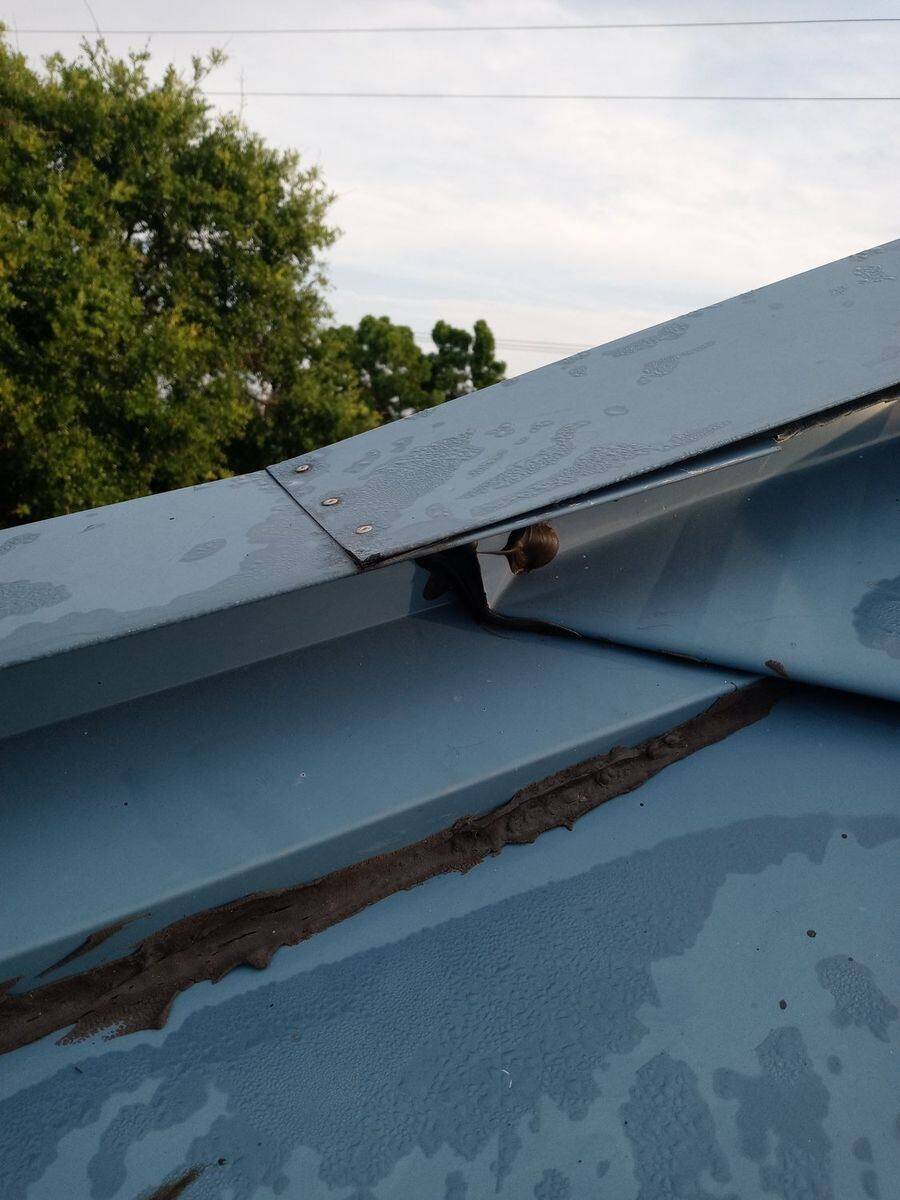
Age isn't what carriers actually judge — condition is. Failed ridge sealant like this is a repair today and a non-renewal letter in two years.
The Credits a New Roof Earns — and When You Can Buy Them
If replacement is the answer, the tear-off is the one and only moment you can buy wind-mitigation credits cheaply. Florida Statute 627.0629 requires insurers to discount the windstorm portion of your premium for verified mitigation features, and those features get documented on the state's Uniform Mitigation Verification Inspection form, OIR-B1-1802 (a revised edition took effect April 1, 2026). Five of its line items are decided on your roof:
- 📄 Roof covering. Whether the covering carries a current Florida Product Approval or Miami-Dade Notice of Acceptance and was permitted to code. This is why an unpermitted roof is worth less than nothing on the form.
- 🔨 Roof deck attachment. How the plywood or OSB is fastened to the trusses. The strong end of the scale is ring-shank nails at tight spacing — a few dollars of fasteners while the deck is exposed, and permanently invisible once it isn't.
- 🔗 Roof-to-wall connection. Toe nails score worst; clips, single wraps, and double wraps score progressively better. Retrofitting straps is dramatically cheaper with the deck open than through a finished ceiling later.
- 📐 Roof geometry. Hip roofs earn a credit that gables don't, because they shed wind on all four sides. This one you inherit with the house — but you should know whether you have it before you accept an inspector's report that says you don't.
- 💧 Secondary water resistance. A sealed roof deck — self-adhering membrane over the deck and seams beneath the covering — so that if the covering blows off, water still doesn't pour into the house. It is a modest add-on during a tear-off and impossible to add afterward without another tear-off.
Every one of those is a decision made in a few hours on the second morning of the job. Miss them and you've bought a roof that protects the house but doesn't argue for you on your premium. That's the entire reason our estimates include a wind-mitigation walk-through before you sign anything.
Openings are the other half of that same form — see the impact window insurance discount guide for how windows and doors stack on top of your roof credits.
How Long Roofs Actually Last in South Florida
National service-life numbers run optimistic here. Palm Beach County roofs live under UV, salt air, driving rain, and hurricane cycling, and they age faster than the brochure says. These are general industry ranges — your roof gets judged on its own condition, not a chart.
3-Tab Asphalt Shingle
Roughly 15–20 years, and it is the material most likely to hit a carrier's age threshold before it hits the end of its own life. Granule loss and curling edges are the tell.
Architectural / Dimensional Shingle
Roughly 20–30 years in general use, commonly toward the lower end in full Florida sun. Better wind ratings than 3-tab and the most common re-roof choice on inland Palm Beach County homes.
Concrete & Clay Tile
The tile itself can go 40–50 years or more — but the underlayment beneath it typically runs 20–30. On tile roofs the underlayment is the real clock, and it's what leaks while the tile still looks perfect.
Metal (Standing Seam & Panel)
Often 40–50 years or beyond with sound detailing. Panels rarely wear out first; fasteners, ridge and valley flashing, and sealant do. Those are maintenance items, not replacement triggers.
Flat / Low-Slope (Modified Bitumen, TPO)
Roughly 15–25 years depending on system and drainage. Ponding water is the enemy; a flat roof that doesn't drain ages on a schedule of its own.
The Tile Exception Worth Knowing
Because tile outlives its underlayment, a "lift and relay" — removing the tile, replacing the underlayment, and re-setting the same tile — can reset the clock and the permit date without buying all new tile. Ask whether your roof is a candidate.
You Got the Letter. Do This, In This Order.
A non-renewal notice or a "replace the roof to keep coverage" letter is a deadline, not a verdict. Work it in order:
- 1. Read the letter for the reason and the date. "Roof age" and "roof condition" are different problems with different answers. Note every deadline in writing.
- 2. Pull your roof's permit date. Municipal or county building records. This determines both your true roof age and whether the 25% rule's newer-code exception is available to you.
- 3. Get an inspection before you get quotes. If the roof is sound and 15+, an authorized inspection certifying five years of useful life may end the conversation. If it isn't sound, you now know exactly what's wrong.
- 4. Send documentation, don't argue on the phone. Inspection report, permit records, photos, receipts for maintenance. Underwriters respond to paper.
- 5. Shop the market with the mitigation form in hand. Carriers value the same roof differently, and Florida also has a state-backed insurer of last resort with its own roof requirements. Never shop without your OIR-B1-1802.
- 6. If replacement is genuinely the answer, buy the credits while the deck is open. Deck nailing, roof-to-wall straps, secondary water resistance. Then get a fresh wind-mitigation inspection the week the job passes final — not next renewal.
What We Hand You When the Job Is Done
A roof that can't be documented can't be credited. As a Florida Certified Roofing Contractor (CCC1332751) and Certified General Contractor (CGC1528750), we pull the permit, install to Florida Product Approval specification, and carry every job through final county inspection — and you leave with the permit, the product approvals, and photographs of the deck nailing, the straps, and the sealed deck taken before the covering went on. That photo set is what a wind-mitigation inspector, an underwriter, and a future buyer all end up asking for.
🎁Our signature offer: a
free wind-mitigation & energy walk-through with every roofing or window estimate. Because the owner is a
RESNET® Certified HERS Rater — RTIN 4516301 as well as a licensed general contractor, that walk-through shows you two things no ordinary roofer can: the wind-mitigation features your insurer will credit on the OIR-B1-1802 form, and where your home is actually losing energy. Every job also carries a
written one-year workmanship warranty. Call
(561) 779-3213 to book it.
Financing Available

Financing available through our partner Renew Financial's RenewPACE program — designed for energy and storm-protection upgrades like new roofs and impact windows. Ask us about eligibility. And because the same tear-off is your one chance to fix attic ventilation and insulation, ask what the roof is costing you in cooling: see how these upgrades can also lower your energy bills ↗
Roof Age & Insurance — FAQ
How old can a roof be for insurance in Florida?
There is no single legal age limit. Florida Statute 627.7011 says an insurer may not refuse to issue or renew a policy solely because the roof is less than 15 years old, and that a roof 15 years or older may be inspected before replacement is required as a condition of coverage. Above that floor, each carrier files its own guidelines — in Palm Beach County many start asking questions around 15 years on asphalt shingle and 20 to 25 years on tile and metal. Condition matters more than the number.
Can my insurance company drop me just because my roof is old?
Not on age alone, if you use your inspection right. For a roof 15 years or older, an inspection by an authorized inspector certifying at least five years of remaining useful life means the carrier may not refuse coverage based on roof age by itself. But "solely" is the key word in the statute — documented deterioration, leaks, missing shingles or tile, or prior claims are separate and lawful grounds for a carrier to act.
What is the 25% rule for roofs in Florida?
Under the Florida Building Code's existing-building provisions, if more than 25% of a roof's total area is repaired, replaced, or recovered within any 12-month period, the entire roofing system generally must be brought up to current code. Since Senate Bill 4-D in 2022 there's an exception: if the roof or its undamaged portion was built to the 2007 Florida Building Code or later, only the damaged portion must be repaired to code. The 2007 code took effect March 1, 2009, so your roof's permit date decides which applies.
How do I find out when my roof was permitted?
Permit records are public. If your home is inside an incorporated city — West Palm Beach, Wellington, Royal Palm Beach, Jupiter, Palm Beach Gardens, Boynton Beach, Lake Worth Beach, Greenacres — the permit was issued by that city's building department. Homes in unincorporated Palm Beach County, including Loxahatchee and The Acreage, are permitted through the county's building division. We routinely pull this for homeowners before quoting, because it can be the difference between a repair and a replacement.
Does a new roof lower my homeowners insurance in Florida?
It can, in two separate ways. A newer roof resets the age clock that drives non-renewals and actual-cash-value roof endorsements. Separately, Florida Statute 627.0629 requires insurers to credit the windstorm portion of your premium for verified mitigation features — roof covering compliance, deck attachment, roof-to-wall connections, roof geometry, and secondary water resistance — documented on the state's OIR-B1-1802 form. The credits only apply once that form is completed and submitted to your carrier.
What is secondary water resistance and is it worth paying for?
Secondary water resistance — a sealed roof deck — is a self-adhering membrane applied over the deck and its seams beneath the roof covering, so that if the covering is torn off in a storm the house still doesn't take on water. It is one of the wind-mitigation line items carriers credit, it is a modest add-on during a tear-off, and it cannot be added later without tearing the roof off again. For most Palm Beach County homes it's one of the better dollars in the job.
My carrier switched my roof to actual cash value. What does that mean?
Instead of declining the policy, many carriers keep an older roof insured but pay claims on a depreciated basis rather than at replacement cost. You remain covered, but after a total loss the check reflects the roof's remaining value, not what a new roof costs — and the difference comes out of your pocket. It's worth knowing whether your policy carries that endorsement before a storm, not after.
Did the 2026 Florida legislature change the roof-age rules?
No. House Bill 815 and its identical Senate companion SB 808 would have expanded the existing inspection right, but they died in committee in March 2026 and did not become law — despite a fair amount of online reporting that says otherwise. The rules in force are still those from the 2022 and 2023 reform sessions, codified in Florida Statute 627.7011.
My tile roof still looks perfect but it's leaking. Do I need all new tile?
Often not. Concrete and clay tile can last 40 to 50 years or more, while the underlayment beneath it typically runs 20 to 30 — so on most tile roofs it's the underlayment that fails first, which is exactly why the roof leaks while the tile still looks new. A "lift and relay" removes the tile, replaces the underlayment, and re-sets the same tile. We'll tell you whether your tile is in good enough shape to be a candidate.
Should I keep patching my old roof or replace it?
Watch the 25% threshold — it's cumulative across a 12-month period, so a series of patches can add up and trigger a full code-compliant replacement anyway. Serial patching on a roof near the end of its life is usually the most expensive route to a new roof, and every patch is another data point in your claims and inspection history. We give an honest repair-or-replace assessment rather than defaulting to the bigger job.
Do you inspect roofs for homeowners who got a non-renewal notice?
Yes, and estimates are free. We inspect the roof, pull the permit history, tell you straight whether you're looking at a repair, a lift and relay, or a replacement, and give you the photographs and documentation to take back to your carrier. Every roofing or window estimate also includes a free wind-mitigation and energy walk-through. Call (561) 779-3213 — we serve all of Palm Beach County from Loxahatchee.