Sequence matters more than speed. Homeowners lose money after a storm in two ways: waiting too long, and doing the right things in the wrong order — permanent repairs before anyone documented the damage, a signature before anyone read the contract.
- 1. Wait for the all-clear, and stay off the roof. A wet, debris-covered roof with hidden soft decking is how storm injuries happen. Assess from the ground, from windows, and from inside the attic with a flashlight.
- 2. Contain water inside first. If water is coming in, the priority is the interior — buckets, plastic over furniture, pulling up wet rugs, cutting power to any circuit near water intrusion. Water sitting in a ceiling for three days turns a roof claim into a mold and drywall claim.
- 3. Photograph everything before you touch anything. Wide shots of the house from all four sides, close-ups of every damaged area, the interior stains, the debris on the ground, the fallen limb, the ceiling. Video walking the property narrating what you see. Leave the timestamps on.
- 4. Notify your carrier and get a claim number. Do it in the first day or two, in writing where you can, and note the date and time. The claim number is what every later conversation hangs on.
- 5. Get emergency dry-in — tarp or temporary patch — not permanent repairs. Your policy generally expects you to prevent further damage, and further damage you allowed can be argued about. Temporary protection is the right move; a brand-new roof installed before anyone inspected is not.
- 6. Keep every receipt, and keep the removed material. Tarps, plywood, a generator, a hotel night, the emergency dry-in invoice. Photograph the torn shingles or cracked tile that came off before any of it goes to the dump.
- 7. Get an independent assessment from a licensed roofing contractor before the adjuster comes. Not to argue — to know. Walking into an adjuster's inspection already understanding what failed and why is the difference between a conversation and a hope.
We inspect storm damage across Palm Beach County at no charge, and we'll tell you honestly when what you have is a repair rather than a replacement. Call (561) 779-3213.
Florida's insurance reforms shortened the clock dramatically, and this is the single most expensive thing homeowners still don't know. The windows below come from state law, not from any one carrier's policy:
- ⏱️ One year to give notice of a hurricane or windstorm claim. Under Florida Statute 627.70132, notice of a new claim must reach the insurer within one year of the date of loss — down from the three years many homeowners still believe they have. For a hurricane, the date of loss is the date of landfall as established by the National Hurricane Center, not the day you noticed the leak.
- 📄 Eighteen months for a supplemental or reopened claim. Measured from the date the insurer paid or denied the original claim. This is the window that matters when a tear-off reveals rotted decking nobody could have seen, or the first estimate turns out to be short.
- 📬 Fourteen days for the carrier to acknowledge you. Under Florida Statute 627.70131, the insurer must review and acknowledge a communication about your claim within 14 days unless it pays within that period, and must begin a reasonably necessary investigation within 14 days of receiving your proof-of-loss statements.
- 🔍 Thirty days to physically inspect. Where the carrier needs to inspect the property, the same statute requires it within 30 days of receiving your proof-of-loss statements.
- 💵 Sixty days to pay or deny. The insurer must pay or deny the claim, or a portion of it, within 60 days of receiving notice, absent factors beyond its control — and payment made late accrues statutory interest.
Two practical consequences. First: a leak you notice in March, from a storm that made landfall last September, is on last September's clock — and that clock may be nearly out. Second: if you're late but still inside the window, notice still beats silence. Missing the deadline entirely hands the carrier a complete defense no matter how plainly covered the damage was.
This page is general guidance from a licensed contractor. It is not legal or insurance advice, and we are neither attorneys nor public adjusters — a Florida roofing contractor cannot adjust or negotiate your claim, and any roofer who offers to is telling you something about how they operate. Your policy language governs your situation; confirm specifics with your agent, and if a claim is denied or underpaid, that is a conversation for a licensed public adjuster or an attorney.
Florida homeowners policies carry a separate, larger deductible for hurricane losses, and it surprises people at the worst possible moment. Under Florida Statute 627.701, residential carriers must offer a hurricane deductible of $500, or 2%, 5%, or 10% of your dwelling coverage — that is Coverage A, your rebuild limit, not your home's market value.
The percentage is where it bites. Purely as arithmetic: on a dwelling limit of $400,000, a 2% hurricane deductible is $8,000 and 5% is $20,000. Plenty of roof damage that feels catastrophic lands near or under that number — which is exactly why knowing your figure before storm season tells you whether a claim is even worth opening.
Two features of the law work in your favor:
- 📅 It applies once per calendar year. Once you have paid your full hurricane deductible on one storm, subsequent hurricanes in that same calendar year fall to your ordinary all-other-perils deductible. In a busy season that is real money.
- 🌀 The hurricane window is defined, not a judgment call. Hurricane coverage runs from the moment a hurricane watch or warning is issued for any part of Florida, through the duration of the storm, and for 72 hours after the last watch or warning ends. Damage outside that window is a windstorm claim under your regular deductible — a distinction worth checking rather than assuming.
Pull your declarations page now, find the hurricane deductible line, and do the multiplication before you need it. If the number startles you, that is a conversation to have with your agent in the spring — not in October.
Every named storm brings out-of-town crews into Palm Beach County. Some are legitimate contractors adding capacity where it is genuinely needed. Others are gone by winter, and the homeowner is left with an unpermitted roof, a compromised claim, and a phone number that rings in another state. The law gives you specific handholds:
- 🚫 Nobody can buy your claim with a gift. Under Florida Statute 489.147, a contractor may not offer a homeowner a rebate, gift, gift card, cash, coupon, or a waiver of your insurance deductible in exchange for letting them inspect your roof or for making a roof claim. Knowingly paying, waiving, or rebating your deductible is insurance fraud punishable as a third-degree felony. "We'll cover your deductible" is not a deal — it is a confession.
- 📃 Your roofing contract must carry the required notice. The same statute requires roof repair and replacement contracts to include that consumer notice, and a contract missing it may be voided by the homeowner within ten days of execution. Read the paper you are handed — what is absent from it tells you plenty.
- ✍️ You cannot sign your benefits over anymore — and should not be asked to. Under Florida Statute 627.7152(13), post-loss benefits under a residential property insurance policy may not be assigned, and an attempt to do so is void and unenforceable. Assignment-of-Benefits paperwork was the engine of the old abuse; if someone still puts an AOB in front of you, they are either years out of date or counting on you being.
- 🪪 Verify the license yourself, on the state's site. Roofing work requires a Florida certified or registered roofing contractor license — ours is CCC1332751, alongside Certified General Contractor CGC1528750, both searchable on DBPR. Ask for the license number rather than the truck logo, and check that the name on the license matches the name on the contract.
- 🏠 Ask where the warranty will be in three years. A written workmanship warranty is worth exactly as much as the company standing behind it. We are a local, state-licensed, insured, BBB A+ Accredited Business working out of Loxahatchee, and every job carries a written one-year workmanship warranty.
Whether the answer is a repair, a tile lift-and-relay, or a full replacement is not decided by damage alone — the Florida Building Code's 25% rule and your roof's permit date have a great deal to say about it, and the answer can swing thousands of dollars. That is covered in detail in the companion guide: Roof Age & Florida Insurance — the 15-year rule, the 25% rule, and the credits a new roof earns ↗
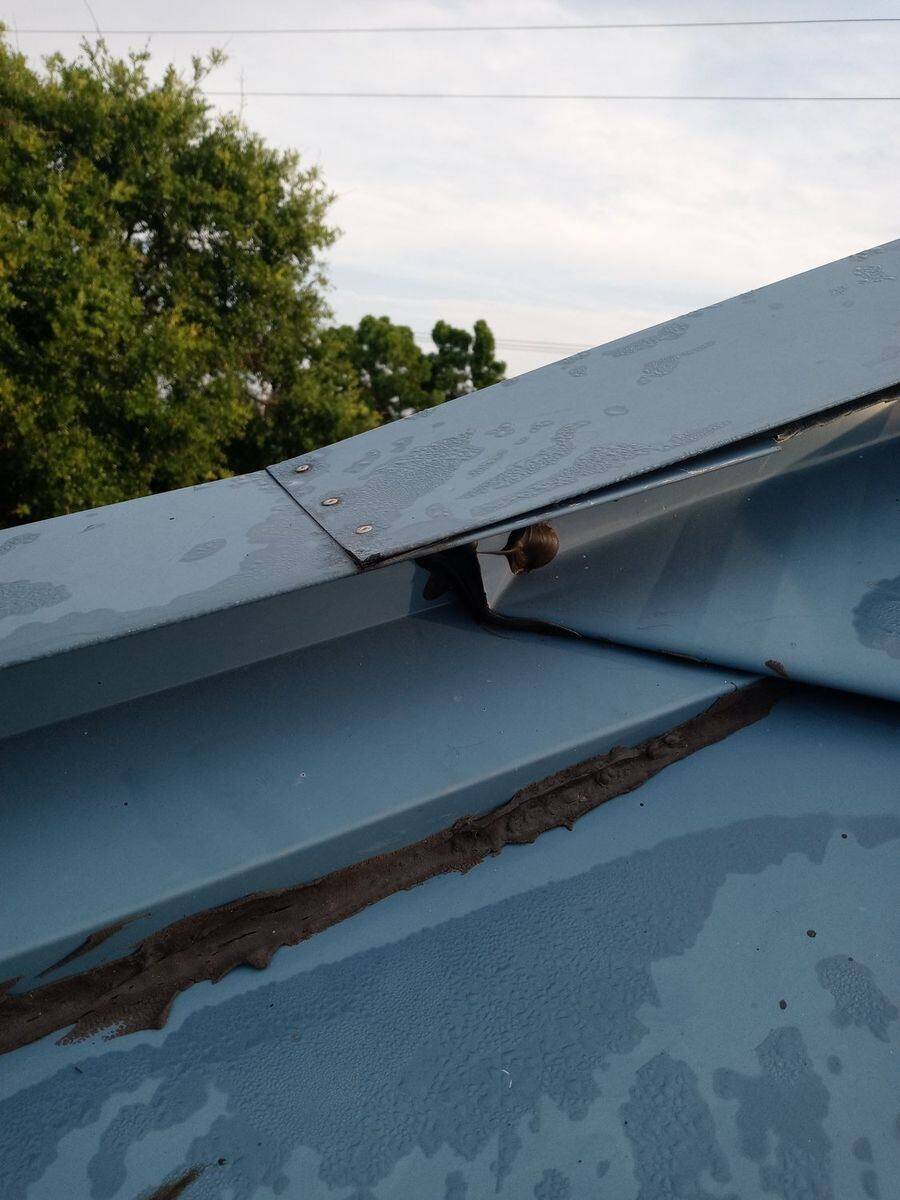
Not all storm damage announces itself. Wind lifts a shingle course, breaks the seal, and sets it back down looking normal. Tile slips a half inch. A soffit panel pops loose behind a gutter. Nothing leaks — until a routine afternoon thunderstorm two months later drives rain sideways into the gap, and a brown ring appears on a bedroom ceiling.
By then, three problems compound. The damage now looks like age and neglect rather than a storm event. Any documentation you would have gathered right afterward does not exist. And that one-year notice clock has been running the whole time from the day of landfall, not from the day the stain appeared.
So after any named storm that affected Palm Beach County — even one you sailed through — do two small things: walk the perimeter and photograph the roof from all four sides, and put your head in the attic on a dry day with a flashlight. If the roof looks untouched, you have just created a dated record proving it was fine, which is worth having in its own right. If something is off, you found it while it was still cheap and still provably storm-related.
An inspection after a near-miss is a genuinely good use of a free appointment. Call (561) 779-3213 and we will get on the roof so you do not have to.
We are a Florida Certified Roofing Contractor (CCC1332751) and Certified General Contractor (CGC1528750) based in Loxahatchee, working across Palm Beach County — West Palm Beach, Wellington, Royal Palm Beach, Jupiter, Palm Beach Gardens, Boynton Beach, Lake Worth, Greenacres, and the unincorporated Acreage. After a storm the sequence is the same every time:
- 🔎 A real inspection, on the roof and in the attic. Not a drive-by. We look at the covering, the flashing, the penetrations, the soffits, and the underside of the deck, because that is where the story of a leak is actually written.
- 📷 A documented photo set you keep. Dated, located, and organized, so you have your own record independent of anyone else's file.
- 🧾 An honest repair-or-replace call, plus your permit history. We pull the permit record before quoting, because it determines whether the code lets you repair. Sometimes the answer is a repair, and we will say so — that conversation is why people call us back years later.
- ⛑️ Emergency dry-in when the house needs protecting now. Temporary protection first, permanent work in the right order afterward.
- 📐 Permitted, inspected, code-compliant work. Installed to Florida Product Approval specification and carried through final inspection, with the deck nailing, straps, and sealed deck photographed before the covering goes on — the photo set your wind-mitigation inspector, your underwriter, and a future buyer will all ask for.
- 🌡️ The energy side, because the deck is open exactly once. A tear-off is the only moment to fix attic ventilation, radiant heat, and insulation gaps — and the owner is a certified energy rater, so those get specified rather than overlooked.

Financing available through our partner Renew Financial's RenewPACE program — designed for energy and storm-protection upgrades like new roofs and impact windows. Ask us about eligibility. And since the same tear-off is your one chance to deal with attic heat and insulation, ask what the roof is costing you in cooling: see how these upgrades can also lower your energy bills ↗