Six sections of statute, read by an operator who has had to stand on them. The preemption is real — and narrower than the internet thinks. Written by Randolph Scott Bell from The Bell Farm, an FDACS-registered agritourism operation in Loxahatchee, Palm Beach County.
Florida’s agritourism law is ss. 570.85–570.89 of the Florida Statutes, and it does two separate things. First, it takes local government out of the business of regulating agritourism activities on land that carries an agricultural classification under s. 193.461. Second, it hands the operator a limitation of liability for injuries caused by the inherent risks of farm life — but only if a specific warning sign is posted, in letters at least one inch high, at the entrance and at the activity itself.
What it does not do is give you a building permit, a lodging licence, a food licence, or immunity from your own gross negligence. The statute protects what you do on the land. It says almost nothing about what you may build on it — and that single line is where most Florida farm-visit ventures get stopped.
⚠️
This is an operator’s reading of the statutes, not legal advice. It is written by a licensed contractor and registered agritourism operator, not by a lawyer, and it cannot account for your parcel, your classification, your county or your insurance. Every statute is linked to the Legislature’s own text so you can read it yourself, and a Florida attorney gives the binding answer on your facts.
Statute text on this page was checked against the 2025 Florida Statutes as published by the Florida Legislature at flsenate.gov on 14 August 2026. Agritourism has been amended repeatedly — 2013, 2016, 2021 and 2022 all left marks on these sections — so this page carries a review date rather than pretending to be permanent. Next scheduled review: February 2027.
The Six Sections, in One Screen
s. 570.85
The preemption
A local government may not prohibit, restrict, regulate or otherwise limit an agritourism activity on agriculturally classified land. Catch: substantial offsite impacts and chapter 252 emergencies are carved back out.
s. 570.86
The definitions
Defines the activity, the operator, the farm, and “inherent risks.” Catch: an agritourism activity expressly does not include constructing new structures to accommodate the public.
s. 570.87
The greenbelt
Your agricultural classification cannot be denied or revoked solely because you host agritourism. Catch: the buildings and improvements still get assessed at just value.
s. 570.88
The liability limit
No liability for injury, death, damage or loss resulting from the inherent risks of the activity. Catch: gross negligence, willful or wanton disregard, and intentional injury are all outside the shield.
s. 570.89
The sign
Exact warning wording, black letters, one inch minimum, at the entrance and at the activity, plus in written contracts. Catch: no sign, no immunity. That is stated in the section itself.
s. 823.14
Right to Farm
A separate statute, and the one that handles neighbours. A conforming farm operation of a year or more is not a nuisance, and agritourism is inside its definition of “farm operation.”
01 · The Preemption — and the Two Doors It Leaves Open
The short version: if your land is classified agricultural under s. 193.461, your city or county cannot pass or enforce an ordinance that limits an agritourism activity on it. The Legislature said why in the same breath — it wanted “to eliminate duplication of regulatory authority over agritourism.” This is genuine state preemption, not a courtesy.
Fla. Stat. s. 570.85(1) — verbatim
“Except as otherwise provided for in this section, and notwithstanding any other law, a local government may not adopt or enforce a local ordinance, regulation, rule, or policy that prohibits, restricts, regulates, or otherwise limits an agritourism activity on land classified as agricultural land under s. 193.461. This subsection does not limit the powers and duties of a local government to address substantial offsite impacts of agritourism activities or an emergency as provided in chapter 252.”
Door one: the classification. The protection runs to land classified agricultural under s. 193.461 — the greenbelt statute — not to land you intend to farm, land zoned rural, or land with a horse on it. That classification lives with the county Property Appraiser, and it is the first thing to verify, because everything downstream is built on it. If the classification is not there, none of this section applies to you and you are back to ordinary zoning.
Door two: substantial offsite impacts. The last sentence is the one nobody quotes. Local government keeps its powers over substantial offsite impacts, and over emergencies under chapter 252. In practice that is traffic backing onto a two-lane road, parking spilling into the swale, sanitation, and access for emergency vehicles. Those are the pressure points a county will use, and they are the ones a serious operator solves on paper before the first event: where cars stack, how they turn around, who directs them, and what happens when it rains. Site work is a real part of this — Bell Land Services does the grading and access work behind our own events, and the land clearing permits and regulations guide covers what the county reviews on rural parcels.
📌
Say the section number correctly. The agritourism preemption is s. 570.85(1), inside ss. 570.85–570.89 (Chapter 570, Part III). If you have seen a longer number in circulation for this rule, check it against the Legislature’s own index before you put it in a letter to a county attorney — a citation that does not resolve costs you the argument before it starts.
02 · The Line at the Barn Door: Activity vs. Structure
The short version: s. 570.86(1) defines an agritourism activity generously and then draws one hard line through it. The definition covers “any agricultural related activity consistent with a bona fide farm, livestock operation, or ranch or in a working forest” that lets the public “view or enjoy” farming, ranching, historical, cultural, civic, ceremonial, training and exhibition, or harvest-your-own activities. Then it says an agritourism activity does not include “the construction of new or additional structures or facilities intended primarily to house, shelter, transport, or otherwise accommodate members of the general public.”
Read that twice, because it is the whole ballgame. The statute protects the activity, not the building. A hayride, a U-pick row, a farm tour, a workshop, a ceremony on the grass — those are activities, and on classified agricultural land a local ordinance cannot limit them. A new pavilion, a new bunkhouse, a new bathroom block, a new parking structure built primarily for visitors is construction, and construction is governed by the Florida Building Code and the permitting authority with jurisdiction like anybody else’s construction. Agritourism status does not shorten that queue by one day.
Why this matters more than the preemption itself. Almost every failed farm-visit business plan I have been shown starts with a structure: we’ll put up an event barn. The plans that work start with the land and what is already standing on it. Use the pasture, the packing shed, the grove, the house that has been there for thirty years. Build later, deliberately, with a permit — and understand that the moment you are building for the public you are in code territory: occupancy classification, accessible route, restroom count, egress. Those are ordinary contractor questions, and they have ordinary answers; they are just not agritourism questions.
Two smaller points from the same section, both useful. An activity is agritourism “regardless of whether the participant paid to participate” — so a free open-farm day is still an agritourism activity, with the same protections and the same sign obligation. And an “agritourism operator” is anyone “engaged in the business of providing one or more agritourism activities, whether for compensation or not for compensation.” You do not buy this status and you cannot apply for it. You acquire it by what you do, and you lose the liability half of it by failing to post a sign. Read s. 570.86 ↗
03 · Your Greenbelt Survives. Your Barn Gets Assessed.
The short version: the fear that opening the gate to visitors will cost you the agricultural classification is addressed head-on in s. 570.87(1). An agricultural classification under s. 193.461 “may not be denied or revoked solely due to the conduct of agritourism activity on a bona fide farm or the construction, alteration, or maintenance of a nonresidential farm building, structure, or facility on a bona fide farm which is used to conduct agritourism activities.” So long as that building is “an integral part of the agricultural operation,” the land under it stays agricultural in nature.
Now the sentence that follows, which is the one that shows up on the tax bill. Those buildings, structures, facilities “and other improvements on the land, must be assessed under s. 193.011 at their just value and added to the agriculturally assessed value of the land.” In plain terms: the land keeps its agricultural assessment; the improvement is valued like any other improvement and added on top. That is not a loophole closing, it is how the deal was written. Budget for it rather than discovering it in November.
Note the word solely, too. The section protects you against losing the classification because of agritourism. It does not protect a parcel whose bona fide agricultural use has quietly stopped while the events kept going. The classification still has to be earned by real agricultural production — the visits ride on top of a working farm, which is exactly what “bona fide” means in every one of these sections. Read s. 570.87 ↗
Subsection (2) is quieter and more useful than it looks: local governments and agricultural representatives “shall meet” to discuss cooperation, conflict resolution, regulatory streamlining and incentives. If you are in a genuine disagreement with a county, that is a statutory invitation to sit down that you are entitled to point at.
04 · The Liability Bargain — and the Sign That Pays For It
The short version: s. 570.88 says an agritourism operator, the operator’s employer or employee, and the owner of the underlying land are not liable for a participant’s injury, death, damage or loss “resulting from the inherent risks of agritourism activities” — and it says so “if the notice of risk required under s. 570.89 is posted as required.” The shield is conditional. The condition is a sign.
What counts as an inherent risk is defined back in s. 570.86(5), and the list is a fair description of a working farm: surface and subsurface conditions; the natural conditions of land, vegetation and waters; the behaviour of wild or domestic animals; and the ordinary dangers of structures or equipment ordinarily used in farming and ranching. It also expressly includes the participant’s own potential negligence — including failing to follow your instructions or failing to exercise reasonable caution. That last clause is why the instructions you give at the gate matter: they are part of the legal architecture, not just hospitality.
What is outside the shield, per s. 570.88(2): an act or omission amounting to gross negligence or willful or wanton disregard for the participant’s safety that proximately causes harm, and intentionally injuring a participant. So the statute forgives the pond, the goat and the uneven ground. It does not forgive a known-broken handrail or a wire left across a path. Subsection (3) adds that this limitation is in addition to other limitations of liability provided by law — it stacks with, and does not replace, your insurance and your waivers. Carry the insurance anyway. Read s. 570.88 ↗
Now the sign, which is the cheapest legal protection in Florida agriculture and the most commonly skipped. s. 570.89 does not merely require “a warning” — it specifies the wording, the letter size, the colour, the contrast and the locations. Here is the notice, verbatim as the statute sets it out:
The required notice — Fla. Stat. s. 570.89(2)
WARNING: Under Florida law, an agritourism operator is not liable for injury or death of, or damage or loss to, a participant in an agritourism activity conducted at this agritourism location if such injury, death, damage, or loss results from the inherent risks of the agritourism activity. Inherent risks of agritourism activities include, among others, risks of injury inherent to land, equipment, and animals, as well as the potential for you to act in a negligent manner that may contribute to your injury, death, damage, or loss. You are assuming the risk of participating in this agritourism activity.
And the specification, which is where operators get caught:
Where
A sign “in a clearly visible location at the entrance to the agritourism location and at the site of the agritourism activity.” Two places, not one. If your U-pick block is four hundred feet from the gate, that is two signs.
How it must look
“Black letters, with each letter a minimum of 1 inch in height, with sufficient color contrast to be clearly visible.” A tasteful six-point plaque by the door does not comply, however good it looks in photographs.
In writing, too
Every written contract for professional services, instruction, or equipment rental to a participant must carry the same notice “in clearly readable print” — whether the activity happens on your land or off it. That means your event contract, your workshop booking, your rental agreement.
The penalty
Stated in the section itself: failure to comply “prevents an agritourism operator, his or her employer or employee, or the owner of the underlying land… from invoking the privileges of immunity.” No sign, no shield. A sign costs less than an hour of a lawyer’s time.
Read s. 570.89 ↗ — and then go and look at your own gate. In my experience this is the single most common gap on otherwise well-run Florida farms: the operation is legitimate, the classification is in order, the insurance is paid, and the statutory immunity has been left on the table for want of a sign and a paragraph in a contract template.
05 · The Neighbour Problem: the Right to Farm Act
The short version: agritourism’s preemption handles the county. Neighbours are handled by a different statute — the Florida Right to Farm Act, s. 823.14. A farm operation that has been in operation for a year or more, that conforms to generally accepted agricultural and management practices, and that was not a nuisance when it was established, may not be deemed a nuisance. Critically, the Act’s definition of “farm operation” expressly includes agritourism activities. Your visitors are inside the protected operation, not an exception to it.
Two features of the current text are worth knowing before a dispute starts. A nuisance action cannot be brought unless the affected real property “is located within one-half mile of the source” of the alleged nuisance — which disposes of complaints from people who are not, in fact, near you. And a plaintiff who fails to prevail in such an action against a conforming farm operation “is liable to the farm for all costs, fees, and expenses incurred in defense.” That fee-shifting arrived with the 2021 amendments, and it changes the arithmetic of threatening a farm considerably.
The practical reading. The Act rewards being ordinary: one year of operation, generally accepted practices, and not having been a nuisance on day one. So date your operation, document your practices, and keep records of both. The farm that can show what it does and when it started has a defence; the one that improvises does not. Read s. 823.14 ↗
06 · Four Things Agritourism Status Does Not Give You
This is the section that saves money. Agritourism is one statute among several that will apply to a farm open to the public, and it does not absorb the others. Each of these lives with a different regulator, and each has to be answered on its own.
01 — Not a lodging licence
Beds are Chapter 509, not Chapter 570.
Florida defines a “transient public lodging establishment” in s. 509.013(4) as accommodation “rented to guests more than three times in a calendar year for periods of less than 30 consecutive days or which is advertised or held out to the public as a place regularly rented to guests for periods of less than 30 consecutive days.” Chapter 509 also contains a list of exemptions, and whether you land inside one is a question for the Department of Business and Professional Regulation’s Division of Hotels and Restaurants before you take a booking — not after. Nothing in the agritourism sections licenses a bed.
02 — Not a food licence
Feeding people is its own regime.
Serving, selling or preparing food for the public brings in public-food-service and mobile-food licensing, inspection and commissary rules, again largely under chapter 509 — plus FDACS rules for some farm products. Our own answer was to license the vehicle: AMERICA operates under Florida mobile food dispensing vehicle licence MFD1654011, a state licence issued under chapter 509. Agritourism status did not produce that licence; an application did.
03 — Not a building permit
Construction is construction.
Per s. 570.86(1), building new structures to accommodate the public is not an agritourism activity at all. Anything you build gets designed, permitted and inspected under the Florida Building Code by the authority with jurisdiction, and the plans examiner there gives the binding answer — on occupancy classification, accessible route, restrooms and egress. That is ordinary work for a licensed general contractor; it is not an agritourism question.
04 — Not cover for offsite impact
Traffic, parking, sanitation, access.
s. 570.85(1) leaves local government its powers over “substantial offsite impacts” and chapter 252 emergencies. If four hundred cars are queueing on a rural two-lane road, that is precisely the fact pattern the carve-out was written for. Solve it on your own site plan — stacking, turnaround, marshalling, wet-weather parking — and the argument never has to be had.
07 · From the Operating Side — What This Looks Like on a Real Farm
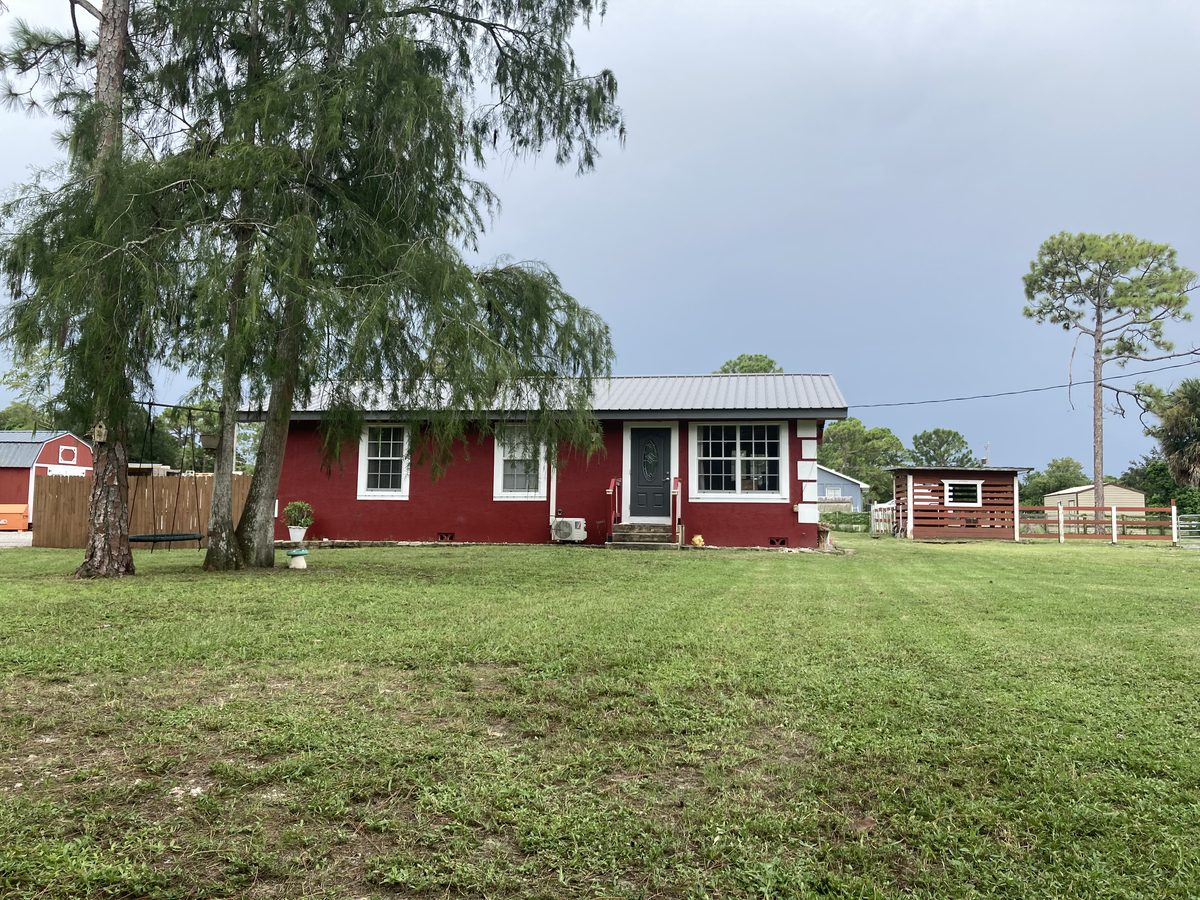
The Bell Farm, Loxahatchee. Everything in this frame was already standing. That is not modesty — it is the statute: what the law protects is what happens on this grass, not a right to put something new on it.
This page is written from inside an operation, not from a library. The Bell Farm sits on agricultural land at 16140 Okeechobee Blvd in Loxahatchee, western Palm Beach County. It is an FDACS-registered agritourism operation and has been a member of Visit Florida Farms since May 2026. It runs the activities the statute describes: overnight farm stays in existing buildings, weddings and private events on the land, farm-to-table dinners at $150 per person, a natural spring soak, a nursery, and a working flock — with a seasonal calendar that follows South Florida’s two real seasons rather than four imagined ones.
And it has had to make the argument. Palm Beach County denied a temporary use permit for the food truck at the farm. The position taken in response is the one on this page, stated factually and without any claim to be legal advice: AMERICA holds a state mobile food dispensing vehicle licence, MFD1654011, issued under chapter 509; the land is classified agricultural; the operation is FDACS-registered agritourism; and s. 570.85(1) says a local government may not adopt or enforce a policy that limits an agritourism activity on land classified agricultural under s. 193.461. That is an assertion of a right, made on the statute’s own words. It is also the reason this guide is so careful about the barn-door line: the strength of an agritourism argument is in the activity, and it weakens the moment you ask the statute to authorise a structure.
What that experience is worth to you. The credential stack behind this page is unusual for farm advice: Certified General Contractor CGC1528750 and Certified Roofing Contractor CCC1332751 for the building side, Community Association Manager CAM34850 and REALTOR® SL3247858 for the land and title side, MFD1654011 for the food side, and a registered agritourism operation that files, posts, hosts and gets inspected like yours will. If you are buying the land first, the buying acreage in Loxahatchee guide is the companion piece to this one — well, septic, ITID, drainage and zoning, before you ever get to visitors.
08 · Order of Operations for a Landowner
If you own Florida land and want the public on it, this is the sequence I would follow. It is deliberately boring, and it is in this order because each step makes the next one cheaper.
Step 1
Confirm the classification, in writing.
Ask the county Property Appraiser what classification your parcel currently carries under s. 193.461, and get it on paper. The entire preemption depends on this one fact. If it is not there, fix that before anything else — or accept that you are operating under ordinary zoning.
Step 2
Write down the activity, not the vision.
List exactly what visitors will do, where they will stand, and what they will touch. Test each line against s. 570.86(1). Anything that needs a new building for the public gets moved to a separate, later, permitted project — not deleted, just sequenced honestly.
Step 3
Post the signs and fix the contracts.
Two locations minimum, black letters at least an inch high, the exact s. 570.89(2) wording. Then put the same paragraph into every contract template you use for instruction, services or equipment rental. This is a one-afternoon job that decides whether the liability limit exists for you.
Step 4
Solve the offsite question first.
Access, stacking, turnaround, wet-weather parking, sanitation, emergency-vehicle access. Draw it. This is the ground local government retains and the ground on which good operations are distinguished from complaints.
Step 5
Handle beds and food separately.
If anyone sleeps or eats, go and get the right answer from DBPR’s Division of Hotels and Restaurants and, where relevant, FDACS — before you advertise. Advertising itself can matter to how an establishment is classified, which is a detail that surprises people.
Step 6
Then insure it, and date it.
The statutory limit stacks with insurance rather than replacing it; tell your carrier plainly that the public will be on the property. And record your start date and your practices, because s. 823.14 rewards the operation that can prove it has been ordinary for a year.
Do You Have to Register With Anyone?
Not to be an operator. Nothing in ss. 570.85–570.89 requires an application, a fee or a registration to be an agritourism operator. s. 570.86(2) makes you one by conduct — providing one or more agritourism activities, paid or unpaid. What the statute conditions is the liability limit, and the condition is the sign, not a filing.
Registration and listing are about being found. s. 570.85(2) directs FDACS to provide marketing advice, technical expertise, promotional support and product development to bodies like the Florida Tourism Industry Marketing Corporation, convention and visitor bureaus, tourist development councils, economic development organisations and local governments, with a focus on rural and urban communities. Alongside that sit the promotional listings operators actually use — The Bell Farm is an FDACS-registered agritourism operation and a Visit Florida Farms member since May 2026, and the Florida Agritourism Association’s own toolkit is linked from the farm page. Treat those as marketing that also demonstrates good faith. They get you visitors; the statute and the sign get you protection. Check current listing requirements with FDACS directly, since programmes change more often than statutes do.
Thinking of Opening Your Gate?
Agritourism and hospitality is one of the advisory engagements on the consulting page — licensing, the structures question, health and lodging rules, and turning a working property into revenue without building first and asking later. You will get a straight answer, including “don’t do it” when that is the honest one.
Stays, weddings, dinners, the spring soak and the seasonal calendar of an FDACS-registered agritourism operation in Loxahatchee — everything this page describes, in operation.
The step before this one. Well, septic, ITID, drainage, flood zone and zoning on a western Palm Beach County parcel — what to verify during the inspection period.
If your plan does end in construction: certified versus registered, the experience rule, the financial-responsibility test, the three-part exam and the renewal cycle.
Twelve months of a South Florida agritourism calendar, including which months are actually bookable — useful as a model when you plan your own year.
Agritourism Advisory
Tell me about the land and what you want to host.
Frequently Asked Questions
Can a Florida county or city shut down agritourism on my farm?
Not by ordinance, if the land is classified agricultural under s. 193.461. Section 570.85(1) says a local government may not adopt or enforce a local ordinance, regulation, rule, or policy that prohibits, restricts, regulates, or otherwise limits an agritourism activity on that land. Two things are carved back out, though: local government keeps its powers over substantial offsite impacts of the activity, and over emergencies under chapter 252. So traffic, parking and access remain live issues even where the activity itself is protected.
What counts as an agritourism activity in Florida?
Section 570.86(1) defines it as any agricultural related activity consistent with a bona fide farm, livestock operation, or ranch or in a working forest which allows members of the general public, for recreational, entertainment, or educational purposes, to view or enjoy activities including farming, ranching, historical, cultural, civic, ceremonial, training and exhibition, or harvest-your-own activities and attractions. Tours, U-pick, workshops, ceremonies on the land and open-farm days all sit comfortably inside that description.
Do I have to charge admission for it to be agritourism?
No. Section 570.86(1) states that an activity is an agritourism activity regardless of whether the participant paid to participate, and 570.86(2) defines an agritourism operator as a person engaged in the business of providing one or more agritourism activities, whether for compensation or not for compensation. A free open-farm day is still an agritourism activity, which also means the warning-notice requirement still applies to it.
Can I build an event barn or guest cabins under the agritourism statute?
No, and this is the most consequential line in the whole scheme. Section 570.86(1) says an agritourism activity does not include the construction of new or additional structures or facilities intended primarily to house, shelter, transport, or otherwise accommodate members of the general public. The statute protects the activity, not the building. Anything you build for visitors is designed, permitted and inspected under the Florida Building Code like any other construction, and the plans examiner with jurisdiction gives the binding answer.
Will hosting visitors cost me my agricultural or greenbelt classification?
Section 570.87(1) says an agricultural classification under s. 193.461 may not be denied or revoked solely due to the conduct of agritourism activity on a bona fide farm, or due to the construction, alteration or maintenance of a nonresidential farm building used to conduct agritourism activities, so long as that building is an integral part of the agricultural operation. The same subsection then requires that those buildings and other improvements be assessed at just value under s. 193.011 and added to the agriculturally assessed value of the land. The land keeps its agricultural assessment; the improvement is valued on top of it.
What sign does Florida require at an agritourism operation?
Section 570.89 requires the statutory notice of inherent risk to be posted in a clearly visible location at the entrance to the agritourism location and at the site of the agritourism activity, in black letters with each letter a minimum of 1 inch in height and sufficient colour contrast to be clearly visible. The same notice must appear in clearly readable print in every written contract with a participant for professional services, instruction or the rental of equipment, whether the activity happens on the property or off it. The exact wording is set out in 570.89(2) and is reproduced on this page.
What happens if I never post the sign?
You lose the liability protection. Section 570.88(1) grants the limitation of liability only if the notice of risk required under s. 570.89 is posted as required, and 570.89(3) states that failure to comply with that section prevents an operator, the operator's employer or employee, or the owner of the underlying land from invoking the privileges of immunity. It is the cheapest protection in Florida agriculture and the one most often left undone.
Does the agritourism liability limit cover everything that can go wrong?
No. It covers injury, death, damage or loss resulting from the inherent risks of the activity, which section 570.86(5) describes as surface and subsurface conditions, natural conditions of land, vegetation and waters, the behaviour of wild or domestic animals, the ordinary dangers of farm structures and equipment, and the participant's own potential negligence. Section 570.88(2) leaves gross negligence, willful or wanton disregard for a participant's safety, and intentional injury entirely outside the shield, and 570.88(3) makes clear the limit is in addition to other limitations provided by law rather than a replacement for insurance.
Do I need a state licence to let guests sleep on my farm?
Lodging is governed by chapter 509, not by the agritourism sections. Section 509.013(4) defines a transient public lodging establishment as accommodation rented to guests more than three times in a calendar year for periods of less than 30 consecutive days, or advertised or held out to the public as a place regularly rented to guests for periods of less than 30 consecutive days. Chapter 509 also contains a list of exemptions, and whether a particular farm stay falls inside one is a question for the Department of Business and Professional Regulation's Division of Hotels and Restaurants before you take a booking. Nothing in the agritourism statutes licenses a bed.
Does agritourism status let me serve food or run a food truck at the farm?
No. Food is its own regime, largely under chapter 509, with FDACS rules applying to some farm products. Our own answer was to license the vehicle: AMERICA, the farm's food truck, operates under Florida mobile food dispensing vehicle licence MFD1654011, a state licence issued under chapter 509. Agritourism status did not produce that licence; an application did. Handle beds and food as separate approvals from the start.
Does the Right to Farm Act protect an agritourism operation from neighbour complaints?
Section 823.14 is the statute that deals with neighbours, and its definition of a farm operation expressly includes agritourism activities. A farm operation in operation for a year or more that conforms to generally accepted agricultural and management practices, and that was not a nuisance when it was established, may not be deemed a nuisance. A nuisance action also cannot be brought unless the affected property is within one-half mile of the source, and a plaintiff who fails to prevail is liable to the farm for all costs, fees and expenses incurred in defence.
Do I have to register with FDACS to be an agritourism operator?
Nothing in sections 570.85 to 570.89 requires an application or a registration to be an agritourism operator; 570.86(2) makes you one by what you do, paid or unpaid. What the statute conditions is the liability limit, and the condition is the posted notice rather than a filing. Registration and directory listings are about being found: The Bell Farm is an FDACS-registered agritourism operation and has been a Visit Florida Farms member since May 2026. Check current listing requirements with FDACS directly, because programmes change more often than statutes do.
Can you help me set an agritourism operation up?
Yes. Agritourism and hospitality is one of the advisory engagements offered here, and it comes from running one: The Bell Farm is an FDACS-registered agritourism operation on agricultural land in Loxahatchee, with stays, events, dinners and a state-licensed food truck. The work is usually sequencing rather than paperwork, deciding what can be hosted now on what already exists and what has to wait for a permitted building. Call (561) 779-3213 with the county, the classification and what you want visitors to do, and you will get a straight read, including do not do it when that is the honest answer. This is general information and business advice from an operator, not legal advice.