RSB Empire → Bell Land Services · Palm Beach County
Land Clearing Palm Beach County & Loxahatchee
Bobcat T740 with 60" grapple — $1,385/day with operator, on site now.
Land clearing in Palm Beach County and Loxahatchee, FL: brush, palmetto, trees and stumps cleared with a Bobcat T740 and 60" grapple at $1,385 a day with an operator. Our yard is in Loxahatchee, so Loxahatchee land clearing starts from our own gate, and the same machine, trailer and crew travel countywide for site preparation, demolition, grading and storm cleanup.
Land clearing Loxahatchee starts with the Bobcat T740 and its 60" grapple, based right at our own yard at 16140 Okeechobee Blvd — the same machine and operator quoted at $1,385/day on every acreage lot from a quarter-acre backyard clear to a full 5-acre parcel. Most Loxahatchee jobs are Brazilian pepper thickets, Melaleuca stands, palmetto and slash pine that have taken over a 1.25-acre-and-up lot, and because the yard sits in Loxahatchee itself, the machine can be on site the same week rather than trucked in from across the county.
Land Clearing Palm Beach County — Countywide, Not Just Loxahatchee
Land clearing Palm Beach County work covers a lot more ground than our home base in Loxahatchee. The Bobcat T740 with its 60" grapple is based right here at 16140 Okeechobee Blvd, but it travels on its own hauler trailer to lots the length of the county — north through Jupiter and Palm Beach Gardens, across Wellington, Royal Palm Beach, The Acreage, Greenacres, Lake Worth, Palm Springs and West Palm Beach, and south to Boynton Beach and Delray Beach. Wherever the lot sits, the rate is the same: $1,385 a day, with an operator, for the T740 and grapple — the one number every estimate in this county starts from.
What triggers a permit is the same question everywhere in Palm Beach County, but who answers it is not. Inside unincorporated county territory — which covers most of the western communities plus large stretches between the cities — a land-clearing or vegetation-removal permit runs through the county's Planning, Zoning & Building Division, 2300 North Jog Road, West Palm Beach, filed through the ePZB portal. Grubbing native trees, cabbage palms, or a lot down to bare dirt is what usually trips that requirement; clearing invasive exotics like Brazilian pepper or Melaleuca generally does not. Each incorporated city — Wellington, Royal Palm Beach, Jupiter, Boynton Beach, and the rest — runs its own version of the same review through its own building department, so the desk changes even when the rule does not.
The Acreage carries one more layer the rest of the county doesn't: it sits inside the Indian Trail Improvement District (ITID), 13476 61st Street North, which permits and inspects any clearing that touches a driveway, culvert, or the swale along an ITID right-of-way — separately from, and in addition to, the county building permit. A lot elsewhere in the county answers to one desk; an Acreage lot can answer to two. We check both, or the single city desk that applies, before the Bobcat ever mobilizes — wherever in Palm Beach County the job is.
Land Clearing Palm Beach County — Cost, Permits and How Fast We Start
What does land clearing cost in Palm Beach County? Our equipment is $1,385 per day with an operator (Bobcat T740, 60" grapple). What the job totals depends on vegetation type and density, access, stump grubbing, and whether debris is hauled off or mulched in place. We give the number after a free walk of the lot, not from a table. The cost guide explains each driver.
Who permits it? That depends on where the lot is: unincorporated county, a city or town, or an improvement district. Our permits and regulations guide lists the offices, and we confirm the right one for your parcel before booking.
Three taps and you get the same honest range we'd quote you on the phone — straight from our Palm Beach County price guide. No email required.
Your estimated range
$6,000 – $12,800
Roughly 2–4 days on site · 1.25 acres, moderate growth, grubbed and hauled off
That spread is real, not a dodge — stump count, wet ground, and haul distance decide where you land inside it. A ten-minute walk of the lot with you turns this range into one number, free.
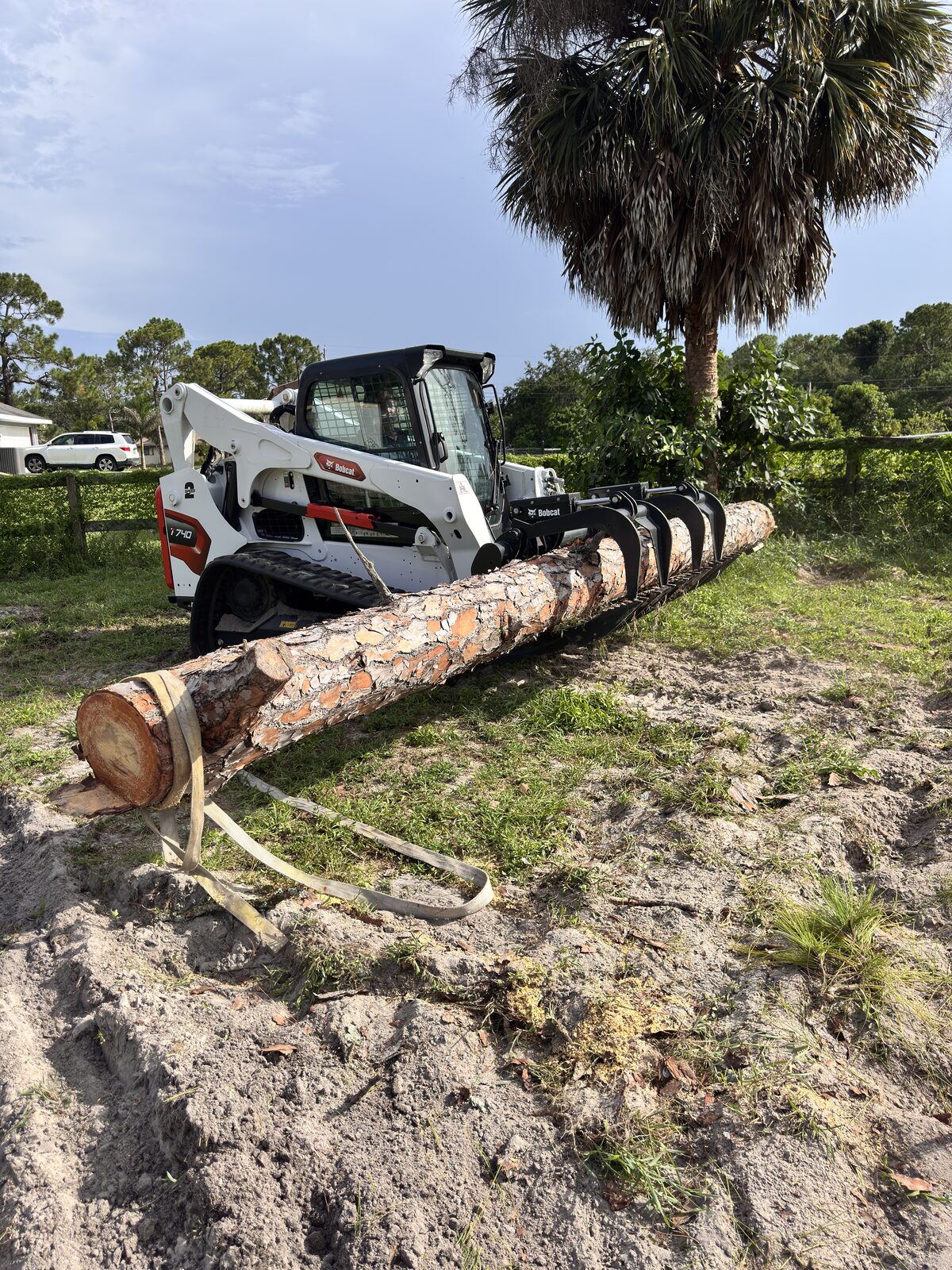
The Bobcat T740 with grapple lifting a pine log on a Loxahatchee clearing job — the same machine and operator that shows up for your lot.
Clearing Land in Loxahatchee & The Acreage — What to Expect
Loxahatchee, The Acreage, and much of western Palm Beach County sit on 1.25-acre-and-up lots carved out of old flatwoods and Everglades-edge scrub. That means most clearing jobs out here are not a manicured backyard trim — they are Brazilian pepper thickets, Melaleuca stands, slash pine, palmetto, and cabbage palm that have had years to take over. Knowing what is on your lot before the machine arrives is what keeps a one-day job from turning into three.
Do you need a permit to clear land in Palm Beach County? Often, yes — and the answer depends on what you are cutting and where. Palm Beach County protects native and specimen trees, and the western communities frequently have wetland areas, native-vegetation preserve requirements, and drainage easements running through them. Selective clearing of exotic, invasive species (Brazilian pepper, Melaleuca, Australian pine, air potato) is usually encouraged, but removing native pines, oaks, and cabbage palms — or grubbing a lot down to bare dirt — can trigger a land-clearing or vegetation-removal permit through the county's Planning, Zoning & Building department, and wetland-adjacent work can involve the South Florida Water Management District. We walk the lot with you first, flag what needs a permit versus what doesn't, and keep the work inside the lines so you are not the one explaining a cleared wetland to the county later. For the full picture — which desk handles what, the acreage thresholds, gopher tortoises, ITID easements, burning, and a pre-clearing checklist — read our Palm Beach County land clearing permits & regulations guide.
Call 811 before anything digs. Every job starts with a free Sunshine State One Call (811) utility locate so the grapple and any grubbing stay clear of buried power, water, and cable — required by law, and it protects your property from a very expensive mistake.
Haul-off vs. mulch-in-place. Once the material is down you have two roads. Hauling everything to a disposal site leaves the cleanest lot but adds trailer trips and tipping fees. Chipping and mulching the debris in place is cheaper and leaves a layer that suppresses regrowth — a good fit for lots you are not building on immediately. For build-ready pads, most owners want the stumps grubbed and the debris hauled; for pasture, trails, or fire-break work, mulching in place usually wins. We price both so you can see the trade-off.
Wet season matters here. From roughly June through October, Loxahatchee lots hold water, and a track loader working saturated ground can rut a property badly. The Bobcat T740's tracks spread the machine's weight better than a wheeled skid-steer, but for heavy clearing we still watch the forecast and the standing water — sometimes the smartest move is to wait a dry week rather than tear up the ground. Dry-season clearing (November–May) is faster, cleaner, and easier on your lot.
Trees and stumps only? A single hazard tree, a stand of Brazilian pepper or a field of old stumps is a smaller job than a lot clearing. See tree and stump removal in Loxahatchee: the same T740 and grapple, pulling stumps whole, at the same $1,385/day with an operator.
Every clearing job is quoted free and in person. Tell us the address and roughly what is on the lot, and we will tell you honestly whether it is a half-day, a full day, or a multi-day job — and what the permit picture looks like — before any money changes hands. If your property is out here, our Loxahatchee & The Acreage land clearing page goes deeper: the five jobs an acreage lot actually asks for, what clearing runs on a standard 1.25-acre lot, the ITID swale and culvert access problem, and the local numbers worth having.
The Transformation — Drag to Reveal
Overgrown, unbuildable scrub in the morning. A level, graded, ready-to-build pad by the end of the day. Drag the slider to see what the Bobcat T740 does to a Palm Beach County lot.
Before · Overgrown
After · Build-Ready
↔
A Day on the Lot — How the Work Actually Goes
Nobody should be guessing what happens after they say yes. This is the order of operations on a Palm Beach County clearing job, start to finish.
Bobcat T740 · 60" grapple · Loxahatchee, FL
STEP 01
We walk the lot with you
Before a quote gets written, we stand on the property together. We flag what's invasive and can go freely — Brazilian pepper, Melaleuca, Australian pine — and what's native, protected, or inside a wetland or drainage easement and needs a permit first. You leave that walk knowing your real scope, and it costs you nothing.
STEP 02
811 gets called before anything digs
Every job starts with a free Sunshine State One Call utility locate, so the grapple and any grubbing stay clear of buried power, water, and cable. It's required by law and it's the cheapest insurance on the whole project — one clipped line costs more than the clearing.
STEP 03
The T740 goes to work
The track loader spreads its weight far better than a wheeled skid-steer, which is what keeps your ground from getting rutted on wet Loxahatchee soil. Thickets and root balls come out with the grapple, and we watch the forecast — in the June-to-October wet season, waiting a dry week is sometimes the smartest call we can make for your lot.
STEP 04
Hauled off or mulched in — your call
Building soon? We grub the stumps and haul everything to disposal, and you get a level, graded, build-ready pad. Pasture, trails, or a fire break? Chipping the debris in place is cheaper and leaves a layer that holds regrowth back. We price both up front so you pick with the numbers in front of you.
Featured Project — Hurricane Irma Debris Cleanup · Tampa & Ybor City, 2017
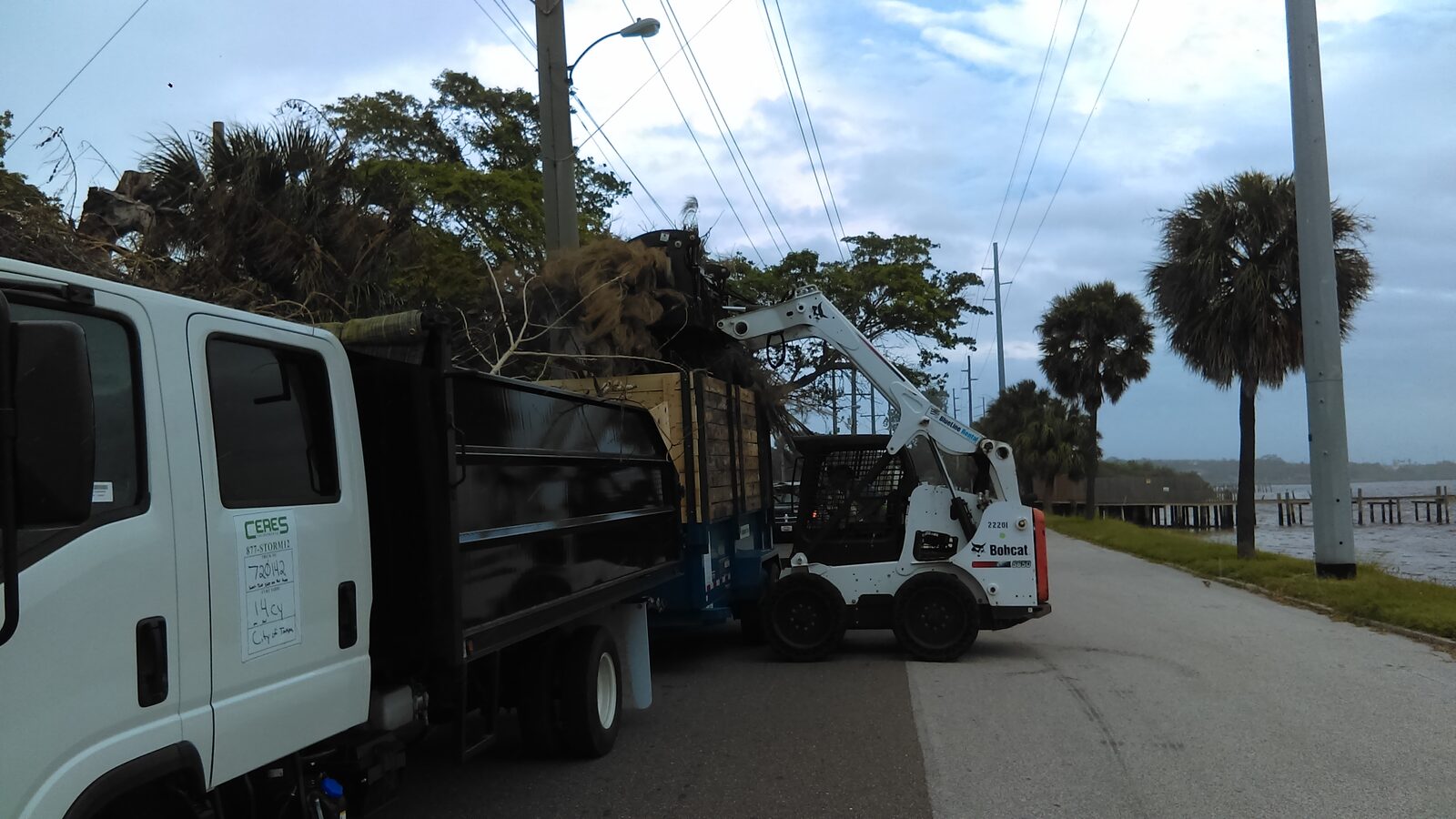
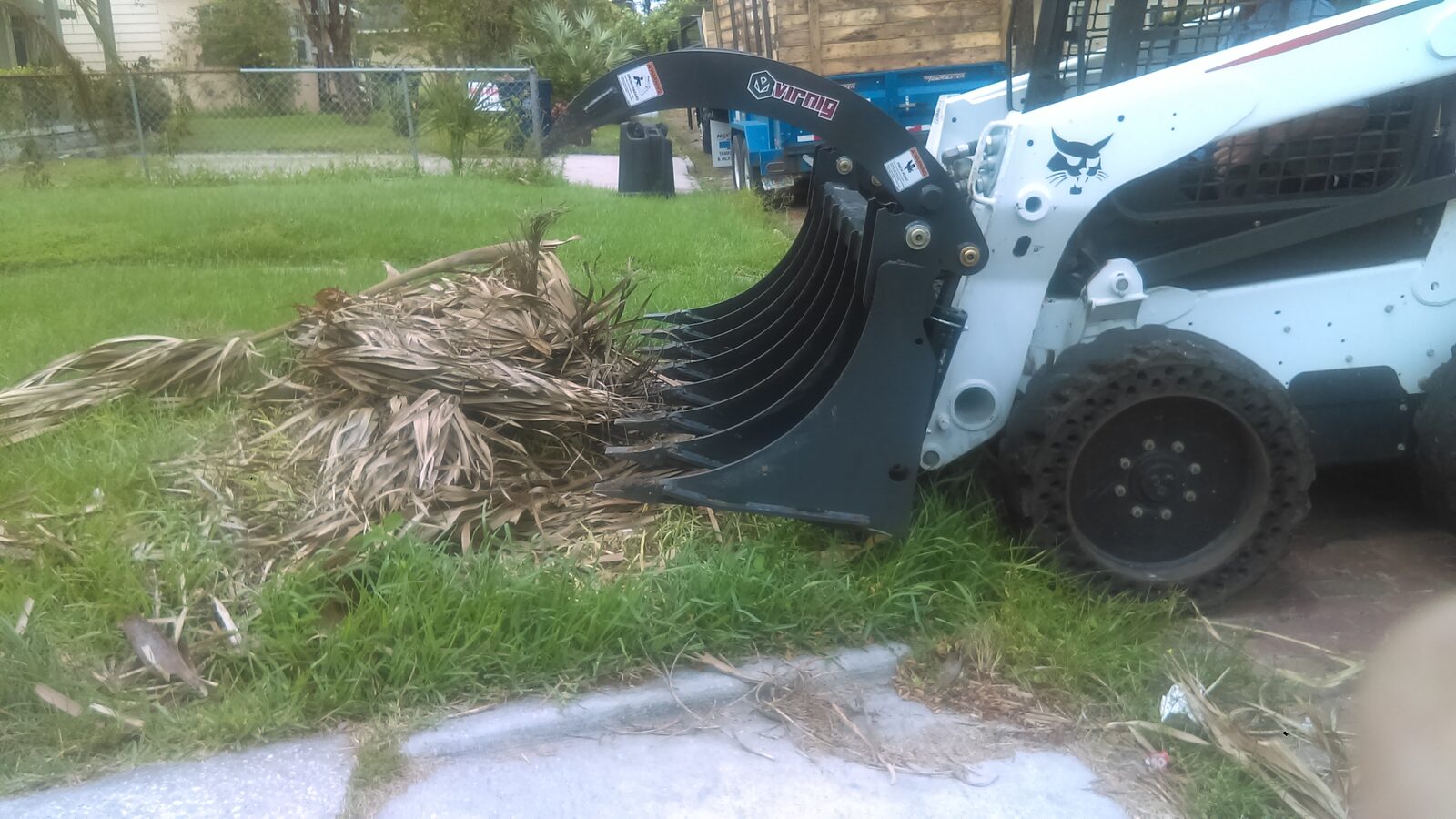
Curbside loading on a Tampa waterfront street — an Isuzu NPR dump truck and dump trailer filling with palm fronds and storm-broken limbs while the Bobcat S650 and grapple work the swale. Hurricane Irma cleanup, 2017.
Hurricane Irma reached the Tampa Bay area in September 2017. In the weeks that followed, Randolph Scott Bell ran storm-debris cleanup through Tampa and Ybor City for Ceres Contractors (Ceres Environmental Services) — one of the largest disaster-debris contractors in the country. This is what the work looked like from inside the cab.
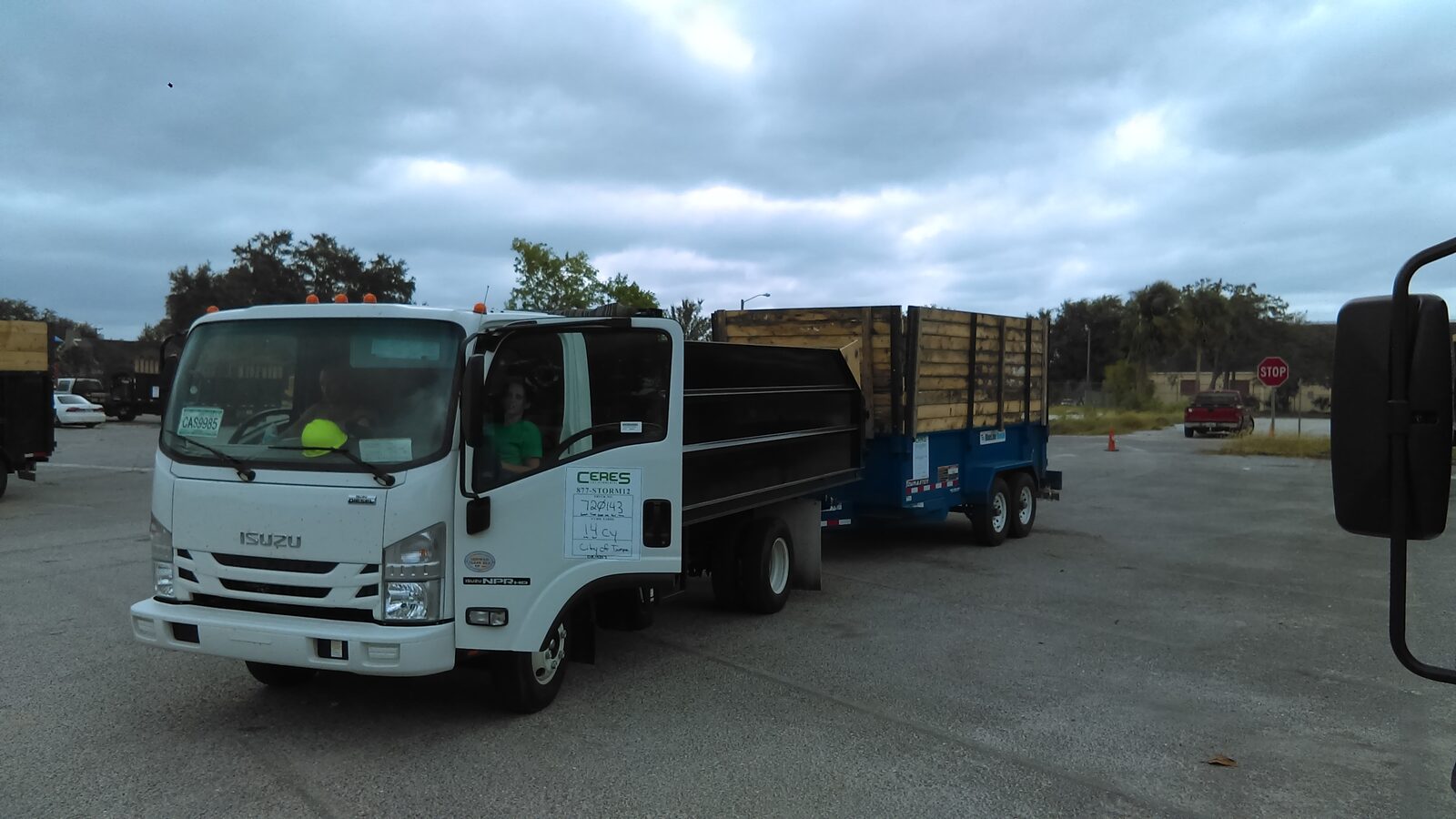
The equipment was the same shape as the equipment that shows up for a Palm Beach County lot today, only there were more of it: Isuzu NPR dump trucks pulling loaded dump trailers, and a Bobcat skid steer fitted with a root-and-brush grapple working downed palm fronds and storm debris curbside, house by house, through residential neighborhoods. Disaster-debris work is measured by the cubic yard and ticketed load by load — the Ceres ticket taped inside the windshield in the photo below reads 14 CY — City of Tampa.
Storm cleanup is the one service nobody shops for in advance. When it is needed, it is needed the same week, and the difference between an outfit that has done it and an outfit that added it to a list after the last hurricane shows up immediately — in whether the truck, trailer and machine arrive together, whether the debris is separated the way the haul-off site wants it, and whether the crew can keep a residential street passable while it works. Bell Land Services brings federal-scale disaster-debris experience to Palm Beach County lots — the same grapple, the same haul-off discipline, on a Loxahatchee or Acreage property instead of a Ybor City block. If a storm has left you with a lot you cannot walk through, that is the number to call. Planning ahead instead? Start with the land clearing cost guide or the Loxahatchee & The Acreage page.
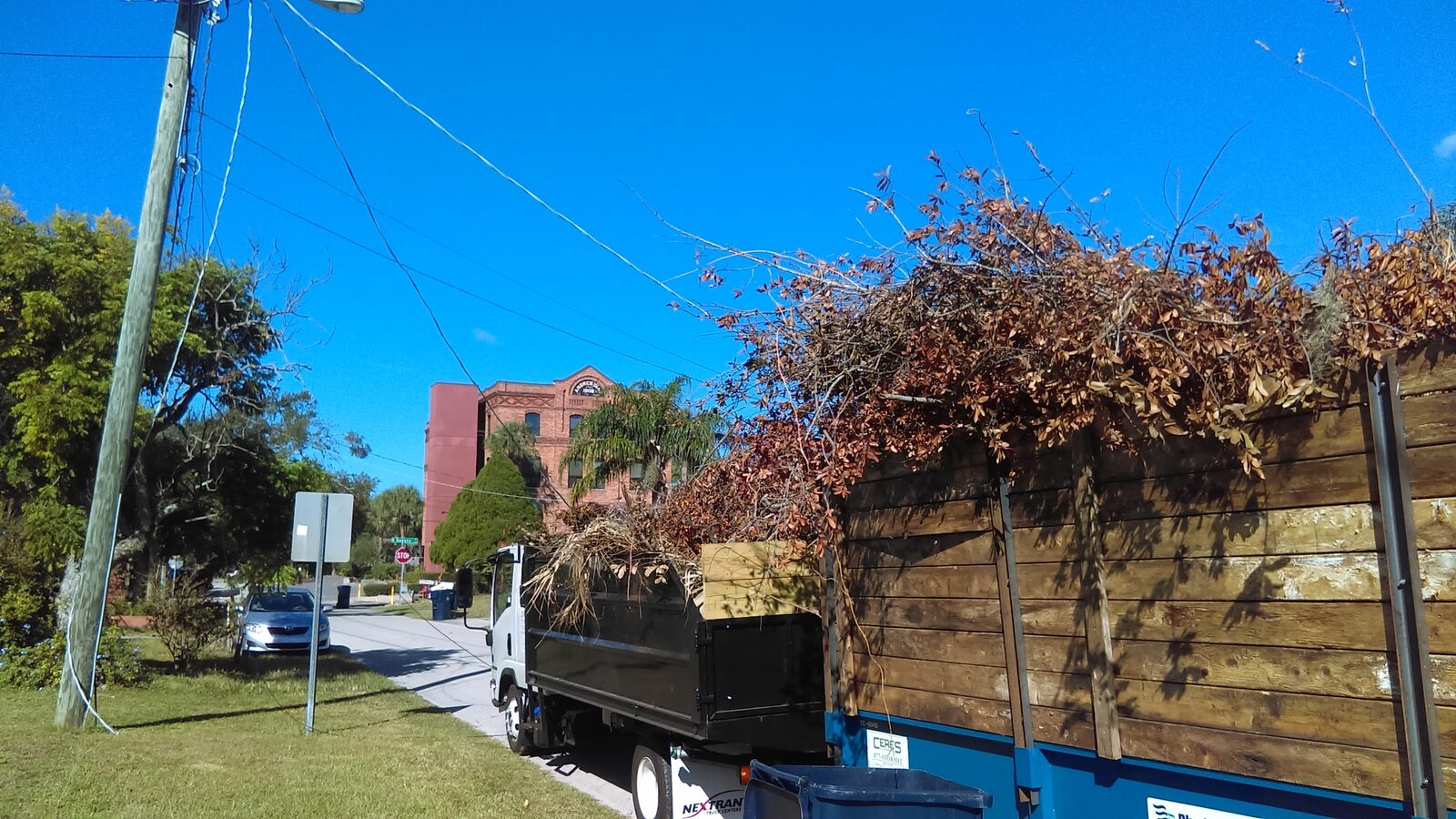
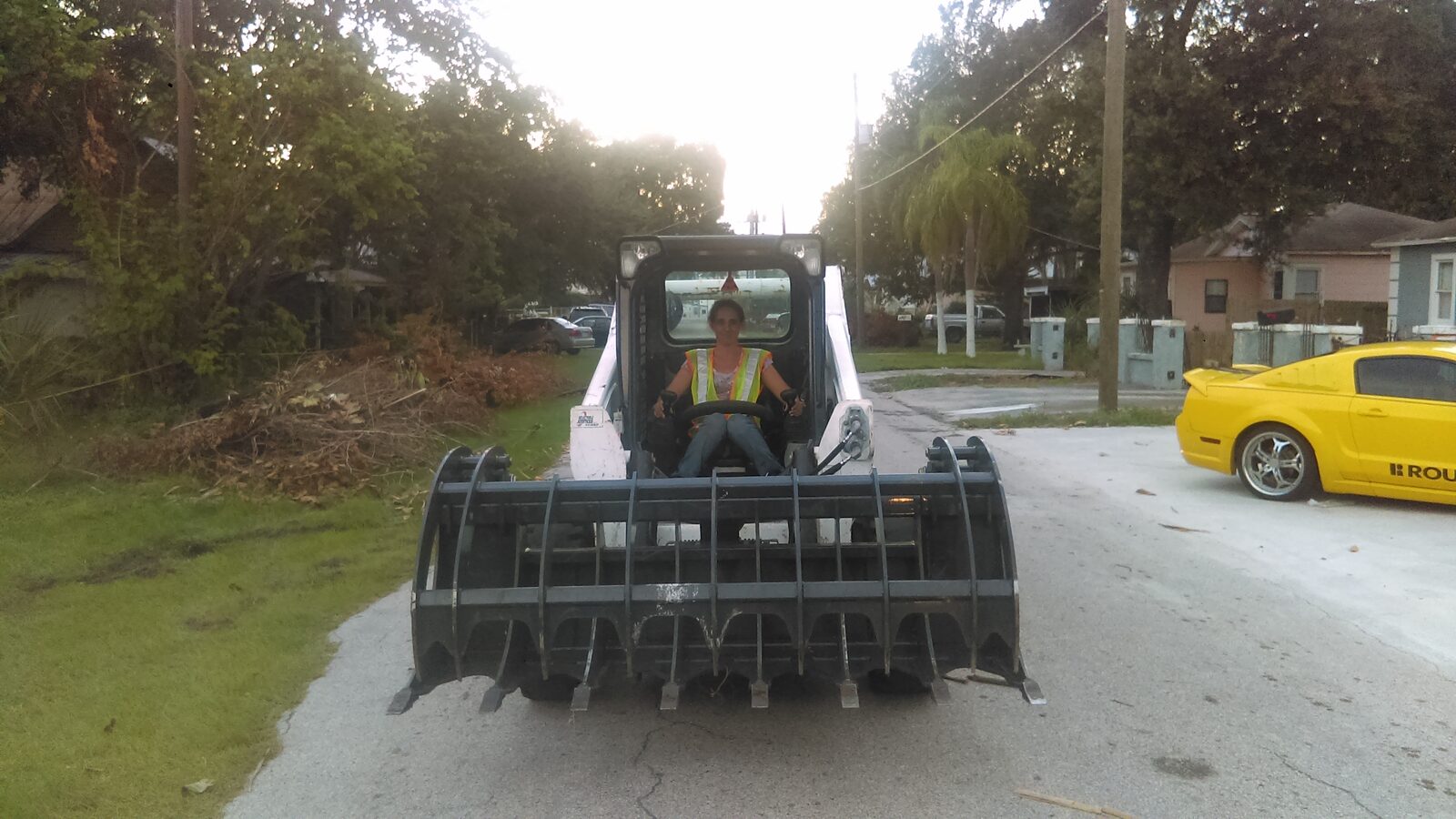
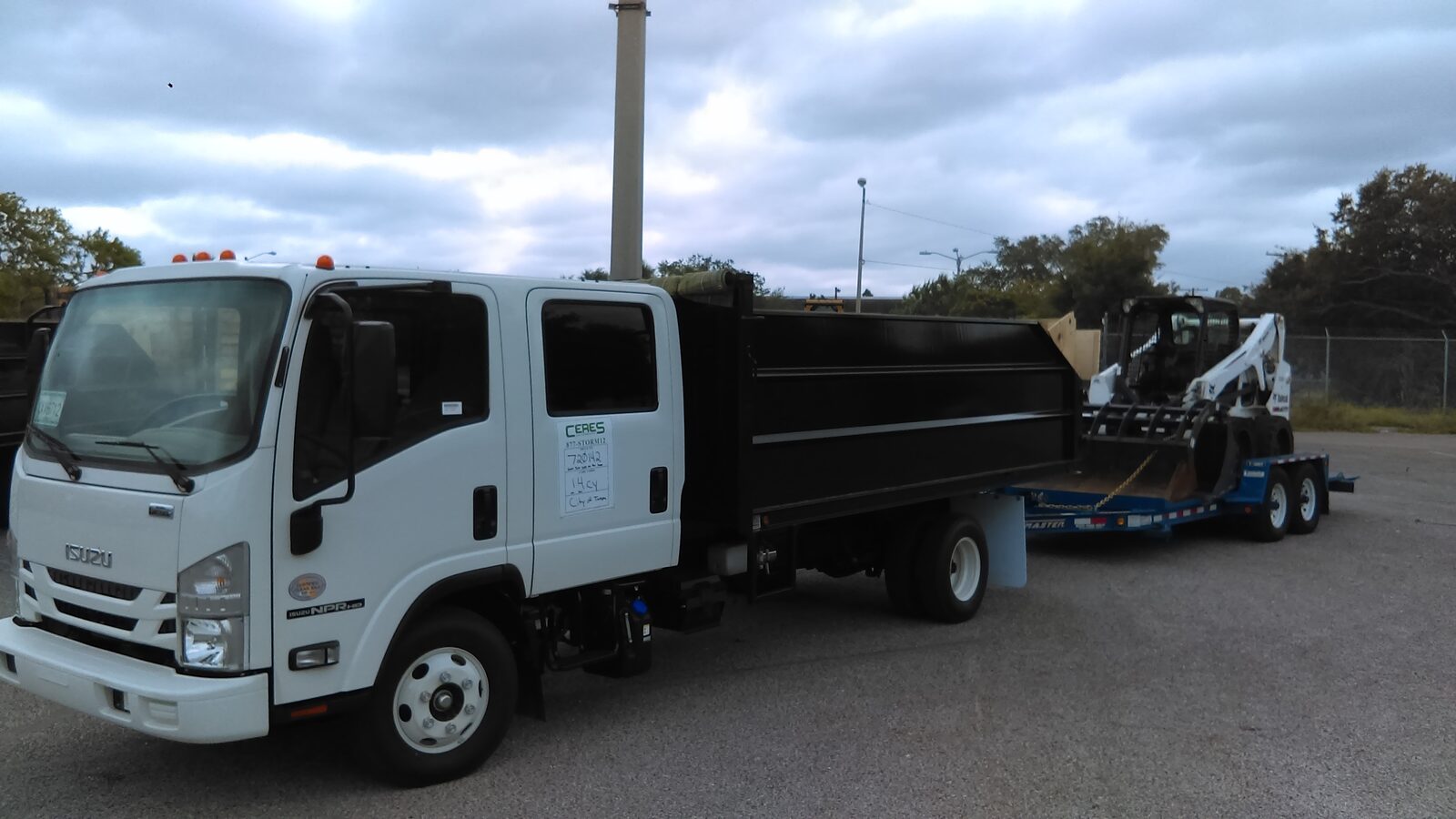
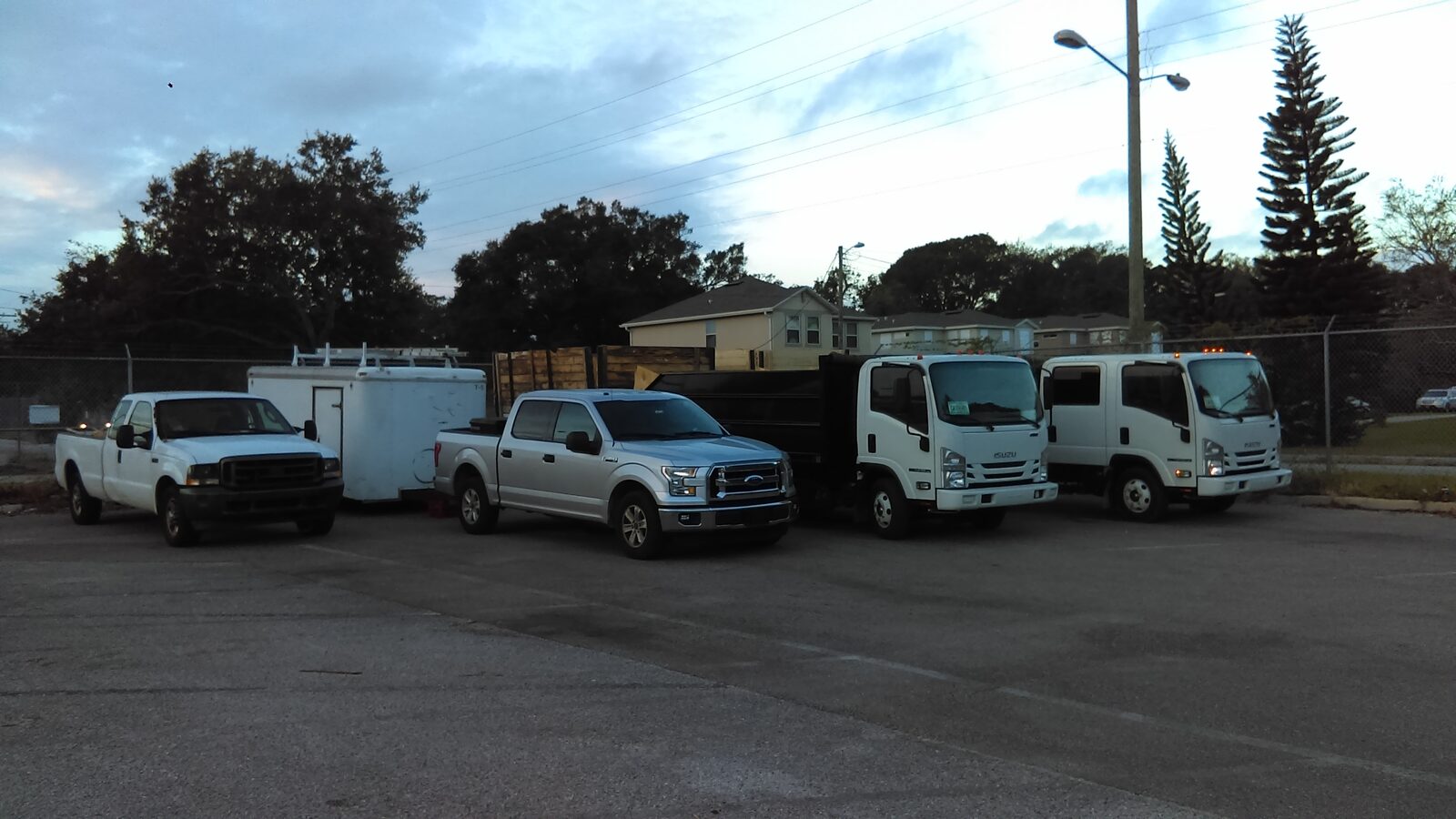
Ybor City — a trailer heaped past the sideboards with storm-killed limbs, the district's historic brick cigar-factory skyline behind it.The root-and-brush grapple doing what a rake cannot — a whole downed palm crown gathered in one bite, front yard, residential Tampa.Wide root grapple mounted and rolling. Debris windrowed along the swale on the left — that is the shape of a residential block after a major storm.Staged and ticketed. The Ceres load ticket in the windshield reads 14 CY — City of Tampa.Truck, trailer and machine travelling together — the same self-contained setup that rolls to a Palm Beach County lot today.Dusk at the staging lot, end of a run — pickups, an enclosed trailer and two Isuzu cabover dumps.
Equipment
Bobcat T740 · 60" Grapple · Available Now · $1,385/Day
Click anywhere to close
The Fleet & Attachments
🚜
Bobcat T740
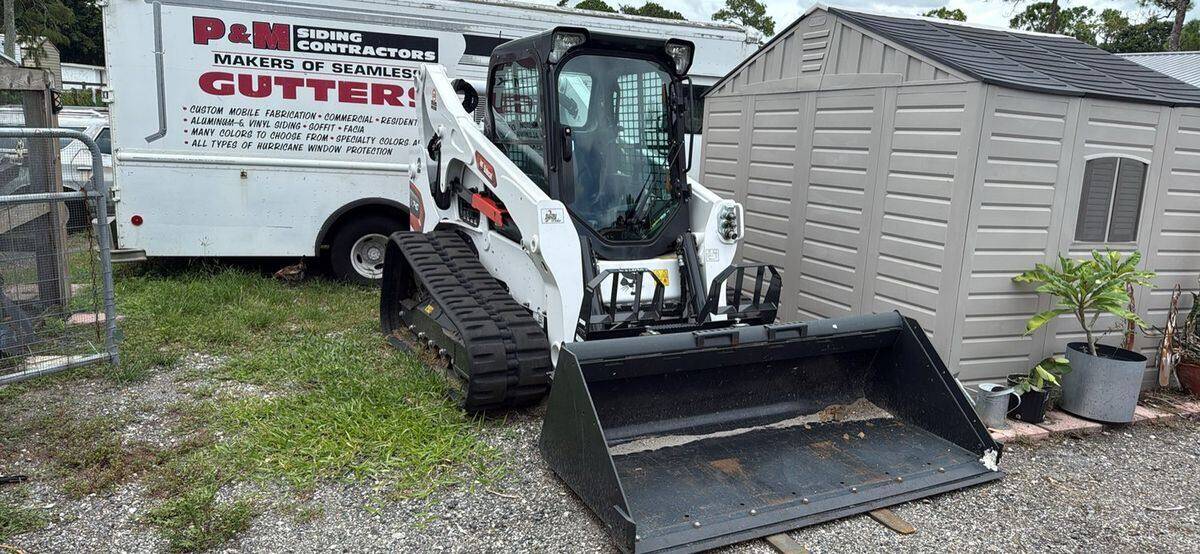
Compact track loader with 60" grapple bucket. Clearing, debris removal, grading, and tight-access site prep.
🚛
Hauler Trailer
The T740 travels on its own hauler trailer — ready to deploy anywhere across Palm Beach County, same week.
🚐
Grumman Gutter Van
Seamless gutter machine on a Grumman step van with aluminum coil on board. Available for contracts.
🚜
Bobcat T740
Track loader with 60" grapple bucket. Ideal for land clearing, debris removal, site prep, and tight-access jobs.
$1,385 / day
🚐
Gutter Machine
Seamless gutter machine on a Grumman step van. Available for gutter installation contracts throughout Palm Beach County — see seamless gutters, with two 2025 jobs photographed.
Post-hurricane debris removal and lot restoration.
📦
Material Handling
Forklift services, loading, material moving.
🌧️
Seamless Gutters
On-site fabrication. Residential and commercial.
Planning a Project? Read This First
🏡
Lot Clearing. A single residential or vacant lot — grass, brush, palmetto, saplings, small stumps — cleared and hauled off or mulched, most often a half-day to one-day job. Read the lot clearing page ↗
🪵
Forestry Mulching & Brush Hogging. Grind brush, palmetto and small trees down where they stand instead of hauling them off — pasture reclamation, fire breaks, and fence-line clearing. Read the forestry mulching page ↗
🚧
Fill Dirt & Excavation. Raise a low or wet lot with fill, level a pad for a foundation, or dig down to grade for a driveway or drainage — the ground-shaping step after clearing. Read the fill dirt & excavation page ↗
🛣️
Driveway Installation Site Prep. Grading the path, compacting the base, and sloping it to drain correctly — the ground work every new driveway or access pad needs before a finish surface goes down. Read the driveway installation page ↗
📘
Land Clearing Cost Guide — Palm Beach County. Honest per-acre price ranges, the factors that move the number, the local permit and wetland rules people forget, and how to keep the bill down. Read the full cost guide ↗
📍
Land Clearing in Loxahatchee & The Acreage. The local page for 33470 — what grows on an Acreage back half, the five jobs a lot actually asks for, what clearing runs on a standard 1.25-acre lot, the ITID swale and culvert problem, and ten questions to ask any clearing outfit out here. Read the Loxahatchee page ↗
🐴
Land Clearing in Wellington. Horse-country ground work, not Acreage-style reclamation — paddock and turnout prep, ring and footing site prep, fence-line clearing, gated-community lot clearing, and the Village permit vs. HOA/ARB approval question answered plainly. Read the Wellington page ↗
🚜
Bobcat Grading Services in Wellington. Paddock and turnout regrading, arena and ring footing pads, wash-rack and drainage grading, and horse-trailer access grading — the shaping-the-ground job, priced and scoped separately from clearing. Read the Wellington grading page ↗
🚜
Bobcat Grading Services in Loxahatchee. Driveway and culvert access grading, building-pad grading for a new home or barn, pasture and drainage grading, and fill placement on wet acreage lots — the same T740 and grapple that grades our own farm here. Read the Loxahatchee grading page ↗
🚜
Bobcat Grading Services in West Palm Beach. Infill and new-construction pad grading, driveway and access grading, post-teardown pad prep, and drainage grading toward the street or a swale — the City's own Building Division, the coastal wind-load band, and the El Cid, Flamingo Park, Grandview Heights and Old Northwood historic-district review question, answered plainly. Read the West Palm Beach grading page ↗
🚜
Bobcat Grading Services in The Acreage. Driveway and culvert-crossing grading, building-pad grading, paddock and ring footing grading, and pasture drainage grading — the ITID culvert question and the no-HOA reality, answered plainly. Read The Acreage grading page ↗
🚜
Bobcat Grading Services in Royal Palm Beach. Driveway base prep, building-pad grading ahead of a new home or addition, and drainage-swale grading — the Village's own Building Division at Village Hall, and the Madison Green, Portosol, Victoria Grove, Bella Terra, Nautica, Greenway Village and Strathmore Gate West ARB question, answered plainly. Read the Royal Palm Beach grading page ↗
🚜
Bobcat Grading in Palm Beach Gardens. Lot and drainage grading, building pads and driveway approaches at $1,385/day with an operator — the City's Building Division, the City Forester and the community ARB question, answered plainly. Read the Palm Beach Gardens grading page ↗
🚜
Bobcat Grading in Lake Worth. Pad, drainage and driveway-base grading on built-out lots, and the plain answer on which desk permits it: the City of Lake Worth Beach Building Division inside the city, the county's Building Division in unincorporated Lake Worth. Read the Lake Worth grading page ↗
🏇
Land Clearing in Jupiter & Jupiter Farms. One name, two rulebooks — the Town of Jupiter's Chapter 26 vegetation ordinance for in-town lots, Palm Beach County's ERM and Zoning process for unincorporated Jupiter Farms, HOA sign-off, mangrove rules on the Loxahatchee River, and the South Indian River Water Control District's swales and culverts. Read the Jupiter page ↗
🏙️
Land Clearing in West Palm Beach. Dense, built-out county-seat ground work, not Acreage-style reclamation — infill and teardown-rebuild lot clearing, canal and drainage-easement clearing, storm cleanup, and the honest permitting picture for a jurisdiction where our one confirmed record points to the county, not a city building department. Read the West Palm Beach page ↗
🌴
Land Clearing in Boynton Beach. The City's own Landscape Permit for tree and palm removal — the exact caliper threshold, the exemptions, the payment-in-lieu cost if a tree isn't replaced on site — plus the Leisureville, Hunters Run and Quail Ridge architectural-review question, answered plainly. Read the Boynton Beach page ↗
🌳
Land Clearing in Palm Beach Gardens. The City Forester's tree and palm removal rules — including pruning, the most-missed approval here — plus the PGA National, BallenIsles, Frenchman's Creek, Mirasol and Avenir architectural-review question, answered plainly. Read the Palm Beach Gardens page ↗
🏛️
Land Clearing in Lake Worth Beach. Built-out city lots, not acreage — storm-debris cleanup in the Wind-Borne Debris Region, a specimen tree or hedge removed through the Certificate of Appropriateness process in College Park, Old Lucerne and the city's other historic districts, and small-lot clearing ahead of an addition. Read the Lake Worth Beach page ↗
🏘️
Land Clearing in Greenacres. HOA and condo-board-compliant landscape and tree clearing in Cresthaven, Lucerne Lakes, Covered Bridge and the city's other named communities, older-lot overgrowth removal, and small-lot clearing ahead of an addition or pool. Read the Greenacres page ↗
🐴
Land Clearing in The Acreage. Paddock and turnout prep, driveway and culvert access onto ITID's swale network, and the plain answer on who regulates your lot — the county's Building Division, not a city hall. Read The Acreage page ↗
🌴
Land Clearing in Delray Beach. The City's Development Services Building Division, the Historic Preservation Board's Certificate of Appropriateness process in Del-Ida Park and the other historic districts, plus the Kings Point and Rainberry Bay HOA question, answered plainly. Read the Delray Beach page ↗
🏘️
Land Clearing in Palm Springs. The Village's own Planning, Zoning & Building Department, the 170 mph wind band, and the Lake Clarke Gardens and Lakeside Village HOA sign-off question, answered plainly. Read the Palm Springs page ↗
📋
Land Clearing Permits & Regulations — Palm Beach County. Who actually regulates your lot, which permit you need, what's exempt, and the wetland, tree, and gopher-tortoise rules that stop a job cold — plus the pre-clearing checklist and the numbers to call. Read the permits guide ↗
🌲
Tree & Stump Removal Guide. How removing one or two problem trees differs from clearing a whole lot, when a permit applies, how the Bobcat T740 and grapple pull a stump, and what drives the cost. Read the tree & stump removal guide ↗
🌪️
Storm Debris Cleanup Guide. The Hurricane Irma proof story from Tampa & Ybor City, what to do first after a storm, and the federal-scale disaster-debris experience Bell Land Services brings to a Palm Beach County lot. Read the storm debris cleanup guide ↗
Licensed & insured · Palm Beach County FL · Fast turnaround.
Frequently Asked Questions
What land services do you offer?
Bobcat T740 excavation, land clearing, hauling, and gutter installation across Palm Beach County.
What areas do you serve?
All of Palm Beach County, Florida, and surrounding communities.
How much does it cost?
Equipment work starts at $1,385/day, and all quotes are free. Pricing depends on the size and scope of the job.
Are you licensed and insured?
Yes. Bell Land Services operates under Bell Engineering & Construction (CGC1528750) and is fully licensed and insured.
Do you take small residential jobs?
Yes — we handle both residential lots and larger commercial clearing and excavation work.
Does the $1,385/day rate include an operator?
Yes — the $1,385 per day rate includes the Bobcat T740 with grapple attachment and an experienced operator.
What equipment do you use for land clearing?
A Bobcat T740 compact track loader fitted with a grapple attachment, ideal for clearing brush, debris, and overgrowth.
Which communities do you clear land in?
We handle land clearing in Loxahatchee, The Acreage, Wellington, Royal Palm Beach, Jupiter, Boynton Beach, and greater West Palm Beach.
Do I need a permit to clear land in Palm Beach County?
Often, yes — it depends on what you're removing and where. Palm Beach County protects native and specimen trees, and western communities like Loxahatchee and The Acreage frequently have wetlands, preserve requirements, and drainage easements. Clearing invasive exotics is usually encouraged, but grubbing a lot to bare dirt or removing native trees can require a vegetation-removal permit, and wetland-adjacent work can involve the South Florida Water Management District. We walk the lot first and tell you exactly what needs a permit before any work starts.
Do you remove invasive trees like Brazilian pepper and Melaleuca?
Yes — removing Brazilian pepper, Melaleuca, Australian pine, and other invasive exotics is some of the most common clearing work out here, and it's the kind the county generally wants to see done. The grapple pulls thickets and root balls efficiently, and we can haul the material off or chip and mulch it in place depending on your plan for the lot.
What's the difference between clearing land in unincorporated Palm Beach County and inside a city?
Unincorporated areas like Loxahatchee and The Acreage are regulated directly by Palm Beach County's Planning, Zoning & Building department, while incorporated cities such as Wellington, Jupiter, or Boynton Beach run their own separate permitting process on top of or instead of the county's. Which rulebook applies depends on where your lot sits, so confirming jurisdiction is the first step of every quote — see the city pages linked below for the local desk in each town.
What are "protected" or "heritage" trees, and can I remove them?
Palm Beach County and several of its cities protect certain native and specimen trees — often based on species and trunk diameter — and removing one without approval can trigger fines or a mandatory replacement requirement. Invasive exotics like Brazilian pepper and Melaleuca are treated differently and are usually fine to remove. We walk the lot with you and flag which trees are protected before any cutting starts.
What does storm debris cleanup actually cover?
Storm cleanup means clearing downed trees, broken limbs, and wind-scattered brush from a property after a hurricane or major storm, then hauling that debris off the lot — the same grapple-and-haul-off work we brought to the 2017 Hurricane Irma cleanup in Tampa and Ybor City. It does not include structural repairs to a home or roof; that's a construction or roofing scope, not a land-clearing one.
What's included in grading and site prep?
Once a lot is cleared, site prep means leveling and smoothing the ground so it's ready for a driveway, pad, or foundation — using the Bobcat T740 to move and grade soil after the vegetation is gone. It's priced and scheduled as a separate step from clearing itself, though many owners bundle the two into one mobilization.
Can the Bobcat T740 handle dense brush and mature trees, or just light growth?
Both, though the approach differs. In dense brush and palmetto, the grapple sweeps thickets and root balls out in bulk; on mature trees it's more targeted — pushing, grappling, and staging trunks and limbs individually before hauling. A heavy stand with large stumps takes longer and more machine hours than a light brush lot the same size.
How long does a typical land clearing job take?
It depends on lot size and what's growing on it — use the Price Your Lot estimator above or our cost guide for the acreage/density math. As a rule of thumb, a light residential lot often takes a day or two with the T740, while heavily wooded acreage or a job with extensive haul-off runs longer.
Does "land clearing" include stump grinding, hauling, and fill dirt?
Not automatically — those are separate scopes you choose. Cutting and removing vegetation is the core clearing job; pulling stumps and roots ("grubbing") is an added step, hauling debris off-site is priced separately from mulching it in place, and bringing in fill dirt to raise or level a lot is its own line item. Tell us your end goal and we'll quote exactly the scope you need.
How much does land clearing cost in Loxahatchee, FL?
Loxahatchee jobs price the same way every Palm Beach County lot does: by acreage, vegetation density, and haul-off vs. mulch-in-place, using the Bobcat T740 at $1,385/day with an operator as the baseline. Use the Price Your Lot estimator above for a real range in three taps, or read the full land clearing cost guide.
Is Bell Land Services actually based in Loxahatchee?
Yes — our yard is at 16140 Okeechobee Blvd, Loxahatchee, FL 33470, home base for the Bobcat T740 and its 60" grapple. Land clearing Loxahatchee lots is where our week starts before the same machine and crew travel countywide.
Do Loxahatchee lots need a permit before clearing?
Often, yes, depending on what's coming out. Loxahatchee is unincorporated Palm Beach County, so a land-clearing or vegetation-removal permit generally runs through the county's Planning, Zoning & Building Division, and work that touches a driveway, culvert, or the swale along an ITID right-of-way needs the Indian Trail Improvement District's sign-off as well. We walk the lot first and flag what needs a permit before any work starts.
How much does land clearing cost in Palm Beach County?
Equipment is $1,385 per day with an operator (Bobcat T740 with a 60-inch grapple). The total depends on vegetation type and density, access, stump grubbing, and haul-off versus mulching in place, so we quote after a free walk of the lot. Call (561) 779-3213.
Who does land clearing in Palm Beach County near Loxahatchee?
Bell Land Services, based at 16140 Okeechobee Blvd in Loxahatchee, clears lots across Palm Beach County with our own Bobcat T740 and operator, under Florida Certified General Contractor CGC1528750. Loxahatchee, The Acreage, Wellington, Royal Palm Beach and Jupiter are all inside our territory.
Do you offer Bobcat grading as well as land clearing?
Yes. We grade for drainage, pads and driveways at the same $1,385-per-day rate with an operator. We have town-specific grading pages for Wellington, Loxahatchee, West Palm Beach, Royal Palm Beach, The Acreage, Jupiter and Palm Beach Gardens.
Do you do land clearing in Loxahatchee?
Yes. Our yard is at 16140 Okeechobee Blvd, Loxahatchee FL 33470, so land clearing in Loxahatchee starts from our own gate. Bobcat T740 with a 60-inch grapple, $1,385/day with an operator. Call (561) 779-3213 for a free walk of the lot.
Do you offer Bobcat grading in Boynton Beach?
Yes. We grade Boynton Beach lots — pads, drainage, fill and driveway base — at the same $1,385/day with an operator. See our Boynton Beach grading page or call (561) 779-3213.
Who does land clearing in Palm Beach County?
Bell Land Services, based at 16140 Okeechobee Blvd in Loxahatchee, clears land across Palm Beach County with a Bobcat T740 and 60-inch grapple at $1,385 per day with an operator. The owner holds Florida Certified General Contractor licence CGC1528750 and has worked in Palm Beach County for 17 years. Call (561) 779-3213 for a free site walk.
What does land clearing in Loxahatchee cost?
Our published price is $1,385 per day with an operator. The total depends on vegetation density, access, stump grubbing and whether debris is hauled off or mulched in place, so we quote after a free walk of the lot rather than from a table. See the land clearing cost guide for each driver.
Do you grade lots in Delray Beach?
Yes. See our Bobcat grading in Delray Beach page: building pads, drainage, driveway bases and fill placement at $1,385 per day with an operator. Call (561) 779-3213.
What does it cost to clear an acre of land in Florida?
There is no single per-acre figure, because the cost depends on how many machine days the acre needs. Vegetation type and density, whether stumps are cut or grubbed, access for the machine, hauling versus mulching in place and any permits all change the days. Our rate is $1,385 per day for the Bobcat T740 with a 60-inch grapple and an operator. Call (561) 779-3213 for a free walk and a written number.
Do you offer Bobcat grading in Lake Worth?
Yes. We grade lots in Lake Worth Beach and in unincorporated Lake Worth at the same $1,385 per day with an operator, and we confirm which permit desk applies to your parcel first. See our Bobcat grading in Lake Worth page or call (561) 779-3213.
Proudly Serving Palm Beach County
Loxahatchee · The Acreage · Wellington · Royal Palm Beach · West Palm Beach · Jupiter · Boynton Beach — Call (561) 779-3213