"Not a coach who read a book. A builder who lived it."
Construction Consultant Palm Beach County Speaking & Consulting
Call (561) 779-3213 to talk it through with a Florida Certified General Contractor (CGC1528750) who holds an MBA and advises owners, boards and contractors across Palm Beach County. A construction consultant reads your bids, permits and schedule on your side of the table; here that is a licensed builder, not a coach.
He is also the energy rater Palm Beach County homeowners can call (RESNET Certified HERS Rater, RTIN 4516301), so the testing behind a home energy audit West Palm Beach owners ask for, and across the county, is done by the same person who reviews your bids. The work is advisory only: pre-construction review, bid leveling, energy testing, and feasibility review for biomass and waste-to-energy owners. Start with the construction consultant guide, owner's representative, biomass power plants or waste-to-energy consulting, or read what is new from Consulting this week.
Seventeen years, six licenses, and eight divisions built from nothing — the lessons that money can't teach, brought to your stage, your boardroom, or your business. Randolph Scott Bell tells it straight.
For the contractors, boards, and homeowners who bring the harder question, the credential most local competitors can't match is the combination itself: an active Florida Certified General Contractor license (CGC1528750), RESNET Certified HERS Rater (RTIN 4516301), and LEED Accredited Professional — one person who is licensed to build, certified to measure a building's energy performance, and credentialed in green building, not three separate referrals. Start with the Florida contractor license guide, or see where the same combination — plus a Danish energy-engineering career in waste-to-energy and biomass power plants — supports the biomass power plant and waste-to-energy consulting practices below.
Not a coach who read a book. A builder who lived it.
Randolph Scott Bell holds six active Florida licenses — general contractor, roofing contractor, community association manager, real estate, and mobile food — plus a LEED AP credential. He didn't consult his way there; he framed the roofs, cleared the lots, managed the tenants, raised the flock, and rolled the food truck himself. When he advises a business, it's from the job site, not the sidelines.
Getting licensed, bidding right, hiring crews, and scaling a construction or roofing business without going broke. Start with the Florida contractor license guide.
Launching a farm stay, food truck, or event venture — licensing, health code, and turning a hobby into revenue. Start with the free Florida agritourism law guide.
Reviewing disputed workmanship and code-compliance questions, documenting defects, and serving as a consulting or testifying expert — on the strength of active CGC1528750 and CCC1332751 licenses. See what this covers.
Navigating Florida Building Code questions, permit submittals, and inspections across Palm Beach County's incorporated cities and the county building division. See how this works.
Feasibility studies, fuel-supply assessment, boiler selection, and owner's-representative work for straw-fired, wood-chip-fired, and waste-to-energy plants. See biomass & waste-to-energy consulting.
Feasibility and owner's-representative work for breweries and distilleries: power generated on site, waste heat into the mash and vats. See CHP cogeneration feasibility in Florida.
Waste-stream characterization, mass-burn/RDF/gasification technology screening, environmental-permitting strategy, and owner's-representative work for municipal waste-to-energy projects. See waste-to-energy plant consulting.
Construction Defect, Expert Witness & Permit Consulting
Construction Defect & Expert Witness Consulting. When a workmanship dispute, a code-compliance question, or a claim of defective construction ends up in front of an attorney, an insurer, or a court, the credential that matters most is having actually built the thing in question. Randolph Scott Bell holds two active Florida licenses that sit directly on top of that kind of dispute — Certified General Contractor CGC1528750 and Certified Roofing Contractor CCC1332751 — earned and maintained through the same state board that licenses the contractor whose work is being questioned. That is the credential base an attorney, a property owner, an association, or an insurer looks for in a construction-defect expert: not someone who only reads plans and reports, but someone who has framed the roof, run the crew, and pulled the permit.
The engagement itself is technical, not legal. A site walk to inspect the disputed work firsthand; a review of the permit history, inspection record, and any manufacturer or code specification the work was supposed to meet; written and photographic documentation of what was found; and, where the matter calls for it, service as a consulting or testifying expert witness on the construction and code side of the dispute — leak paths, structural framing, roof assemblies, water intrusion, workmanship measured against the Florida Building Code. Randolph is not an attorney and does not give legal advice; this is technical and construction expertise offered in support of a legal or dispute process, brought by the license holder who can speak to how the work was supposed to go and where it didn't.
Because CGC1528750 and CCC1332751 are state certifications rather than county registrations, this work is not limited to Palm Beach County — a state-certified general contractor and roofing contractor is licensed to evaluate and consult on construction anywhere in Florida.
Permit & Code Consulting. Palm Beach County isn't one building department; it's dozens, a patchwork of incorporated cities each running their own submittal process alongside the county's own building division for unincorporated areas. A permit that sails through in one town can stall in the next over a different interpretation of the same Florida Building Code section, a different inspection sequence, or a different set of required attachments. Randolph's crews permit across multiple of these jurisdictions routinely as part of running the rest of the construction business, and that same experience is available as a standalone consulting engagement — for a homeowner trying to make sense of a rejected submittal, a condo or HOA board weighing a capital project against code and permitting reality, or another contractor working a jurisdiction outside their usual territory. The scope covers reading and explaining how the Florida Building Code applies to a specific job, structuring a permit submittal so it clears review the first time, and understanding what an inspector will actually be checking for and when.
Both are engagements, not fixed-price products — call (561) 779-3213 to discuss the specific dispute or permit question and what it would take.
Everything an event planner needs in one place: the five signature talks and who each room is for, running times from a 45-minute keynote to a half-day workshop or a closed board session, the short AV list, how booking works in five steps, what actually moves the fee — plus ten questions worth asking any keynote speaker before you sign. Delivered in English, Danish, or German.
Certified vs. registered, the four-year experience rule and degree substitutions, the FICO 660 financial-responsibility test, the three-part CILB exam, insurance, qualifying your business, and the 14-hour continuing-education renewal cycle — written out in full, free, by a contractor who has filed for six Florida licenses. Read it before you spend a dollar on exam prep.
Six sections of statute, read by an operator who has had to stand on them: the local-ordinance preemption at s. 570.85 and the two exceptions nobody quotes, the definition at s. 570.86 that stops dead at the barn door, what happens to your greenbelt classification and your tax bill under s. 570.87, the liability limit at s. 570.88, the warning sign at s. 570.89 that the limit depends on, and the Right to Farm Act. Plus the four things agritourism status does not license. Written from The Bell Farm.
This website is the working example. It went from a noindex tag and a brand split across three names to a 59-page hub that writes, optimizes and submits itself to Google every day through seven autonomous workflows. The full case study documents the methodology, the bot fleet, the hurdles, and the numbers — written by the AI that did the work.
Featured Project — Home Energy Audit · Blower Door + FLIR Thermography
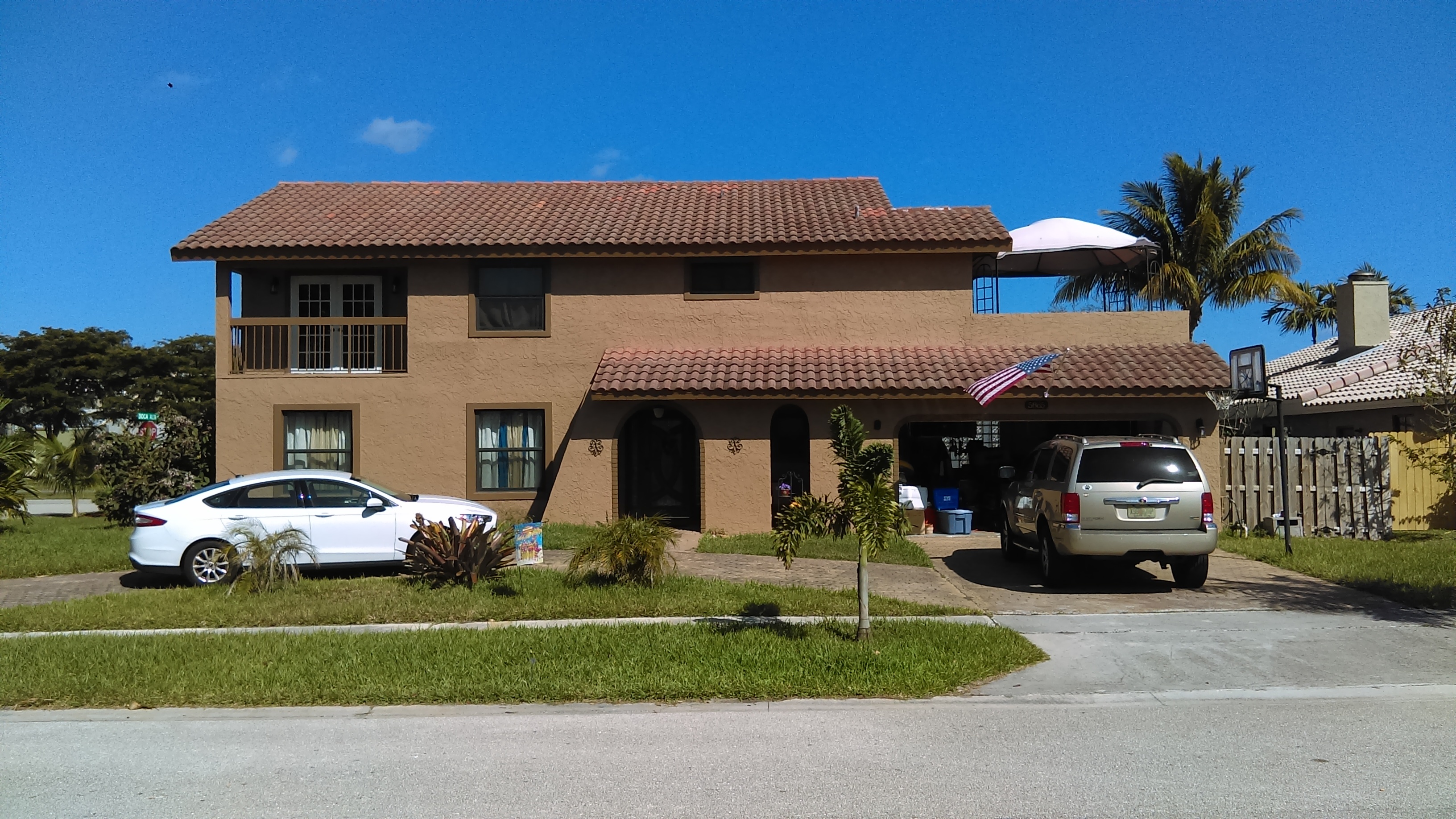
The house in visible light — two-storey stucco, barrel-tile roof, second-floor balcony. Everything wrong with it is invisible from here.
Every energy claim on this site rests on something like this job: a measurement, not an opinion. This 2017 residential audit paired a blower-door depressurization test with FLIR i7 infrared thermography to answer one question — where is this house losing the air the homeowner already paid to cool?
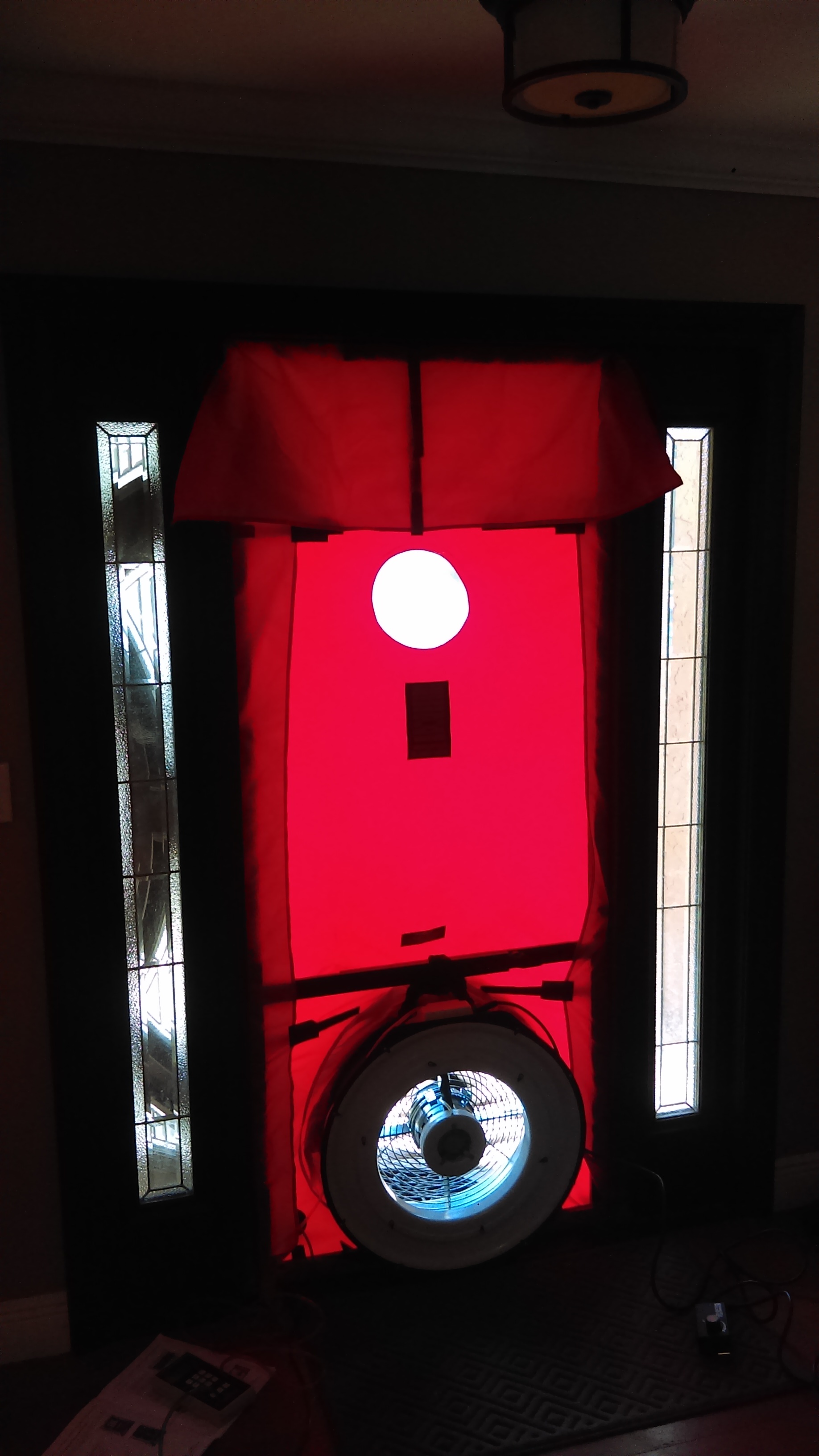
What the blower door does. A calibrated fan is sealed into an exterior doorway and pulls the house to a known negative pressure. Every gap left in the building envelope then draws outside air inward, hard enough to find. That is the “how much.” What the camera does. The incoming air carries the outdoor temperature with it, so a leak that is invisible to the eye becomes a plume on the thermal image. That is the “where.” Run either one alone and you get half an answer; run them together and the house stops being a guess.
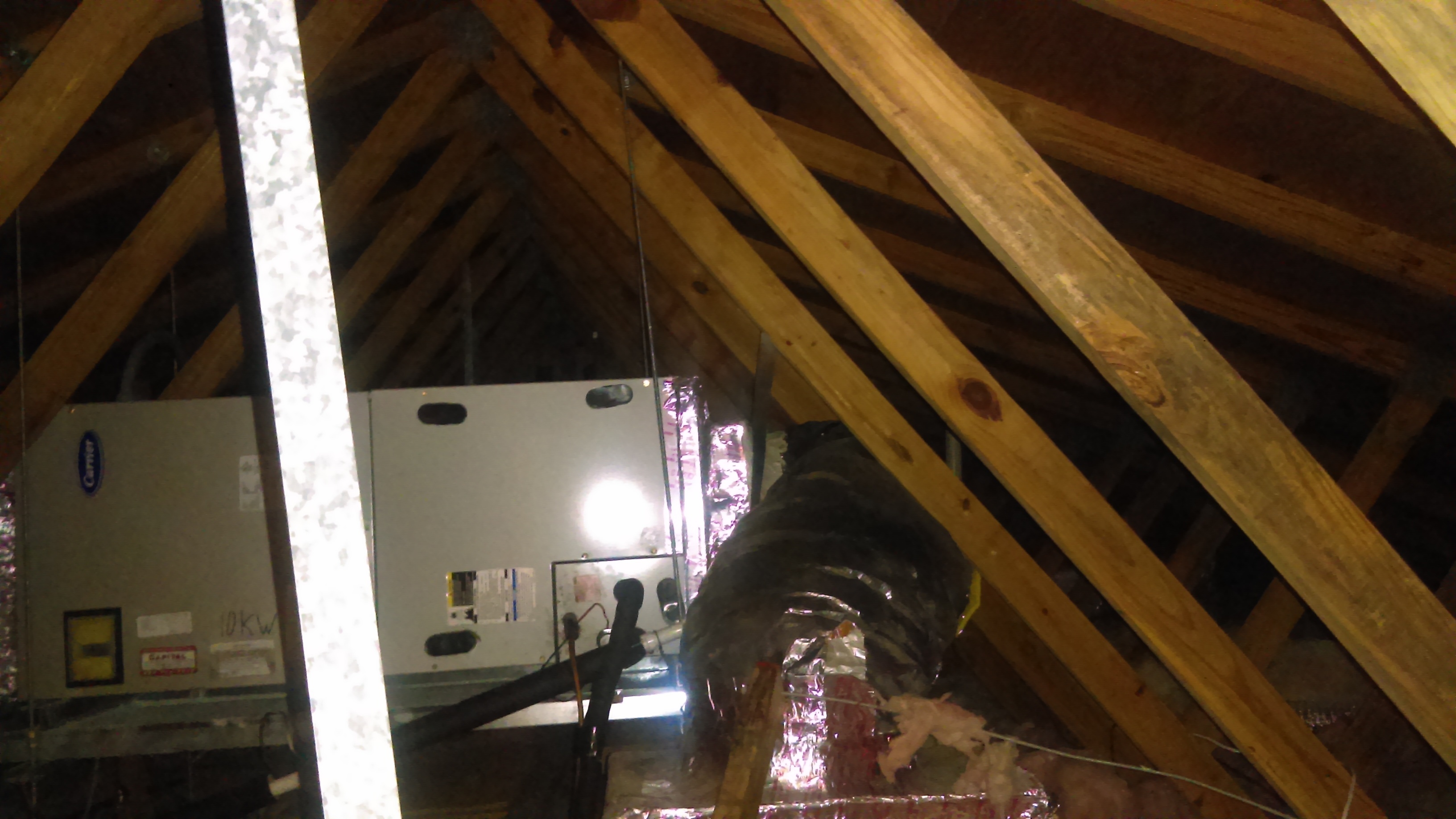
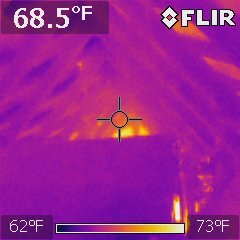
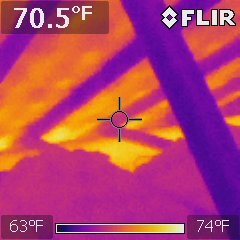
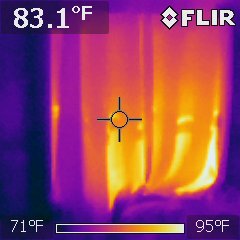
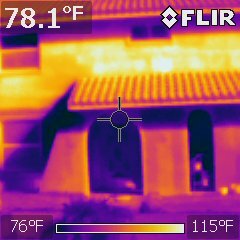
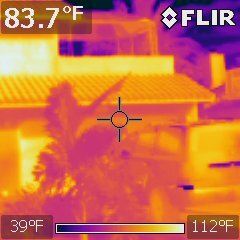
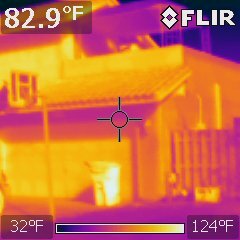
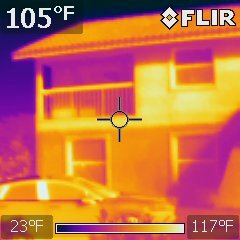
What this house was doing. The scan found the three failures that account for most of a South Florida cooling bill: insulation gaps in the attic around the HVAC ductwork, heat loss at the ridge and along the roofline, and infiltration through wall cavities. The FLIR captures below run from roughly 68°F at the attic ridge to 105°F on the exterior elevation — a spread of nearly forty degrees across one building, on one day, and every degree of it is a load the air conditioner has to carry.
Why this sits on the consulting page. Diagnostic work like this is the floor under both of the energy services offered here. A RESNET® HERS rating is the scored, documented, third-party-registered version of the same investigation — performed by a RESNET® Certified HERS Rater (RTIN 4516301). LEED and green-building consulting starts from the same place: you cannot design or certify performance you have never measured. And because the same person holds a Certified General Contractor licence (CGC1528750), the findings do not stop at a report — the duct sealing, insulation and roof work that the scan calls for can be executed by the firm that found them. If you want the homeowner-facing version of this process, read the home energy audit guide, or see what gets fixed afterwards in energy-efficient home improvement.
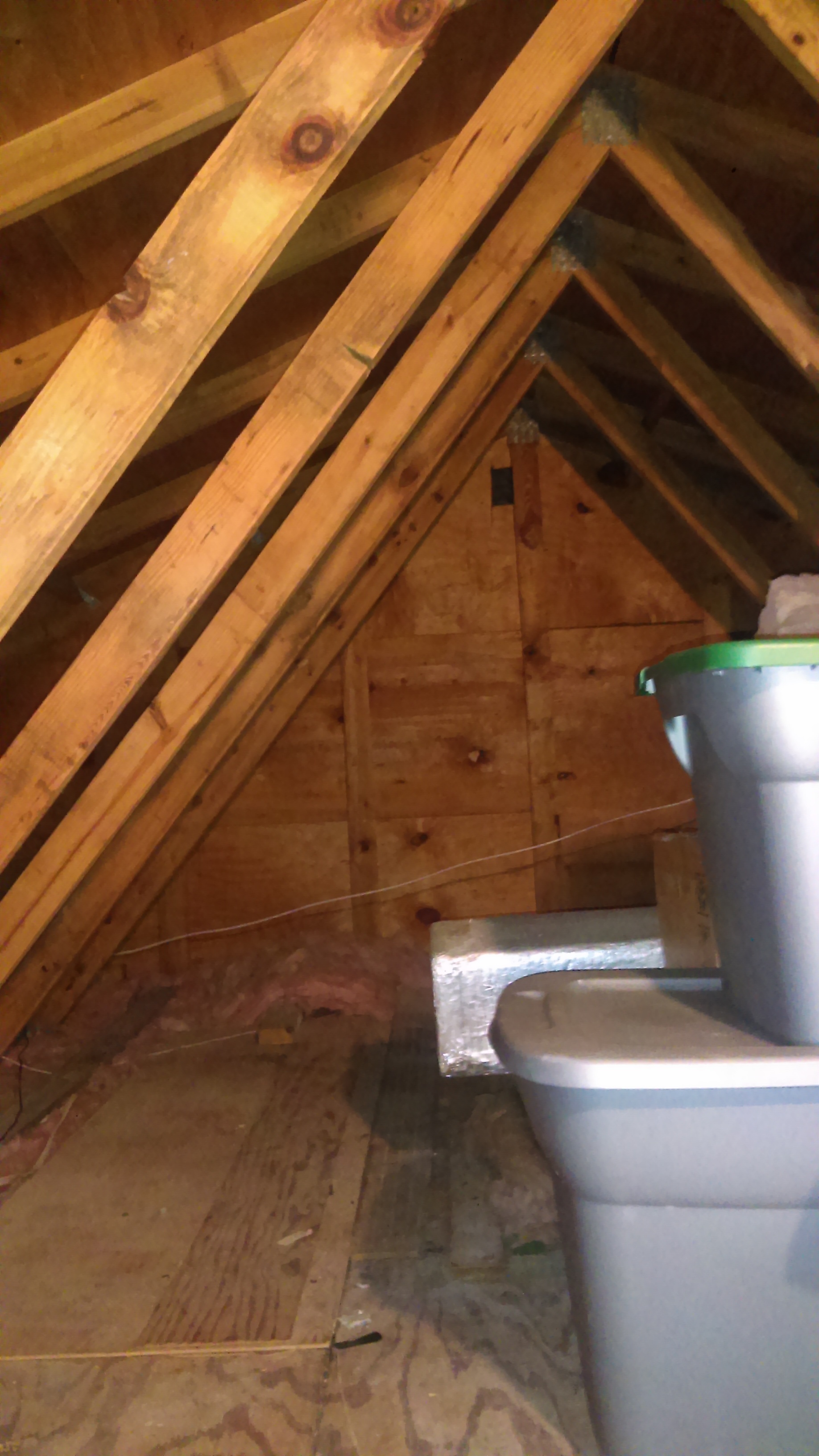
The blower door in the front entry — red panel sealed into the frame, calibrated fan at the bottom, manometer on the floor reading the pressure difference.Air handlers and flex duct living in unconditioned attic space. In a Florida house this is one of the most expensive places to lose conditioned air — and it is where the scan looked first.Inside the attic: framing, sheathing, and insulation that thins out toward the eaves. Thermography turns a judgement call like this into a number.
The Thermal Scan — FLIR i7 Captures
Seven frames from the same visit. Each carries its own spot reading and its own temperature scale, so read the number, not the colour — the palette rescales frame to frame.
Which license, in what order, and what it actually takes to pass — straight from someone holding six of them. The written version is free: the Florida contractor license guide.
02
A bid that won't bury you.
How to price construction and roofing work so the job makes money instead of costing you it — the math from real jobs.
03
Systems for many ventures.
How to run eight divisions under one roof without dropping the ball — delegation, cash flow, and who to hire first.
04
A straight answer.
Including "don't do it," when that's the honest call. No fluff, no upsell — just what worked, what didn't, and why.
Credentials On the Table
CGC1528750 — Certified General Contractor CCC1332751 — Certified Roofing Contractor CAM34850 — Community Association Manager
SL3247858 — Florida Real Estate License MFD1654011 — Mobile Food Dispensing LEED AP — Energy & Environmental Design
See It For Yourself
Don't take the bio's word — watch him work.
Job sites, the farm, the food truck, the wins and the fights — posted straight, unedited, in real time. See how Randolph thinks before you put him in the room.
Keynotes, workshops, one-on-one advisory, or a standing board seat — tell me the audience and the goal, and I'll tell you straight whether I'm the right fit.
A HERS energy rating engagement starts with two measurements, not a guess. Randolph Scott Bell is a RESNET Certified HERS Rater (RTIN 4516301) and an Energy Star v3 Verifier who performs licensed blower-door testing on the home or building in question. The blower door depressurizes the structure with a calibrated fan and measures exactly how much outside air is leaking in through the building envelope — the same test used in the Featured Project above. A separate duct-leakage test checks how much conditioned air the HVAC ductwork itself is losing before it ever reaches a room, often the single biggest hidden loss in a Florida attic. Those two numbers feed the HERS Index, the scored, third-party-registered rating where lower is better — a code-built new home lands around 100 and a net-zero home approaches 0. The HERS Index is the credential that verifies a new home under the Energy Star v3 program, documents Florida Building Code energy-code compliance on new construction, and is increasingly what utility rebate programs and insurance discount programs ask for before they'll pay out. It's a report with a number attached, not an opinion.
LEED green-building consulting is a related but different engagement. As a LEED Accredited Professional, Randolph guides a residential or small commercial project toward the credits that add up to LEED certification — helping choose materials and mechanical, electrical and plumbing systems that earn points, and assembling the documentation a certifying body actually requires to award them. Where a HERS rating measures how a specific house performs today, LEED consulting shapes how a project is designed and built from the start, credit by credit, across energy, water, materials, and indoor air quality. The two overlap — an energy-efficient design earns LEED credits and also improves the HERS Index — but a HERS rating is not itself a LEED submission, and a LEED consultation is not a substitute for the blower-door and duct tests a HERS rating requires.
Owners Representative work is a third kind of engagement, and it draws on a different credential: an active Certified General Contractor license, CGC1528750. Acting as Owners Representative means standing on the owner's side of the table for the length of a construction or renovation project — reviewing contractor bids for what's actually included versus what's quietly excluded, monitoring the schedule and the quality of work as it's built, and coordinating the permitting process with the jurisdiction of record. Plenty of owners-representative services are staffed by project managers who have never held a contractor's license themselves; this one is run by someone who currently holds his own, which changes what he's able to catch in a bid or a punch list — the same trained eye a GC uses to review his own crew's work, turned toward protecting the owner instead.
The clearest example of where these three meet is Randolph's own 1974 West Palm Beach home, retrofitted with an 8kW solar system that now serves seven residents — the same energy-engineering pipeline that runs from a blower-door reading, to a LEED-style systems decision, to a General Contractor executing the retrofit himself, under one roof, on one project. Call (561) 779-3213 to talk through a HERS rating, a LEED consulting engagement, or bringing an Owners Representative onto your next project.
Real Estate & Development Advisory
Most real estate investment advisory splits into two separate relationships: an agent who finds the deal and values it, and a general contractor, hired afterward, who prices and executes the renovation. Every handoff between those two adds a markup and a coordination gap — the agent's number for what the rehab will cost is an estimate from the outside, and the contractor who actually swings the hammer had no say in what was bought or for how much. Randolph Scott Bell holds both sides of that relationship under one active license set: Florida Real Estate Sales Associate license SL3247858, brokered through LoKation, and Certified General Contractor license CGC1528750. The person analyzing the acquisition, pricing the value-add scope, and running the crew that executes it is the same license holder, on the same file, from the first walkthrough to the final punch list.
That matters most on fix-and-flip and buy-and-hold rental investment, where the renovation budget is usually the number that makes or breaks the deal. An agent who has never run a crew is guessing at rehab costs from comps and gut feel. A contractor brought in after closing is pricing a scope he had no hand in shaping and has every incentive to expand. Here, the acquisition analysis and the renovation estimate come from the same person who will be the one holding the crew accountable for the number — under Bell Property Group, the branded division that covers HOA/CAM management, real estate sales, and fix-and-flip renovations that are self-performed rather than subcontracted out to a third-party GC, because the same person already holds the license to do the work himself.
The engagement doesn't have to stop at the closing table or the final inspection, either. BeacCorp Property Management — Randolph's CAM34850 individual and CAB3255 firm licenses — can take over management of the property once it's acquired or renovated, so an investor who wants it can run the whole arc, acquisition through post-close leasing and ongoing management, inside one accountable operation instead of three separate vendor relationships. Just as often, a client only wants one piece of that: help finding and underwriting a deal, or a renovation scope and price on a property they already found, or management on a rental they already own and self-renovated. Any one step stands on its own; nothing here requires buying the whole pipeline to get value from one part of it.
This is built for the buyer type Palm Beach County sees constantly: an out-of-state or first-time investor looking at a rental or flip who doesn't have a trusted local contractor relationship yet, and doesn't want to learn that the hard way after closing. Seventeen years operating in Palm Beach County and a BBB A+ Accredited business rating back the credential stack. No transaction counts, deal examples, or return figures are published here — what's offered is the licensing and operating structure itself: one accountable operation across the acquisition, the renovation, and, if wanted, the ongoing management. Call (561) 779-3213 to talk through a specific property or investment plan.
Multi-Venture Operations Consulting
Running one licensed trade well is hard. Randolph Scott Bell runs eight lines out of the same seat: Certified General Contractor construction and remodeling (CGC1528750), Certified Roofing Contractor roofing (CCC1332751), real estate sales as a licensed Sales Associate (SL3247858, brokered through LoKation), property management and HOA/CAM administration under Community Association Manager and firm licenses (CAM34850 individual, CAB3255 firm), land clearing and site work through Bell Land Services, the working agritourism farm at The Bell Farm, the state-licensed farm-to-table food truck America (MFD1654011), and the energy-engineering and advisory work behind this page itself, backed by a LEED Accredited Professional credential and RESNET Certified HERS Rater status (RTIN 4516301). Six active Florida licenses, eight operating lines, one seat — that is the credential stack Multi-Venture Operations Consulting draws on: not a case study read in a book, but eight state-board renewal cycles, eight sets of insurance and liability exposure, and eight different customer bases run out of the same calendar.
The honest answer to "how do you run this many divisions without dropping the ball" is that no single person actually performs every task in every line at once — the job is deciding which pieces genuinely require the license holder personally (signing a permit, testifying as a construction-defect expert, performing a licensed blower-door test) and which pieces can and should be delegated to crew, subs, or staff working inside a system built once and reused. Bell Construction Group's self-performing crews and owned equipment are the model: rather than subbing out work a CGC-licensed operator can do himself, the same people and equipment get reused across the construction, roofing, and land-clearing lines instead of sitting idle between jobs. That reuse of people, equipment, and process across divisions — not heroics — is what makes this many lines possible from one seat.
None of it holds together without treating each division as its own set of books. A dollar spent on the food truck's commissary has to stay out of the construction division's job costs, and equipment rented for a land-clearing job has to be tracked back to that job, not absorbed into general overhead — the same job-costing discipline a solo GC applies to a single construction job, run in parallel across every line. Cash flow gets managed the same way: a slow month on one line doesn't get papered over by quietly borrowing from another division's receivables, because that is exactly how multi-venture operators lose track of which lines are actually profitable. This is the less exciting half of the advisory, and the half that actually keeps multiple lines solvent at once.
What this engagement is not: a franchise pitch, or a promise that running this many licensed businesses is easy. It's a straight look, from someone who has filed for and holds six active Florida licenses himself — CGC1528750, CCC1332751, CAM34850, CAB3255, SL3247858, MFD1654011 — plus LEED AP and RESNET Certified HERS Rater credentials, at whether taking on a second or third line makes sense for your business, and if so, what actually breaks first when you try. Call (561) 779-3213 to talk through where your operation is today and where you're thinking about taking it.
Consultant or Contractor? When to Hire Which
Hiring a consultant and hiring a contractor are two different agreements, not two names for the same visit. A contractor signs the construction contract, pulls the permit under his own license, and carries the legal and financial responsibility for the finished work — that's what happens when Randolph is retained under CGC1528750 or CCC1332751 to actually build, repair, or replace something. A consultant is paid for judgment: a walkthrough, a bid review, a code opinion, a written finding — with no permit and no construction contract attached to the engagement at all. Knowing which one you actually need before you pick up the phone saves both the caller's time and his.
A consulting engagement is usually the right call in a handful of recurring situations. A buyer under contract on a Palm Beach County resale home who wants a licensed contractor's eye on visible workmanship, obvious code red flags, and energy performance before closing — alongside, never instead of, a licensed home inspection, which is a separate, statutorily defined service this engagement does not replace. An owner who already has a contractor hired and a bid in hand, and wants a second, construction-trained opinion on what that bid actually includes before signing — that's the Owner's Representative engagement described above. A project stuck at permitting, where the value is in correctly reading the Florida Building Code and a jurisdiction's submittal quirks, not in a crew showing up. A finished project with a workmanship dispute, where what's needed is documentation and a professional opinion, not a repair — the construction-defect and expert-witness work covered earlier on this page.
Hiring Randolph as the contractor is the right call once the scope, the price, and the permitting path are already settled and someone actually needs to frame the roof trusses, hang the impact windows, pour the concrete, or run the crew — that's construction, governed by CGC1528750 and CCC1332751, and it moves through a written contract, a deposit, and a permit pulled in his name. See the construction division for that side of the business.
The two roles are kept deliberately separate on any single property. A consulting finding is the client's to take anywhere — to Bell Engineering & Construction for a bid, or to any other licensed contractor, with no obligation either way. That separation is also why a paid consultant reviewing a project shouldn't, in the same breath, be quietly angling to become its contractor: the value of an outside opinion depends on it staying outside. If a consulting engagement turns into construction work afterward, it's because the client asked for a bid on the findings, not because the two were ever the same agreement. Call (561) 779-3213 and describe where you are in the process — buying, bidding, mid-project, or already in a dispute — for a straight answer on which engagement actually fits.
Which Engagement Do You Need?
Not sure if you need a consultant or a contractor?
Describe the property and where you are in the process — buying, bidding, mid-project, or already in a dispute — and you'll get a straight answer on which engagement fits, not a sales pitch for the more expensive one.
What does Randolph Scott Bell speak and consult on?
Building and scaling a contracting or roofing business, real estate and development, running multiple ventures at once, and turning trades and hobbies into licensed, revenue-generating businesses — all from 17 years of hands-on operating experience.
What makes him different from a business coach?
He holds six active Florida licenses and personally built six operating divisions — construction, property management, land services, a farm, a food truck, and real estate. The advice comes from the job site, not a textbook.
Does he take board or advisory seats?
Yes. Randolph is available for board and advisory-panel engagements where construction, real estate, property management, or hospitality expertise adds value.
What areas and audiences does he serve?
Based in Palm Beach County, Florida, and available across the region for conferences, trade associations, company events, and private advisory. Travel considered for the right engagement.
How do I book?
Call (561) 779-3213 or use the booking form above with your audience, date, and goal. You'll get a straight answer on fit and availability. For a keynote or workshop, the keynote speaking page lists the talks, formats, AV requirements and what moves the fee.
Can you help me get my Florida contractor license?
Yes — that's the most common mentorship request. The work is choosing the right classification for the experience you can actually document, assembling the experience affidavits the board will accept, handling the financial-responsibility requirement, and sequencing the three exam parts sensibly. Most of it is written out free in our Florida contractor license guide; call (561) 779-3213 if you want a second set of eyes on your own file.
Do you consult for contractors who compete with you?
Outside Palm Beach County, freely. Inside it, we talk about it up front — mentoring a direct competitor in the same trade and the same towns isn't fair to either of us, and it's better to say so on the first call than to discover it later. Contractors in other counties, other trades, or other stages of growth are welcome.
What does a mentorship engagement actually look like?
It starts with one call to establish where you really are — licensed or not, bidding profitably or not, hiring or drowning. From there it's usually a working rhythm rather than a course: reviewing real bids, real contracts, and real numbers as they come up, and deciding what to fix first. Format and length are set to the problem, not to a package.
What does a construction consultant in Palm Beach County actually do?
As a construction consultant Palm Beach County contractors, boards, buyers and attorneys turn to for the harder question, Randolph Scott Bell reviews bids, reads Florida Building Code and permitting questions specific to the county's dozens of incorporated jurisdictions, documents construction defects, and — through the energy-engineering background behind this page — advises on biomass power plant and waste-to-energy plant feasibility and EPC advisory. It is advisory work: no permit is pulled and no construction contract is signed under a consulting engagement.
Why hire a Palm Beach County-based construction consultant instead of a national firm?
Palm Beach County is a patchwork of dozens of incorporated cities, each running its own permit submittal process alongside the county's own building division — local jurisdiction knowledge matters. That's paired here with active Florida Certified General Contractor (CGC1528750) and Certified Roofing Contractor (CCC1332751) licenses, so the opinion comes from someone who currently builds and permits in these same offices, not a national firm reading code from a manual.
What does speaking or consulting cost?
It depends entirely on the engagement — a single keynote, a workshop, an ongoing advisory relationship, and a board seat are four different commitments. Call (561) 779-3213 or send the details through the form above and you'll get a straight number and an honest read on whether it's worth it for you.
What does a construction-defect expert witness do, and why do the licenses matter?
A construction-defect expert witness reviews disputed workmanship or code-compliance issues, documents what was found, and offers a technical opinion in support of a legal or insurance dispute. Randolph's active Certified General Contractor (CGC1528750) and Certified Roofing Contractor (CCC1332751) licenses are the same state credentials the contractor whose work is in question would hold, so the opinion comes from someone who has actually built and inspected this kind of work, not only reviewed it on paper. He is not an attorney and does not provide legal advice.
Does he only review construction in Palm Beach County, or elsewhere in Florida too?
Statewide. CGC1528750 and CCC1332751 are Florida state certifications, not county registrations, so the same license that lets him build in Palm Beach County lets him evaluate and consult on construction-defect and code questions anywhere in the state.
What does permit and code consulting cover, and who is it for?
Reading and explaining how the Florida Building Code applies to a specific project, structuring a permit submittal to clear review the first time, and understanding what an inspection will check for and when. It's built for homeowners facing a rejected or confusing submittal, condo or HOA boards weighing a project against code and permitting reality, and other contractors working outside their usual jurisdiction.
What does a HERS energy rating engagement involve?
A blower-door depressurization test to measure air leakage through the building envelope, plus a duct-leakage test to measure how much conditioned air the HVAC ductwork is losing, performed by a RESNET Certified HERS Rater (RTIN 4516301) who is also an Energy Star v3 Verifier. The results produce a HERS Index score used to verify Energy Star v3 homes, document Florida Building Code energy-code compliance on new construction, and qualify for utility or insurance efficiency programs.
What's the difference between HERS rating and LEED consulting?
A HERS rating measures how a specific home performs today, scored on the HERS Index from blower-door and duct-leakage testing. LEED consulting, performed here by a LEED Accredited Professional, guides a residential or small commercial project's design and material choices toward the credits needed for LEED certification. They overlap — efficient design helps both — but one is a performance measurement and the other is a certification pathway.
What does an Owners Representative do, and why does the GC license matter?
An Owners Representative acts on the property owner's behalf during a construction or renovation project: reviewing contractor bids, monitoring schedule and quality as the work is built, and coordinating permitting with the jurisdiction of record. Because Randolph holds his own active Certified General Contractor license (CGC1528750), he brings a working contractor's eye to that review, not just a project-management background.
What does real estate & development advisory include?
Acquisition analysis and underwriting on a prospective purchase, a renovation value-add scope and cost estimate, self-performed execution of that renovation, and, if wanted, ongoing property management once the property is acquired or renovated. Any one piece stands alone; a client can use just the acquisition help, just the renovation, or just the management.
How is this different from just hiring a real estate agent?
A typical agent hands the renovation off to a contractor after closing, adding a markup and a coordination gap between the person who valued the deal and the person who executes the fix. Here, the Florida Real Estate Sales Associate (SL3247858) and the Certified General Contractor (CGC1528750) are the same license holder, so the acquisition analysis and the renovation scope and price come from one accountable operation.
Can Randolph act as both my agent and my contractor on a renovation project?
Yes. His real estate license is brokered through LoKation, and his General Contractor license is separately active, so the same person can represent you in the purchase and self-perform the renovation afterward rather than subcontracting it out to a third-party GC.
Do you work with out-of-state or first-time Palm Beach County investors?
Yes — that's a common client here: an investor who doesn't yet have a trusted local contractor relationship for a rental or flip. Seventeen years operating in Palm Beach County and a BBB A+ Accredited business rating back the credential stack behind the acquisition, renovation, and management work.
What licenses back the real estate advisory work?
Florida Real Estate Sales Associate SL3247858 (brokered via LoKation) and Certified General Contractor CGC1528750 for the acquisition and renovation sides, plus CAM34850 (individual) and CAB3255 (firm) through BeacCorp Property Management if ongoing management is part of the engagement.
How does someone running one business benefit from advice from someone running six?
The lessons that transfer aren't line-specific — they're operational: job-costing discipline, knowing which tasks require your own signature and which can be delegated, and keeping cash flow honest across more than one revenue stream. A single-line operator gets the same discipline applied to their one business, learned from someone who has had to apply it to eight.
Does the engagement cover cross-training staff across divisions?
It can. Cross-training that lets a crew member move between construction, roofing, and land-clearing work, or lets an office role cover more than one division's paperwork, is one of the practical ways a smaller operation stretches its payroll further — and it's something Randolph has had to build for his own crews.
How is licensing and insurance kept straight across eight business lines?
Each line carries its own license and its own liability exposure — a roofing job and a food truck event don't sit on the same insurance policy, and a property-management engagement doesn't get covered by a general contractor's coverage. Keeping that separation clean, line by line, is a compliance discipline in its own right, and it's part of what this engagement walks through.
Is this available as a one-time audit versus an ongoing retainer?
Both. Some clients want a single sit-down to pressure-test whether a second business line makes sense before they commit to it; others want an ongoing relationship as they scale into it. Call (561) 779-3213 to talk through which fits.
What does a typical first conversation cover?
Where your business or businesses stand today, what's actually working versus what's being propped up, and where the real bottleneck is — licensing, cash flow, staffing, or simply too many lines for one calendar. It's a straight conversation, not a sales pitch.
Why is running eight business lines under six Florida licenses considered rare?
Most operators specialize because each license carries its own continuing-education, renewal, and insurance burden, and stacking multiple active licenses multiplies that compliance load rather than adding it once. Holding CGC1528750, CCC1332751, CAM34850, CAB3255, SL3247858, and MFD1654011 simultaneously, on top of LEED AP and RESNET HERS Rater credentials, means carrying all of that regulatory overhead at once — which is exactly the operational discipline this consulting engagement teaches.
How is hiring you as a consultant different from hiring you as my contractor?
As a contractor, Randolph signs the construction contract, pulls the permit under his own CGC1528750 or CCC1332751 license, and carries legal and financial responsibility for the finished work. As a consultant, he's paid for a walkthrough, a bid review, or a written opinion — no permit and no construction contract attached. The two are separate agreements, never the same visit.
Can I get a pre-purchase consultation on a home I'm considering buying in Palm Beach County?
Yes. A licensed contractor's walkthrough can flag visible workmanship issues, obvious code concerns, and energy performance red flags before you close — but it runs alongside a licensed home inspection, not instead of one; a home inspection is a separate, statutorily defined service this engagement does not replace.
If your consulting review finds a problem, am I obligated to hire you to fix it?
No. Consulting findings belong to the client and can be taken to any licensed contractor for bids, including Bell Engineering & Construction. The consulting engagement and any later construction contract are always separate agreements.
Can the same engagement have you as both my paid consultant and my contractor?
No, not at the same time on the same review. The value of an outside opinion depends on it staying outside — a consultant quietly angling to become the contractor undermines the point of paying for independent judgment. If a client wants a construction bid after a consulting finding, that's handled as its own, separate engagement.
What does a pre-purchase or pre-renovation consulting walkthrough cost?
It depends on the property's size, age, and what's being reviewed — a workmanship walkthrough, a bid review, and an energy assessment with blower-door testing are different scopes. There's no set price published here; call (561) 779-3213 with the property and the timeline and you'll get a straight number.
Who is the construction consultant for Palm Beach County owners?
Randolph Scott Bell: a Florida certified general contractor (CGC1528750), RESNET certified HERS Rater (RTIN 4516301), LEED Accredited Professional, with a B.S. in Engineering and an MBA, and 17 years building businesses in Palm Beach County. The work is advisory: bid leveling, pre-construction review, energy testing and owner-side guidance. The local guide is at /consulting/construction-consultant-palm-beach-county/.
Do you consult on biomass and waste-to-energy plants?
Yes, as advisory work only: feasibility review, owner's-representative support and EPC review for owners and developers, drawing on a Danish energy-engineering career in waste-to-energy and biomass boiler plants. Consulting does not mean building or operating a plant. See the biomass power plant and waste-to-energy consulting pages.
Should I hire a consultant or a contractor first?
Hire a consultant when the question is whether the scope, bids or contract are right, before you commit. Hire a contractor once the scope is settled and you need the work built. The construction consultant guide explains how to decide.
Do you test energy performance as well as review construction?
Yes. Randolph is a RESNET certified HERS Rater (RTIN 4516301) and performs blower-door testing. See the HERS energy rating and blower-door testing pages for what each involves.