Not every overgrown lot needs to be hauled off. Forestry mulching and brush hogging grind brush, palmetto, vines and small trees down where they stand, leaving a layer of mulch instead of a bare, trucked-out lot. Bobcat T740 with a 60" grapple, $385/day with an operator. (561) 779-3213.
"Forestry mulching" and "brush hogging" both describe grinding vegetation down where it grows instead of cutting it and trucking it away. Brush, palmetto, vines, saplings and smaller trees are ground into mulch and left on the lot — a layer that suppresses regrowth, holds moisture, and skips the dump-run and tipping-fee side of the bill entirely. It's the right call for a lot you're reclaiming or maintaining rather than one you're grading down to bare dirt for a foundation.
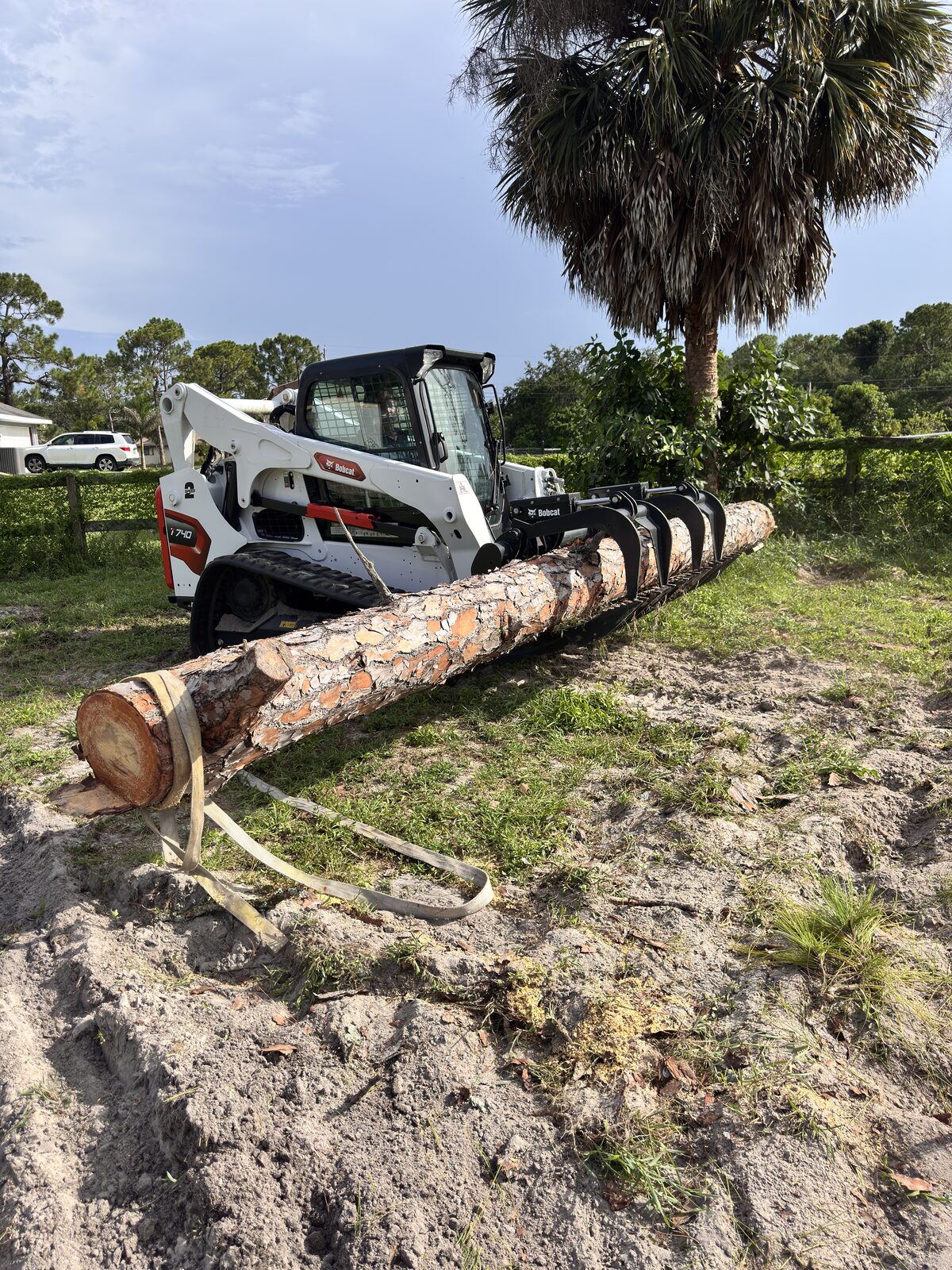
Our Bobcat T740 with its 60" grapple handles the mechanical side of this work — pulling and staging dense growth so it can be ground down efficiently. The rate is the same flat $385/day with an operator that anchors every land-services quote we write, whether the job is an overgrown pasture, a fence line that's disappeared into brush, or a back half of a lot nobody has walked in years.
Mulching isn't the answer for every lot. If you're building soon, the ground usually needs to be grubbed — stumps and roots pulled, not just ground down — and hauled clean before grading and fill dirt work can start; see our fill dirt & excavation page for that next step. And if the real job is a single lot with lighter growth rather than a mulching-scale project, our lot clearing page may be the closer match. We'll tell you honestly which approach fits your lot on the free walk-through — 811 gets called before anything digs, either way.
Forestry mulching grinds brush, palmetto, vines, saplings and small trees down where they stand, leaving mulch on the ground instead of hauling the material off site. It's a mechanical alternative to cutting and trucking.
The terms are often used interchangeably for mechanical clearing that leaves debris in place rather than hauling it away. Both describe the same end result — cleared ground with mulch or ground material left behind instead of a bare, trucked-out lot.
Our Bobcat T740 with a 60" grapple runs $385 per day, including an experienced operator — the same flat rate as our other land services. How many days it takes depends on the acreage and how dense the growth is.
Usually, yes — mulching skips the dump-run and tipping-fee side of a clearing job, since the material stays on the lot instead of being trucked to a disposal site. It's the cheaper option when you're not building on the lot right away.
Generally no — mulching grinds down what's above ground. If you need the ground truly build-ready with stumps and roots pulled, that's grubbing, which is priced and scoped separately.
Fresh mulch is denser and holds more moisture than standing dry brush, so it's generally considered lower risk than the overgrowth it replaced — but any debris pile can dry out over time. Ask us about spreading versus piling if fire risk is a concern for your property.
Yes — fence-line clearing is one of the most common brush-hogging calls we get. Vines and brush along a property line get ground down so the line and the fence are visible and maintainable again.
It depends on what's being ground down and where. Removing invasive exotics is usually straightforward, but protected native trees and wetland-adjacent ground can still trigger a review even when the material stays on site. See our permits & regulations guide for the details.
All of Palm Beach County — Loxahatchee, The Acreage, Wellington, Royal Palm Beach, Jupiter, West Palm Beach, Boynton Beach, and the rest of the county.