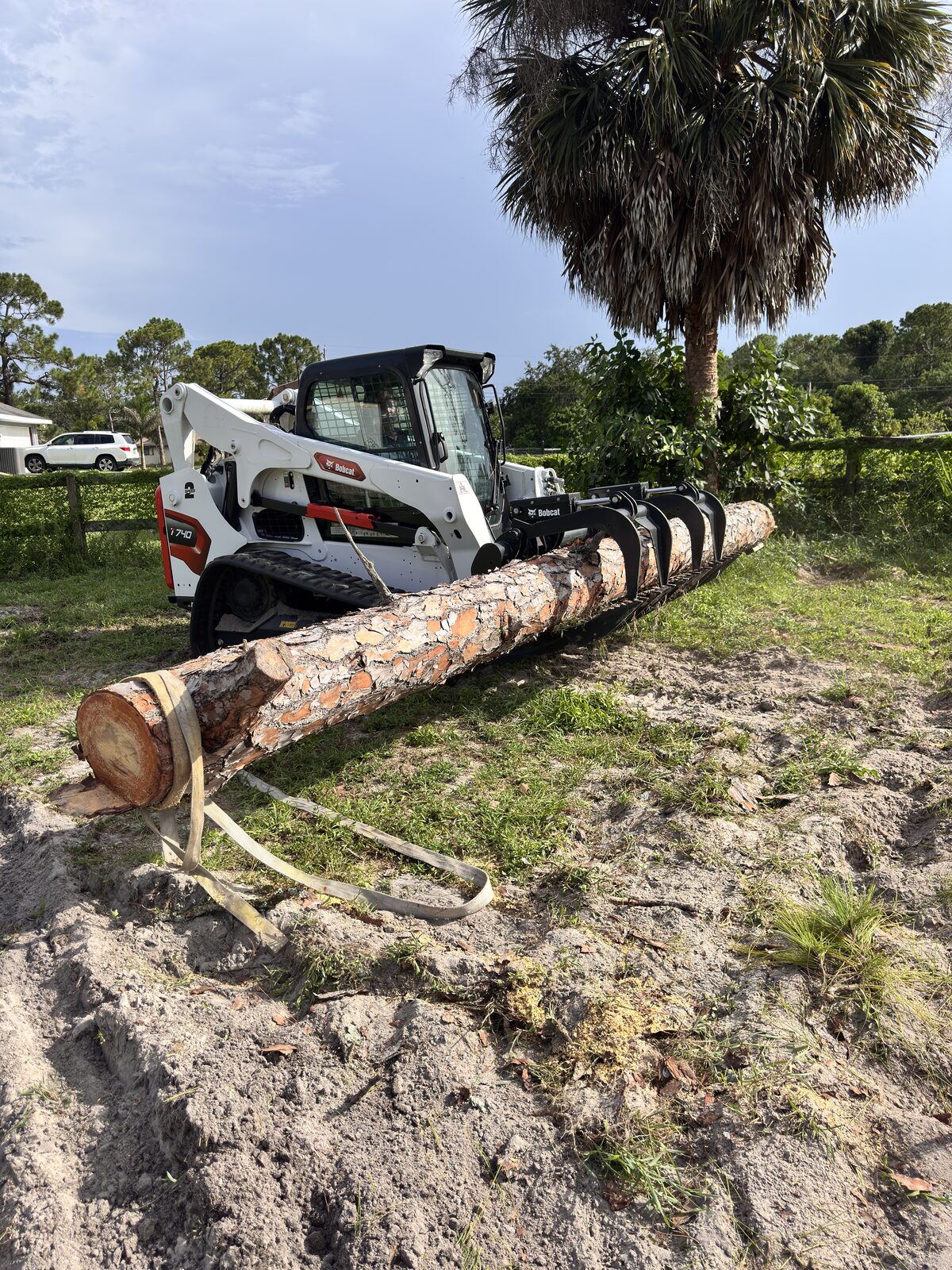
Two very different lots share one name. A gated, HOA-governed acre near the Loxahatchee River and a one-acre-plus equestrian parcel off Indiantown Road both get called "Jupiter" — but they don't answer to the same desk, and a crew that doesn't know the difference will either quote you wrong or clear something it shouldn't have touched. Bobcat T740 with a 60" grapple, $1,385/day with an operator. (561) 779-3213.
"Jupiter" on a mailing address does not tell you who regulates your lot, and for land clearing that matters more here than almost anywhere else in Palm Beach County. The Town of Jupiter proper — Abacoa, the coastal neighborhoods, the gated communities along the Loxahatchee River — is an incorporated municipality with its own Planning & Zoning department and its own vegetation ordinance. Jupiter Farms, the horse-country community fifteen square miles west of the Turnpike, is unincorporated Palm Beach County. Same ZIP-code area, two different agencies, two different permit processes.
The lots look different too. A Jupiter Farms parcel is typically an acre or larger — agricultural-reserve zoning, horses on the property, a back half that has grown into palmetto and pepper thicket. A lot inside the Town, whether in an older charter neighborhood or a deed-restricted community like Abacoa or Admirals Cove, is usually smaller and the clearing scope is one or two problem trees, a hedge line, or site prep ahead of a remodel — work that pairs naturally with our contracting side in Jupiter.
Tell us the address and roughly what is on it, and the first thing we tell you back is which desk you're dealing with — before a number gets written. Free lot walk, straight answer. (561) 779-3213.
The T740 grapple lifting a pine log. Same machine, same operator that comes north to Jupiter and Jupiter Farms.
What Is Actually Growing on Your Lot
Jupiter sits on the sandy pine-flatwoods ridge that runs the length of the county, with the Loxahatchee River cutting through the western and coastal edges — so the plant list is close cousin to what we clear in Loxahatchee and The Acreage, with one addition the river brings.
Usually cleared freely
The invasive exotics
Brazilian pepper and melaleuca are the two that own most neglected Jupiter Farms back-lots. Australian pine and earleaf acacia show up along old fence rows and canal banks, and both are a real hurricane hazard standing near a structure.
Protected — check first
The natives — and the mangroves
Slash pine, live oak, sand pine, cabbage palm and saw palmetto make up the native canopy the Town's ordinance exists to preserve. On any lot touching the Loxahatchee River, add mangroves to the list — the Town does not issue permits to remove them at all; that authority sits entirely with the Florida Department of Environmental Protection.
The practical read: in Jupiter Farms, most of the volume you're paying to remove is invasive exotic and most of the permit risk is native canopy — same math as Loxahatchee. Inside the Town, the calculus shifts toward a smaller number of specific trees, because Chapter 26 names caliper thresholds rather than treating the whole lot as one green mass.
The Jobs a Jupiter Lot Actually Asks For
Naming which of these is yours is what turns a wide range into a real number.
1 · The equestrian back-lot
Jupiter Farms' bread and butter. Pulling brush and pepper off a paddock, opening a sightline, clearing a fence line ahead of installing fencing. Mulch-in-place usually wins — cheaper, and the layer holds regrowth back on ground horses will stand on.
2 · The build pad or remodel clearing
A house, addition or accessory structure is coming, in-town or on acreage. Stumps grubbed, debris hauled, ground graded level. If a Jupiter remodel or new build is the plan, the clearing and the building permit are one conversation.
3 · The driveway and canal-front access
Long Jupiter Farms drives and second entrances, where a culvert crosses a South Indian River Water Control District swale before it ever touches your property. Getting a machine on and off the lot without damaging that infrastructure is planned before the trailer is booked.
4 · The fire break and perimeter
Dry-season pine flatwoods carry fire, and a wall of Brazilian pepper against a barn or house is fuel with a property line drawn through it. One of the highest-value, lowest-cost jobs on a Jupiter Farms lot.
5 · The problem tree, in town
Inside the Town of Jupiter, the call is more often one or two specific trees — storm-damaged, root-heaving a driveway, or blocking a remodel's footprint — than a whole lot. That is exactly where Chapter 26's caliper rule decides whether a permit applies.
And the sixth: after the storm
Downed Australian pine across a Jupiter Farms drive, storm debris on a canal-front lot. Priced by the day, and it arrives on its own schedule between June and November.
Usually one to two days — effectively our $1,385 day rate with an operator included.
Moderate — most common here
Palmetto, saplings, thick undergrowth
$6,000–$12,800 · 1-acre lot
Two to three days grubbed and hauled — the band a neglected Jupiter Farms back-lot normally falls into.
Heavy
Mature pines, oaks, deep stumps
$11,800–$22,500 · 1-acre lot
Multi-day, and the band where specimen-tree mitigation belongs in the budget rather than a surprise.
In-town jobs in Jupiter proper — Abacoa, the older charter neighborhoods, the gated communities — are usually priced by the tree or by the day rather than by the acre, since the lots are smaller and the scope is narrower. The free walk is what turns either kind of lot into one number.
🧮
Want your own number before you call? The estimator on the main land page takes three taps and gives you the same range we would quote on the phone, no email required. Price your lot ↗
Two Rulebooks Under One Name
Inside the Town of Jupiter — Abacoa, the coastal neighborhoods, Jonathan's Landing, Admirals Cove, Egret Landing, Indian Creek, Maplewood and the streets along the Loxahatchee River — clearing and tree removal run through the Planning & Zoning Department under Chapter 26 of the Town Code, "Vegetation and Environmental Preservation." It is unlawful to remove trees, vegetation or clear land without a Vegetation Removal Permit first. Naturally occurring native trees — laurel oak, live oak, scrub oak, sand pine, sweet bay, red bay, sea grape, gumbo limbo, mahogany, turkey oak — with a caliper of four inches or more, measured 4½ feet above grade, are protected by default, and trees at 28 inches DBH or larger get particular weight in the review. Designated specimen and historic trees carry their own protections under Section 26-122. Mangroves are never permitted for removal by the Town at all; that sits with the state.
A handful of older, "charter" neighborhoods are the exception — Pine Gardens North and South, East View Manor and Jupiter River Estates among them. These developed before the preservation ordinance existed, so removing a tree on an already-developed lot in one of them generally does not need a Town permit. Undeveloped or non-residentially-zoned parcels inside those same neighborhoods still do.
Jupiter Farms is not in the Town at all. It is unincorporated Palm Beach County — the Town's own published guidance sends Jupiter Farms residents to county code enforcement, not to Jupiter Planning & Zoning. For clearing specifically that means the same two county desks we work with in Loxahatchee and The Acreage: Environmental Resources Management for native vegetation under ULDC Article 14.C/14.D, and the Zoning Division for the Tree Removal & Replacement Permit under Article 7.
One practical result: a lot mailed "Jupiter" and a lot mailed "Jupiter Farms" a few miles apart can answer to entirely different departments, different ordinances and different permit forms. We check the parcel record before we quote, not after. For the building-side view of the same jurisdiction split — permitting, wind zone, coastal rules — see our contractor page for Jupiter.
HOA Rules, and Who Actually Signs Off
Most of the Town of Jupiter's residential land is inside a homeowners association, and the Town's own tree policy for HOA communities draws a clean line: you can generally remove a tree on your own lot without a Town permit, but your HOA's architectural approval is still required. Street trees — the ones in the green space between sidewalk and road — and vegetation in common areas are different: those need a Town Vegetation Removal Permit, and the HOA is the one that applies for it, not the individual homeowner.
Deed-restricted communities run their own review on top of that. Abacoa is a Traditional Neighborhood Development with strict architectural standards; gated communities like Jonathan's Landing, Admirals Cove and The Loxahatchee Club run their own boards. We prepare whatever the board asks for and keep the HOA approval moving alongside the Town permit so the two don't stall each other. Jupiter Farms has no comparable architectural review layer — its HOA structure, where one exists at all, is far lighter, and the constraint out there is the county's vegetation rules, not a design committee.
The Swale, the Culvert, and Getting a Machine Onto Your Lot
Jupiter Farms, Palm Beach Country Estates and Egret Landing sit inside the South Indian River Water Control District, which maintains roughly 189 miles of roads and over 375 miles of swales and canals across the community. As in The Acreage under ITID, those swales are drainage infrastructure, not spare yard, and the culvert under your driveway is the only bridge between the road and the work.
Every load the T740 brings in or takes out crosses that culvert. We plan the trailer route, staging and culvert protection before the machine is booked — a crushed culvert or rutted swale becomes the District's problem, then yours. Clearing, filling or driving equipment across a District easement generally needs District permission in its own right, separate from any county vegetation approval on the lot itself. The District's office is out on Jupiter Farms Road if a driveway or culvert question needs a direct answer.
Inside the Town of Jupiter, drainage runs through the Town's own Public Works and stormwater system rather than an improvement district — one more reason the same word, "Jupiter," can mean two completely different sets of contacts depending on which side of the Turnpike your lot sits on.
🐢
Two things that stop the machine, not the paperwork. A gopher tortoise burrow — the half-moon opening with an apron of sand, common in Jupiter Farms' sandy soil — must go through the FWC's permitting and relocation process by an authorized agent before ground is disturbed. Nesting birds are protected under state rule and federal law. And on any lot touching the Loxahatchee River, mangroves do not come down for a land-clearing job, full stop — that call belongs to the Florida DEP alone. On our walk we flag all three before any number gets written.
Timing It — Wet Season, Dry Season
From roughly June through October, Jupiter Farms ground holds water and a track loader on saturated soil can rut a property badly enough that the repair outlasts the memory of the clearing. November through May, the same lot is firmer, faster and cleaner to work. The T740's tracks spread weight far better than a wheeled skid-steer, but no machine outruns standing water — on a heavy wet-season job, waiting a dry week is sometimes the smartest call we can make for your lot, and we will say so even though it delays our own invoice.
Dry season is also fire-break season, and wet season overlaps hurricane season, when storm cleanup jumps the queue. A non-urgent Jupiter Farms back-lot job books friendlier in January than in September.
How a Jupiter Clearing Job Actually Runs
The order of operations, with the local steps a generic clearing page leaves out.
1 · We stand on the lot with you
Free, before a number is written. Invasives separated from protected natives out loud, burrows and river frontage flagged, and your real scope named.
2 · Parcel record, first
Property Appraiser lookup for Town of Jupiter vs. unincorporated Jupiter Farms, plus zoning and HOA status — the facts that decide which desk you're calling.
3 · The right desk, in writing
Town Planning & Zoning and the HOA if you're inside Town limits; PBC Environmental Resources Management and Zoning if you're in Jupiter Farms. SIRWCD separately if a culvert or swale is in scope.
4 · 811 before anything digs
Free Sunshine State One Call locate ticket, full statutory notice period. Grubbing stumps and setting posts both count as excavation.
5 · Access, staging, then work
Trailer route and culvert protection set, staging placed on ground that can take it, then the grapple starts. Flagged zones — burrows, mangroves, protected canopy — stay untouched.
6 · Hauled off or mulched in — and the file
Grub and haul for a build-ready pad; chip and mulch for pasture or a break. Then the paperwork worth keeping: permit numbers, the 811 ticket, dated before-and-after photos.
Who Calls Us Here
Jupiter Farms owners
The back half, and the paddock
Selective clearing, invasives out, a fence line ready for installation, footing that drains.
Town of Jupiter homeowners
One tree, ahead of a remodel
A storm-damaged specimen tree or a hedge line cleared ahead of a construction project, HOA and Town approvals handled alongside it.
Buyers
Before you close
A walk during the inspection period tells you what a Jupiter Farms lot will cost to make usable, and which jurisdiction it falls in.
Builders
Pad, drive, access
Grubbed, graded and build-ready, with demolition of old outbuildings handled by the same licensed GC, CGC1528750.
Equestrian & agritourism
Working ground, close to home
Jupiter Farms borders our own yard and The Bell Farm in Loxahatchee — the machine doesn't travel far to reach it.
After a storm
Everyone at once
Downed pine across a Jupiter Farms drive, debris where the truck needs to be. Priced by the day.
Ten Questions to Ask Any Clearing Outfit in Jupiter
1 · Is my lot in the Town of Jupiter or unincorporated Jupiter Farms — and how did you check? The Property Appraiser record answers it; "Jupiter" on the mailbox doesn't.
2 · Which trees on this lot are protected by caliper, and which aren't? Inside Town limits that's a Chapter 26 question with a four-inch threshold, not a guess.
3 · Does my HOA need to sign off, and does the Town also need a permit? Both can apply at once, and they're not the same approval.
4 · Is any of this a mangrove, or does it touch the Loxahatchee River? If so, that decision belongs to the state, not to us or to you.
5 · How does your equipment get on the lot, and who's responsible if a culvert cracks? In Jupiter Farms, that's a South Indian River Water Control District question.
6 · Who calls 811, and when? The locate ticket needs its full statutory notice period.
7 · Are stumps cut or grubbed in this price? Two different jobs, two different numbers.
8 · Where does the debris go, and are tipping fees included? Haul-off and mulch-in-place are two different, regulated decisions.
9 · What's your license number, and are you insured? Ours is CGC1528750, verifiable on the state DBPR site.
10 · If you find a tortoise burrow, what happens? Work stops in that zone and it gets properly assessed first.
The Local Numbers Worth Having
Verify these against each agency's current listing. The county-side directory, including SFWMD and FWC, is in the permits guide.
The walk is free, and figuring out whose rulebook applies is half of it. We check the parcel record, separate invasives from protected natives, flag burrows and river frontage, and tell you honestly which desk to call — before any money changes hands. Bobcat T740 with 60" grapple and operator, $1,385/day. Licensed & insured, CGC1528750, a Florida corporation formed in 2009, BBB A+ Accredited Business.
The full permitting picture for Palm Beach County — ERM vs Zoning, thresholds, wetlands, wildlife, burning, penalties, and a nine-step pre-clearing checklist.
The building-side view of the same Town/county split: permitting, coastal wind-zone rules, impact windows, re-roofs and remodels.
Land Clearing in Jupiter — FAQ
Do I need a permit to clear land or remove trees in the Town of Jupiter?
Generally, yes. Under Chapter 26 of the Town Code, it is unlawful to remove trees, vegetation or clear land without a Vegetation Removal Permit from the Planning & Zoning Department. Native trees — species like laurel oak, live oak, sand pine and gumbo limbo — with a caliper of four inches or more are protected by default, and trees at 28 inches DBH or larger get extra scrutiny. A handful of older "charter" neighborhoods, including Pine Gardens North/South, East View Manor and Jupiter River Estates, are exempt on already-developed lots because they predate the ordinance.
Is Jupiter Farms inside the Town of Jupiter, or does it follow different rules?
Jupiter Farms is unincorporated Palm Beach County, not part of the Town — the Town's own guidance directs Jupiter Farms residents to county code enforcement rather than Town departments. For land clearing that means Palm Beach County's Environmental Resources Management and Zoning Division, the same desks we work with in Loxahatchee and The Acreage, not the Town's Chapter 26 process.
Can I remove a tree on my lot if I live in an HOA community like Abacoa or Admirals Cove?
Usually you can remove a tree on your own residential lot without a separate Town permit, but your HOA's architectural approval is still required. Street trees in the right-of-way and vegetation in common areas are different — those need a Town Vegetation Removal Permit that the HOA applies for, not the individual homeowner. Deed-restricted communities like Abacoa also run their own architectural review on top of that.
Can you clear mangroves along the Loxahatchee River?
No, and no local contractor can authorize that on their own. The Town of Jupiter does not permit mangrove removal at all — that authority belongs entirely to the Florida Department of Environmental Protection. On any river-frontage lot we flag mangrove stands on the walk and leave them untouched.
Who handles the swales and canals in Jupiter Farms — can you clear those?
Jupiter Farms, Palm Beach Country Estates and Egret Landing sit inside the South Indian River Water Control District, which maintains the roads, swales and canals across the community — over 375 miles of them. Clearing, filling or crossing a District easement with equipment generally needs District permission in its own right, separate from any county vegetation approval on the lot itself.
How much does it cost to clear a Jupiter Farms lot?
On the roughly one-acre lots common in Jupiter Farms, our published per-acre bands run about $2,500–$6,500 for light grass and brush, $6,000–$12,800 for the moderate palmetto-and-undergrowth case a neglected back-lot usually is, and $11,800–$22,500 for heavy mature canopy with deep stumps. In-town jobs in Jupiter proper are usually priced by the tree rather than by the acre, since the scope is narrower. The free walk turns either into one number.
Do you handle gopher tortoises or other protected wildlife found while clearing?
Work stops in that zone. The gopher tortoise is state-listed and common in Jupiter Farms' sandy soil — its burrows must go through the Florida Fish and Wildlife Conservation Commission's permitting and relocation process by an authorized agent before ground is disturbed. Active bird nests are protected under state rule and federal law as well.
Are you licensed and insured to work in Jupiter and Jupiter Farms?
Yes. Bell Land Services operates under Bell Engineering and Construction Corporation, Florida Certified General Contractor CGC1528750 — a state license that lets us work in any Florida county or municipality without additional local licensure — fully insured, incorporated in 2009, and a BBB A+ Accredited Business.
Do you take small in-town jobs, or only Jupiter Farms acreage?
Both. A single problem tree ahead of a remodel in Abacoa or a coastal neighborhood is a completely normal booking, priced by the tree rather than the acre — and it often pairs with our contracting work in Jupiter on the same project.
Is it better to clear a Jupiter Farms lot in the dry season?
Usually, yes. From roughly June through October these lots hold water and a track loader on saturated ground can rut a property badly. November through May the same lot is firmer, faster and cleaner to work. The T740's tracks spread weight far better than a wheeled skid-steer, but no machine outruns standing water — on a heavy wet-season job, waiting a dry week is sometimes the best call we can make for your lot.