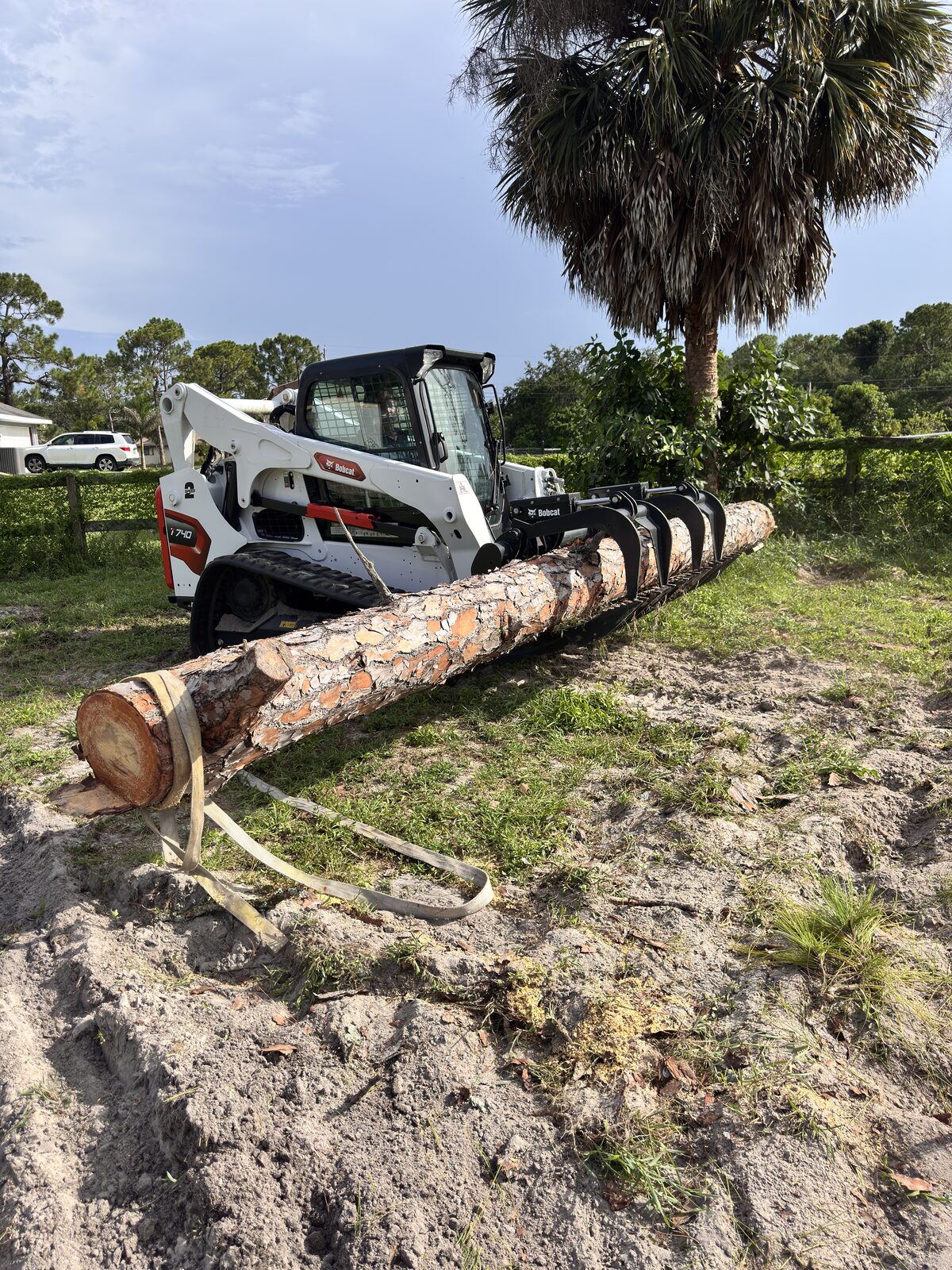
The Acreage is roughly 37 square miles of platted acreage lots run by a drainage district instead of a city hall, built for horses, gardens and elbow room. We clear the invasives, plan the culvert crossing, and tell you which county desk actually regulates your parcel — before any money changes hands. Bobcat T740 with a 60" grapple, $385/day with an operator, dispatched from our own yard three miles away in 33470.
The Acreage was never platted the way a subdivision is. There is no developer's deed restriction and, outside a handful of newer enclaves, generally no homeowners' association at all. What runs the place instead is the Indian Trail Improvement District (ITID) — a special taxing district, not an HOA — which maintains the interior roads, the canals and the roadside swales across the community's roughly 37 square miles. Persimmon Boulevard, 60th Street North and Orange Boulevard carry most of the through-traffic, feeding out to Royal Palm Beach Boulevard, with Acreage Community Park sitting near the middle of it.
Lots here commonly run an acre or more, on well and septic rather than municipal utilities, which is exactly what draws horses, chickens, citrus rows and the odd tractor shed. It also means every clearing job has to plan around two things a platted subdivision doesn't have: the swale in front of the property, and the culvert that is the only crossing onto it.
We are not a service-area outfit reading this off a map — our own yard sits three miles away at 16140 Okeechobee Blvd in 33470, and a good share of our calendar every month is Acreage back-half work. Tell us the address and roughly what's out there and you'll get a straight answer inside 24 hours, plus a free lot walk before any number gets written. (561) 779-3213.
The T740 and grapple on a nearby job — the same machine and operator that dispatches to an Acreage lot.
Who Actually Regulates Your Lot — Stated Plainly
The Acreage is unincorporated Palm Beach County — the same status as neighboring Loxahatchee — which means there is no separate Acreage city hall or building department to call. Two county desks share the work: Environmental Resources Management handles native vegetation and the prohibited invasive-plant list under ULDC Article 14.C and 14.D, and the Palm Beach County Building Division issues the permit and inspects it wherever clearing is tied to a structure, a driveway or a grading change. There is no village or town layer in between for either process.
That single-desk structure also settles the licensing question plainly: Bell Land Services operates under a confirmed Palm Beach County Business Tax Receipt. Because The Acreage is unincorporated county land rather than its own municipality, that county-level receipt covers work here directly — the same way it covers our work in Loxahatchee — with no separate town-specific receipt to chase down. We do not claim, and The Acreage does not have, a city-specific business tax receipt, because there is no city here to issue one.
ITID sits alongside both desks for anything touching a road, canal or roadside swale, and it is worth calling before the county rather than after — see the swale-and-culvert section below. The county's own guidance is to check with ERM in writing before any clearing begins; our permits & regulations guide has the full acreage thresholds, mitigation and wildlife rules, and the pre-clearing checklist.
The Jobs an Acreage Lot Actually Calls For
Almost every call here sorts into one of four scopes. Naming yours up front is what turns a wide guess into a real number.
1 · Paddock, ring & turnout
The single most Acreage-specific call we get. Brush and stumps out, footing graded so it drains instead of ponding, and a clean line ready for fencing. Mulching in place instead of hauling off is usually the right call here — cheaper, and the layer holds regrowth back where a horse will actually stand.
2 · The build pad
A house, barn or garage is going up. Stumps come out grubbed rather than cut, debris hauled rather than mulched, ground graded level. If a new home is the plan, the clearing scope and the building permit go through the same Palm Beach County Building Division file rather than two separate conversations.
3 · The driveway, the culvert, the second gate
Long private drives, a second entrance for a trailer, room for a horse box to turn around. This is where ITID's swale stops being scenery and becomes a design question — see below.
4 · Reclaiming the acre nobody's used
No build, no horses yet — just a back half that's spent years growing over. Selective: exotics out, good canopy kept, a mowable path opened, left in a state a homeowner with a tractor (not a track loader) can maintain going forward.
Two scopes that don't fit neatly into a plan but come up constantly out here: the perimeter fire break ahead of the dry season, and storm cleanup after it — downed Australian pine across a drive, a hung limb over a barn roof. Both are priced by the day rather than by the acre.
Whichever scope is yours, the vegetation itself is a short, repeating list — Brazilian pepper, Melaleuca, Australian pine and climbing fern doing most of the volume, slash pine, live oak, cabbage palm and saw palmetto doing most of the permit risk. Our Loxahatchee & The Acreage page walks through that plant-by-plant split in full if you want the detail before we walk your lot.
What It Runs on a Standard 1.25-Acre Lot
Our Palm Beach County cost guide publishes the per-acre bands behind this table, applied here to the acre-and-a-quarter platting that's typical of an Acreage lot. Same figures the estimator on our main page runs on — the guide, the estimator and this page are never allowed to disagree.
Light
Grass, weeds, light brush
$2,500–$6,500 · 1.25-acre lot
Usually one to two days — on a lot this size the floor is effectively our $385 day rate with an operator included.
Moderate — most common here
Palmetto, saplings, thick undergrowth
$6,000–$12,800 · 1.25-acre lot
Two to three days grubbed and hauled — the band a neglected back half usually falls into.
Heavy
Mature pines, oaks, deep stumps
$11,800–$22,500 · 1.25-acre lot
Multi-day, and where mitigation for protected native canopy belongs in the budget as its own line rather than a surprise at the end.
🧮
Want your own number before you call? The estimator on the main land page takes three taps — lot size, what's growing, where the debris goes — and returns the same range we'd quote by phone. Price your lot ↗
ITID: The District, Not an HOA, That Runs the Ground Around Your Lot
Nobody clearing an Acreage lot for the first time expects the drainage district to matter more than the plants do, but it usually does. The Indian Trail Improvement District maintains the road network and the swale system that fronts every property in the community. Those swales, and the canals they drain into, are infrastructure the district is responsible for — not extra yard, however wide the grass strip looks.
Every load in and out crosses the culvert. The trailer hauling the T740 in, and every load of cleared debris going out, cross the culvert under your driveway apron. We plan that crossing, the staging pad and the culvert protection before the trailer is even booked — a crushed culvert or a rutted swale turns into a district drainage complaint fast, and this is flat, poorly-draining ground where standing water is taken seriously.
The swale itself is not ours, or yours, to clear on a whim. Cutting, filling, fencing across, or simply driving heavy equipment over a district easement generally needs ITID's sign-off first, and the same logic covers any platted FPL or utility strip running through the property — the ground can sit inside your legal boundary while the right to disturb it does not.
If the scope includes reshaping a driveway, adding a culvert or regrading where water leaves the lot, that's an ITID permit and inspection of its own, separate and in addition to anything the county's Building Division issues for the structure itself.
🐢
Two things that pause the machine, not the paperwork. A gopher tortoise burrow — the half-moon opening with a sand apron in front of it — has to go through the Florida Fish and Wildlife Conservation Commission's permitting and relocation process before ground near it is disturbed. Active bird nests, including burrowing owls that favor exactly this kind of open acreage, are protected under state and federal law. We flag both on the walk and leave that zone alone until it's been properly assessed — a day's delay against a problem that costs far more to undo.
Wet Ground, Dry Ground — Timing an Acreage Job
This part of Palm Beach County was drained for building, not naturally dry, and an Acreage lot remembers that every summer. Roughly June through October the ground holds water, and a track loader working saturated soil can rut a pasture or a future build pad badly enough that the repair bill outlasts any memory of the clearing job. November through May the same ground is firm, and the work goes faster and cleaner for it.
The T740's tracks spread its weight far better than a wheeled skid-steer would on this soil, which is genuinely why we run one out here rather than a cheaper machine. But no undercarriage outruns standing water — on a heavy wet-season job, telling you to wait for a dry week is sometimes the right call for your ground, even though it costs us the invoice that week.
Dry season doubles as fire-break season, so a perimeter you've been meaning to open is worth booking before the flatwoods cure out. Wet season overlaps hurricane season, when storm cleanup jumps the queue — if your job isn't urgent, January books faster and cheaper than September.
How the Job Actually Runs, Start to Finish
No one should be guessing what happens after they say yes. This is the order of operations, with the ITID-specific steps a generic clearing quote leaves out.
1 · The walk
Free, before a number is written. We split invasive from native out loud, flag burrows and wet ground, and name your real scope — paddock, pad, drive, break or reclaim.
2 · Parcel record & the right desk
Property Appraiser lookup for parcel control number, zoning and land-use code, then ERM and the Building Division confirmed in writing — plus ITID if the driveway or culvert is in scope.
3 · 811, then access
The free Sunshine State One Call locate ticket first, with its full statutory notice window. Trailer route and culvert protection get set before the T740 ever crosses onto the lot.
4 · The grapple works, flagged zones don't
Thickets and root balls come out where they're supposed to; any tortoise burrow or active nest stays untouched until it's cleared by the right agency.
5 · Hauled or mulched — your call, priced both ways
Grub and haul for a build-ready pad; chip and mulch in place for pasture, trails or a fire break.
6 · The file you keep
Permit numbers, the county's written answer, the 811 ticket, and dated before-and-after photos — the paperwork that matters if a neighbor or the district ever asks.
Who Calls Us in The Acreage
Horse & livestock owners
Paddock, ring, turnout
The most Acreage-specific call we take. Graded footing, clear sightlines, a fence-ready line — before fencing ever gets scheduled.
Builders & owner-builders
Pad, drive, access
Grubbed, graded and build-ready, with old barn or shed demolition handled by the same licensed GC, CGC1528750.
Farms & hobby growers
Rows, orchard ground, equipment access
We run The Bell Farm a few miles from here ourselves — a different kind of reference than a photo of someone else's job.
Buyers
Before you close
A walk during the inspection period tells you what the lot actually costs to make usable. The acreage buyer's guide covers wells, septic, ITID assessments and zoning first.
Owners at a distance
Vacant & held lots
Parcels bought and left, that grow back every wet season. BeacCorp Property Management covers the ongoing side for owners who aren't local.
After a storm
Everyone, all at once
Downed pine across a drive, debris where a farrier's or delivery truck needs to be. Priced by the day, most likely June through November.
Eight Questions to Ask Before You Hire Anyone to Clear Acreage Ground
Ask us these. Ask the next bidder too — the answers sort a real Acreage crew from a company that only works subdivisions.
1 · Have you actually worked in unincorporated Palm Beach County, or only inside a city? The permitting desk, the ITID layer and the lot geometry are all different from a platted subdivision.
2 · How does your equipment cross my culvert, and who's on the hook if it cracks? Get the answer before the trailer shows up.
3 · Is my back half inside a drainage easement or a preserve? Those lines outlast whoever owns the property.
4 · Do you know which desk — ERM or the Building Division — signs off on this scope? A vague answer here means a vague permit later.
5 · Who calls 811, and when in the schedule? The locate ticket needs its full statutory notice period before ground gets touched.
6 · Is footing for a paddock or ring part of this quote, or just clearing? Two different jobs — ask which one you're buying.
7 · What's your license number, and can I verify it myself? Ours is CGC1528750, checkable on the state DBPR site right now.
8 · If you find a tortoise burrow, what actually happens? The right answer is: the machine stops in that zone until it's properly assessed — not "we'll be careful around it."
The Local Numbers Worth Having
Verify these against each agency's current listing. The full directory, including SFWMD and FWC, is in the permits guide.
Free locate ticket, required by Florida law before excavation. Dial 811 and wait for the marks.
🚜
The walk is free, and it's the whole point. We split invasives from natives, flag burrows and wet ground, plan the culvert crossing, and tell you plainly which desk to call — before any money changes hands. Bobcat T740 with 60" grapple and operator, $385/day. Licensed & insured, CGC1528750, held by a Florida corporation formed in 2009, BBB A+ Accredited Business.
The full Palm Beach County permitting picture — ERM vs. Building Division, thresholds, wetlands, wildlife, burning, and a nine-step pre-clearing checklist.
The building-side view of the same district: permitting, the 140 mph inland wind band, and well-and-septic remodel logistics.
Land Clearing in The Acreage — FAQ
How much does it cost to clear a lot in The Acreage?
On the acre-and-a-quarter lot most of The Acreage is platted in, grubbed and hauled off, our published per-acre bands run roughly $2,500–$6,500 for light grass and brush, $6,000–$12,800 for the moderate palmetto-and-undergrowth case a neglected back half usually is, and $11,800–$22,500 for heavy mature pine and oak with deep stumps. Mulching in place instead of hauling brings that down, and selective clearing beats total clearing on price nearly every time. The only accurate number comes from a free on-site walk — call (561) 779-3213.
Do I need a permit to clear land in The Acreage?
Often, and it depends on what's coming out. The Acreage is unincorporated Palm Beach County, so Environmental Resources Management handles native vegetation under ULDC Article 14.C and 14.D and the Palm Beach County Building Division issues any permit tied to a structure, driveway or grading change — there is no separate town layer to check. Removing invasive exotics is generally encouraged; removing native canopy or grubbing to bare dirt is where review applies. The county's guidance is to contact ERM in writing before clearing begins.
Do you hold a Business Tax Receipt for The Acreage?
We hold a confirmed Palm Beach County Business Tax Receipt. Because The Acreage is unincorporated Palm Beach County rather than its own city, that county-level receipt covers our work here directly — there is no separate Acreage-specific municipal receipt to hold, because there is no municipality here to issue one.
Is The Acreage governed by an HOA?
Generally no. Most of The Acreage grew from platted acreage lots rather than a developer-built, deed-restricted community, so there's usually no architectural review board to clear on a clearing job. What does run the area is the Indian Trail Improvement District (ITID) — a special taxing district, not an HOA — which maintains the roads, canals and drainage swales, and whose permission is needed for anything touching those easements.
Can your equipment damage my driveway culvert?
It's the first thing we plan for, since every load in and out crosses it. We set the trailer route, the staging pad and culvert protection before the machine is even booked. If the driveway or culvert is itself part of the scope, that's an ITID permit and inspection in its own right, separate from anything the county issues for the structure.
Do you clear ground for a paddock or riding ring?
Yes — it's one of our most common Acreage calls. Brush and stumps come out, footing gets graded so it drains rather than ponding, and the line is left clean for fencing. Mulching in place instead of hauling off is usually the better economic call on ground a horse will be standing on.
Can you clear the swale in front of my property?
Not on your say-so or ours alone. Those swales, and the canals they feed, are ITID drainage infrastructure. Cutting, filling, fencing across or driving equipment over a district easement generally needs ITID's permission first, and the same applies to platted utility or FPL strips running through the lot.
What if there's a gopher tortoise burrow on the lot?
Work stops in that zone. The gopher tortoise is a state-listed species, and its burrows — look for the half-moon opening with a sand apron — must go through the Florida Fish and Wildlife Conservation Commission's permitting and relocation process before ground nearby is disturbed. Active bird nests, including burrowing owls that favor open acreage like this, are protected under state and federal law as well.
Is dry season the better time to clear?
Usually. From roughly June through October this ground holds water, and a track loader on saturated soil can rut a pasture or a future pad badly. November through May the same ground is firm and the work goes faster and cleaner. The T740's tracks spread weight better than a wheeled skid-steer, but on a heavy wet-season job, waiting a dry week is sometimes the right call for your ground.
Are you licensed, insured, and actually based nearby?
Yes to all three. Bell Land Services operates under Bell Engineering and Construction Corporation, Florida Certified General Contractor CGC1528750, fully licensed and insured, incorporated in Florida in 2009, and a BBB A+ Accredited Business. Our yard is three miles away at 16140 Okeechobee Blvd in Loxahatchee 33470, and we run our own working farm in the same area — the machine, and the person who signs off on the work, are both close by.