From the Field
Our work
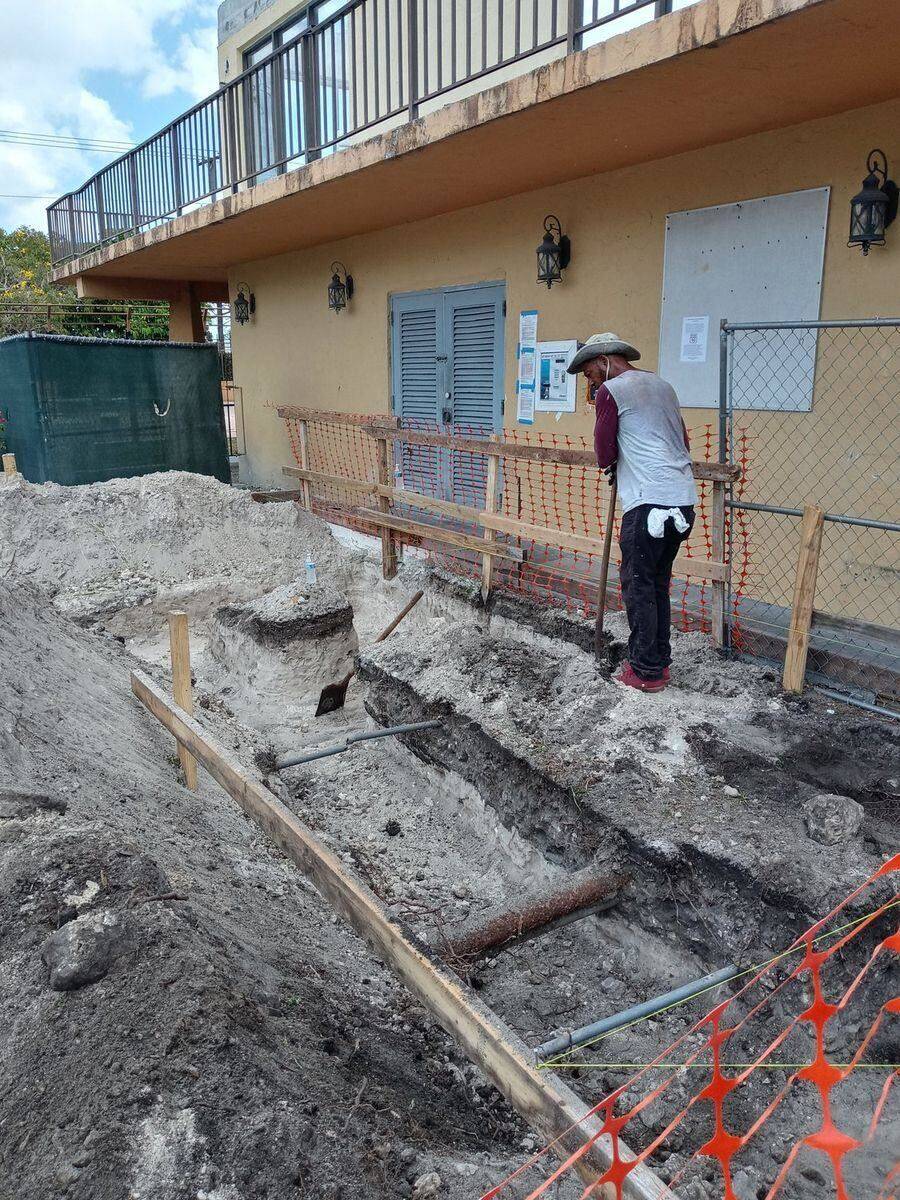
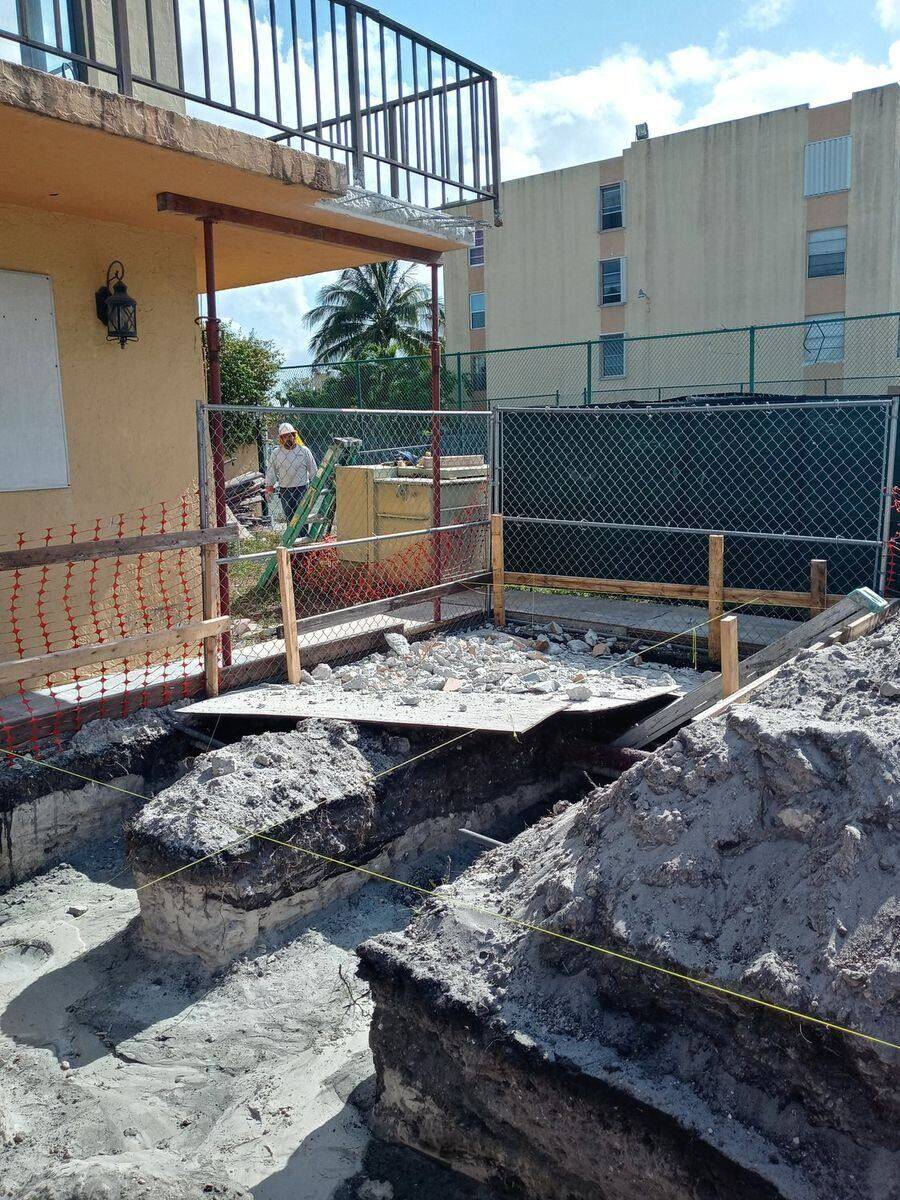
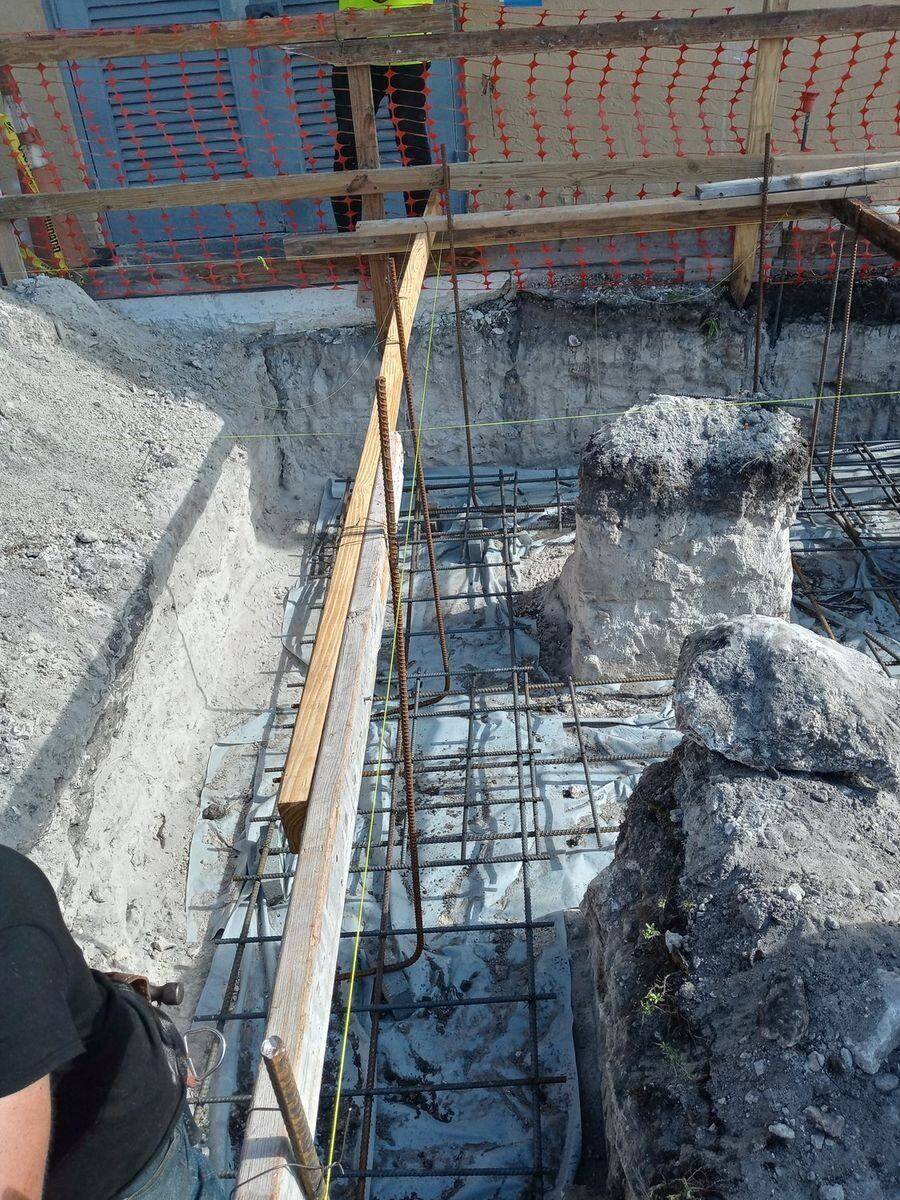
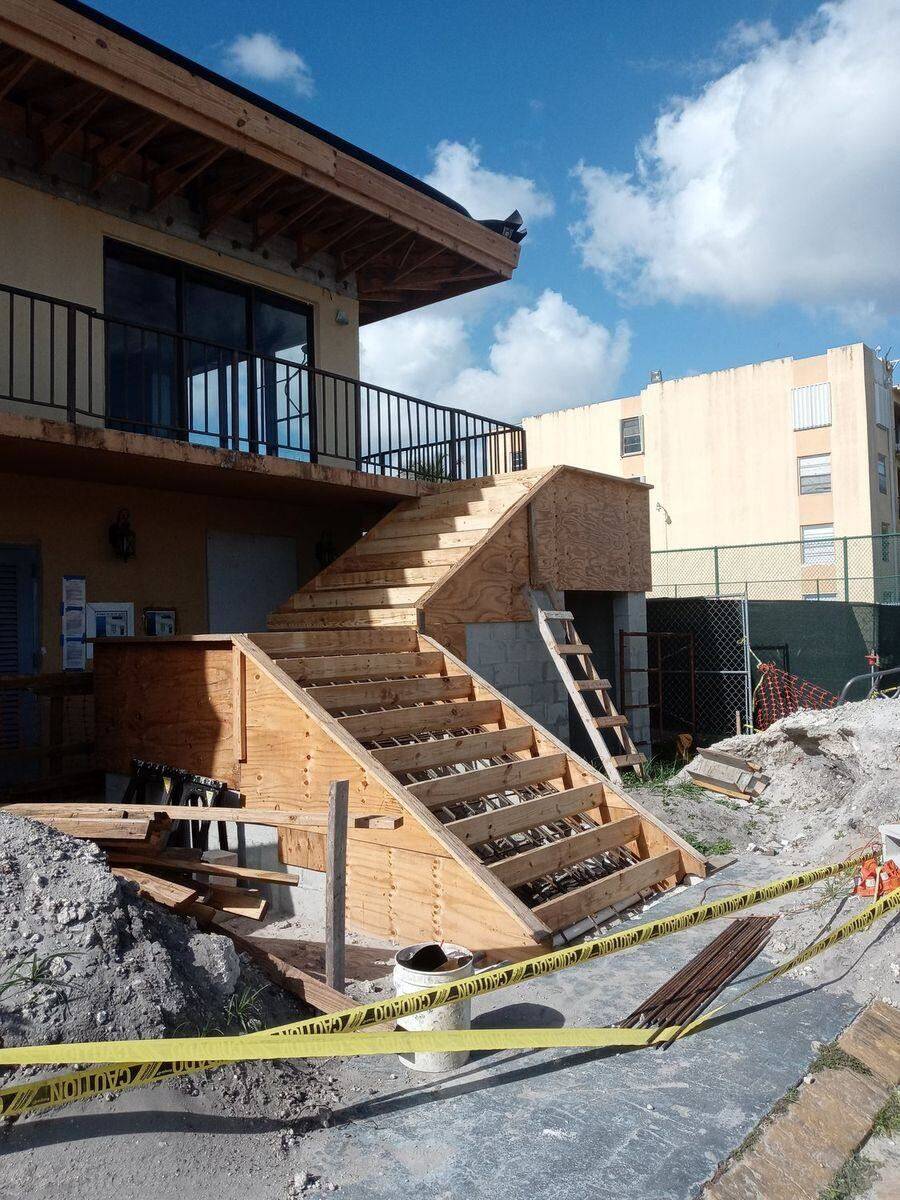
Concrete stair construction & restoration · CGC1528750 · Palm Beach County
RSB Empire → Construction → Concrete Restoration
Sheet A-103 · Bell Engineering & Construction
Concrete restoration near me means spalling, rebar, balcony, stair and slab repair by a licensed general contractor, CGC1528750. We cut out the damage, treat the steel and rebuild it. Free estimates.
Scope of Work
From the Field
Concrete stair construction & restoration · CGC1528750 · Palm Beach County
Project Log
Every concrete contractor’s website says the same six things. So rather than say them again, here are three Palm Beach County jobs we actually did — each photographed on site, in the order the work happened, with the reasoning behind each step written down next to the picture of it.
They are deliberately different sizes. One is a structural beam over an occupied home’s patio opening in West Palm Beach — permitted, shored and rebuilt. One is a carport beam and the roof above it at Greenway Village in Royal Palm Beach. One is two panels of resident walkway at that same community. The small job is on this page for the same reason as the big one: how a contractor handles two panels of sidewalk tells you exactly how they will handle a balcony line.
Featured Project · 01
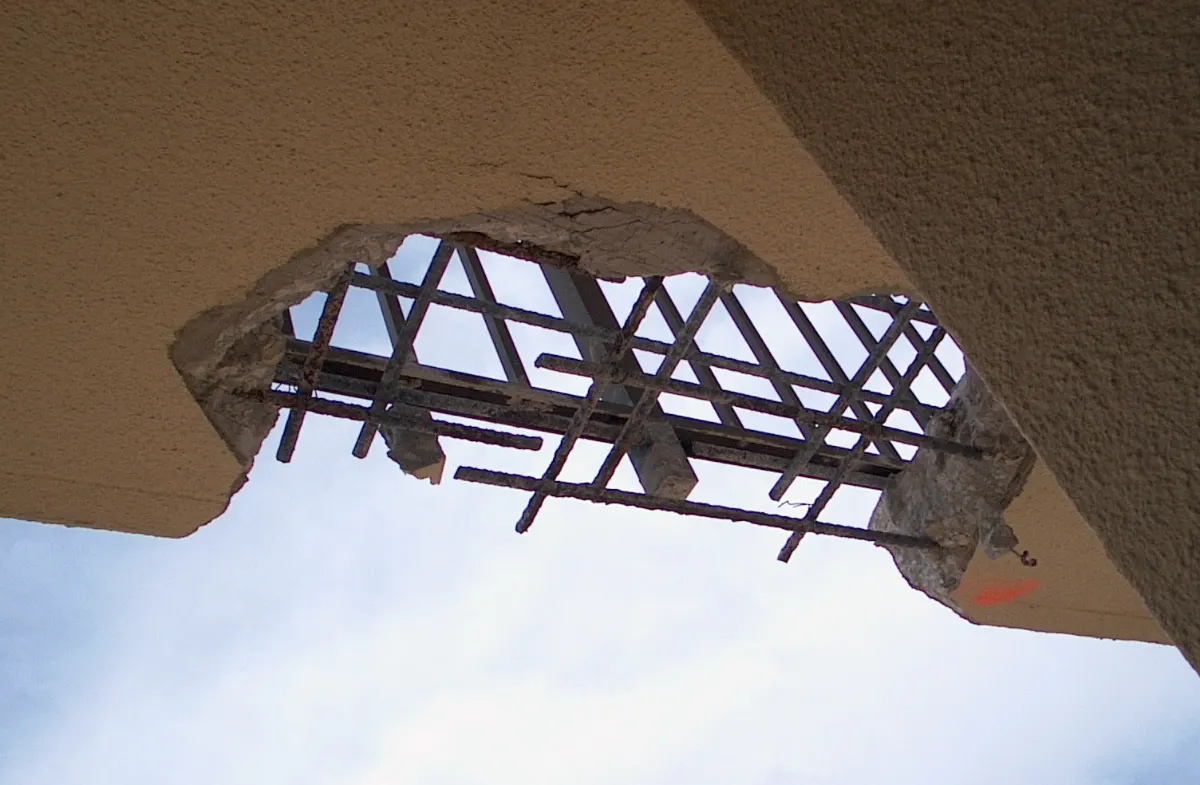
At the back of a two-storey West Palm Beach home, the concrete beam spanning the wide covered-patio opening had been failing quietly for years, and it announced itself the way these always do — a straight horizontal crack line in the stucco directly above the opening, then paint lifting in a band, then pieces coming down onto the pavers. Cut the stucco away and the reason is sitting there in daylight: the reinforcing steel inside the beam had corroded, expanded, and split the concrete off itself from the inside out.
What makes this different from every pool deck on this page is what the member is doing. A pool deck can spall for a decade and still only be an ugly pool deck. A beam over an opening is working every second of every day: it is the reason the wall, the second floor and the roof above that opening are not resting on the sliding glass door. That single fact changes the whole order of the repair. You cannot cut out a failed structural member and then start thinking about how to hold the building up. The support goes in first.
So the first work on this job was not concrete at all. Adjustable steel posts went in across the opening, capped with steel channel and timber run tight against the underside of the second-floor slab, so the load above the beam was carried on temporary steel before a hammer touched the failure. Only then did demolition start — stucco cut off back to the block, the beam broken out with a rotary hammer until the tool stopped finding rotten material and started finding sound concrete, and the double run of reinforcing bar fully uncovered top and bottom so the section loss could be seen rather than guessed at.
“This is a concrete restoration project we had to do with a permit in West Palm Beach. The permit was pulled through the Palm Beach County Building Department.”
Randolph Scott Bell · CGC1528750
That sentence is worth more than it looks. Structural repair is permitted work, and the permit is what turns a private opinion about a beam into inspected work with a record behind it — a record your insurer can see and the next buyer’s inspector can find. A great deal of this work gets done in South Florida with a bag of patching compound and no paperwork at all. In the best case that repair is merely invisible. In the worst case it is a structural member nobody ever looked inside, sitting over a door your family walks through every day.
How to catch this on your own house before it costs you a beam. Ordinary spalling turns up in isolated patches — a chunk here, a rust stain there. A failing beam or lintel turns up as a line: a horizontal crack running the length of a door or window opening, stucco lifting in a band directly above it, rust-coloured staining bleeding down out of that band, or a door or window that has started to bind in a frame that worked perfectly for thirty years. Anything running the length of an opening is the structural member talking, not the paint, and it is worth a phone call the same week. See also selective & structural demolition and impact windows & doors — the beam over an opening and the opening itself are the same conversation more often than owners expect.
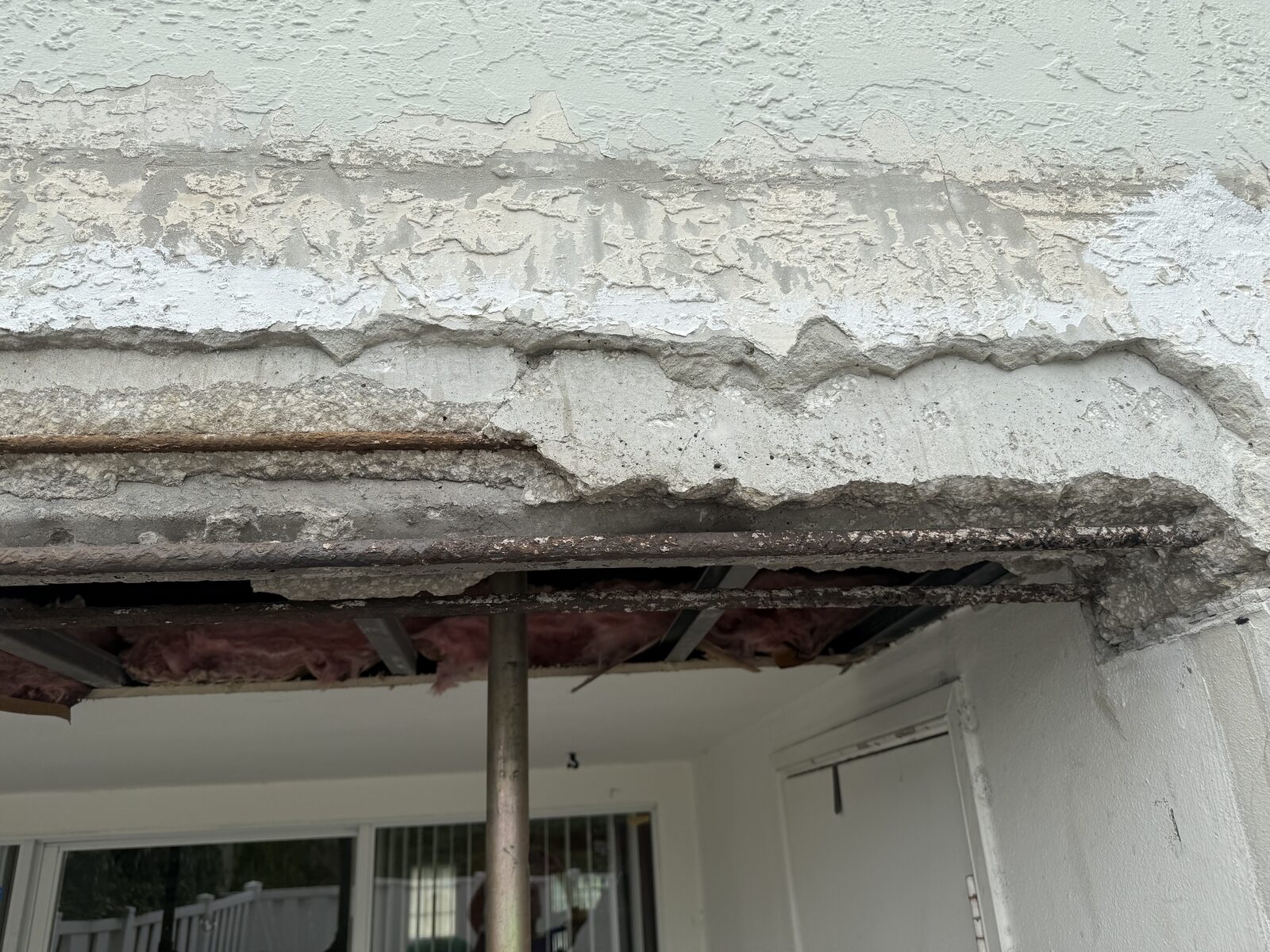
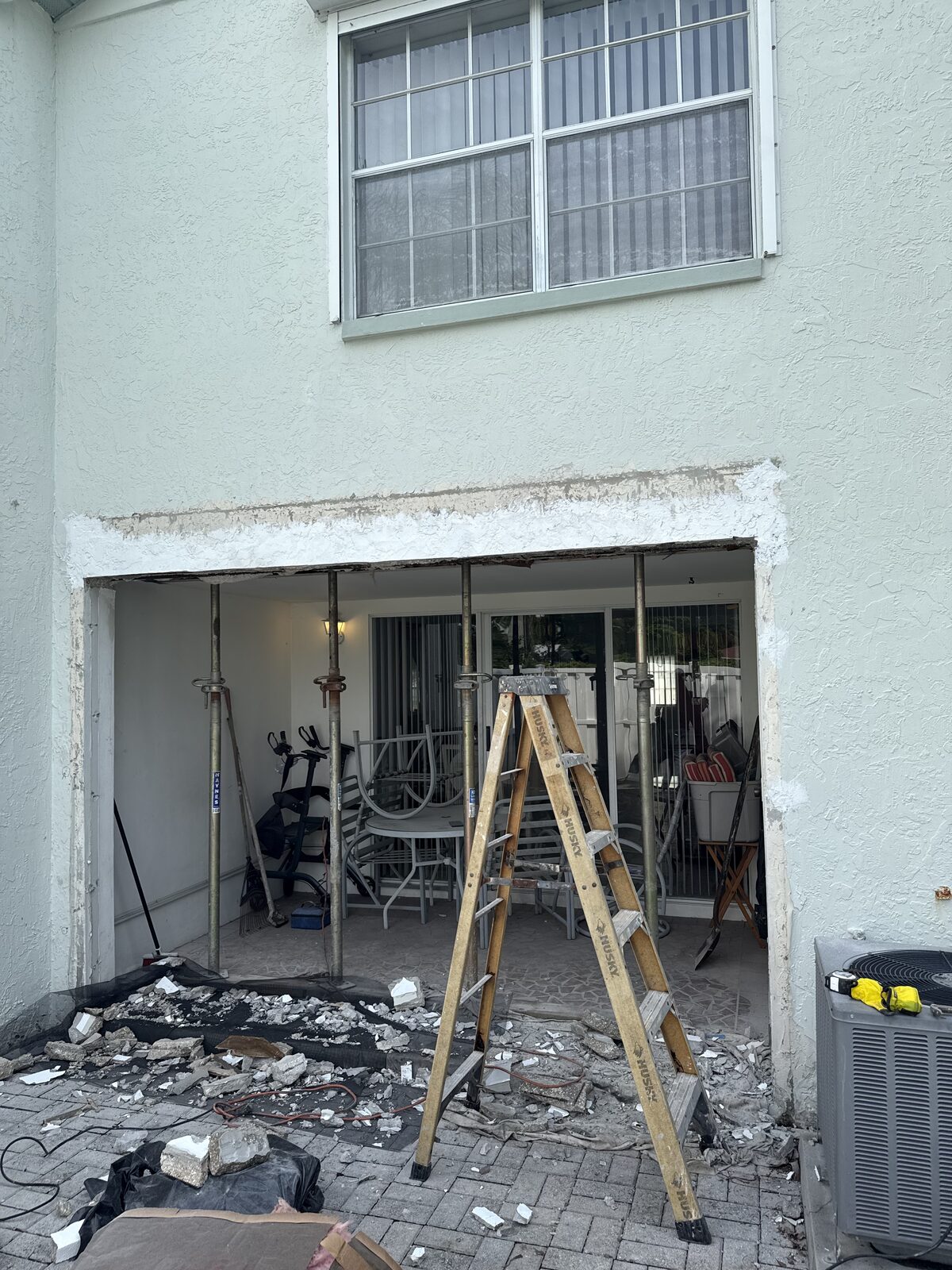
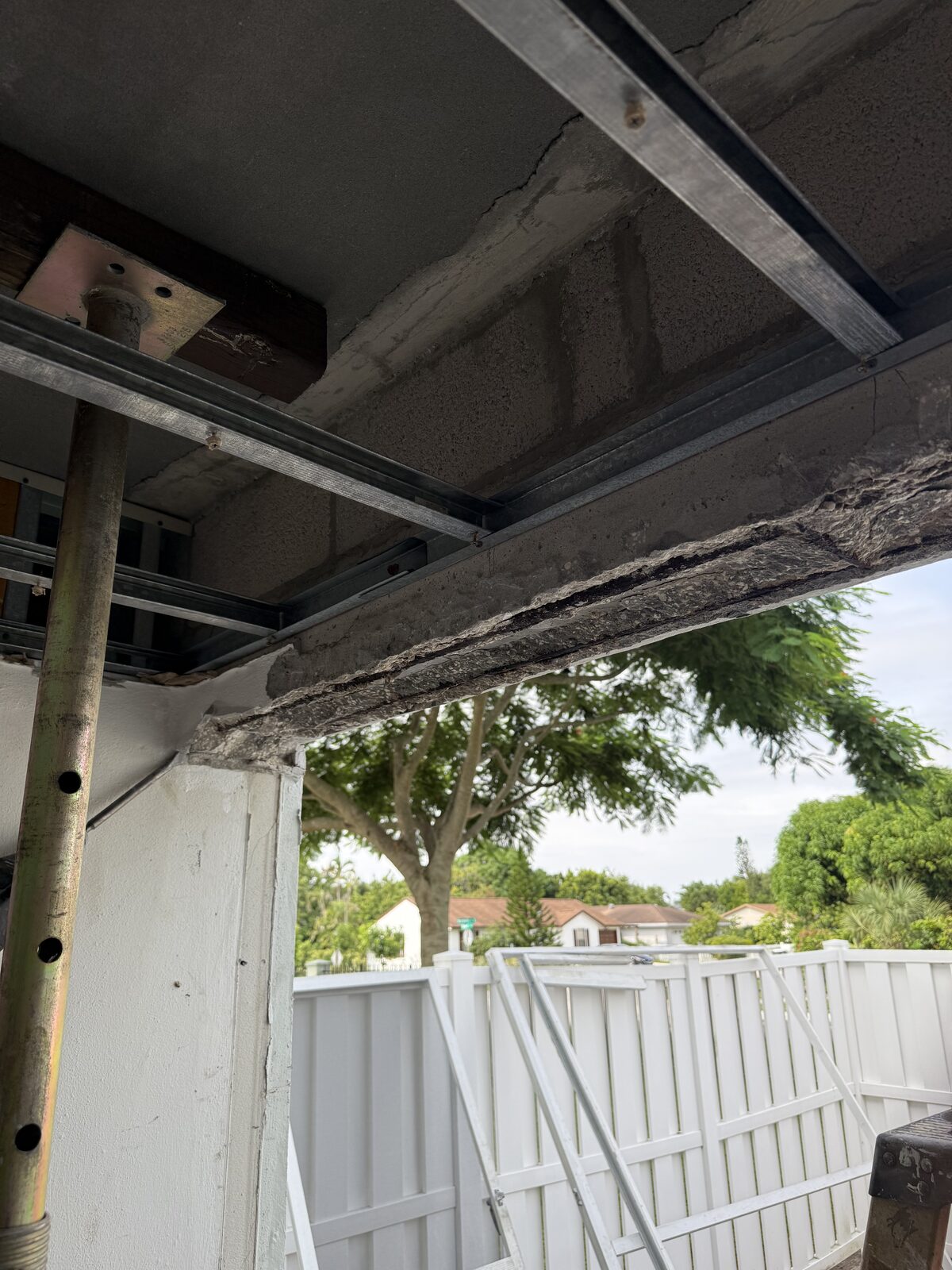
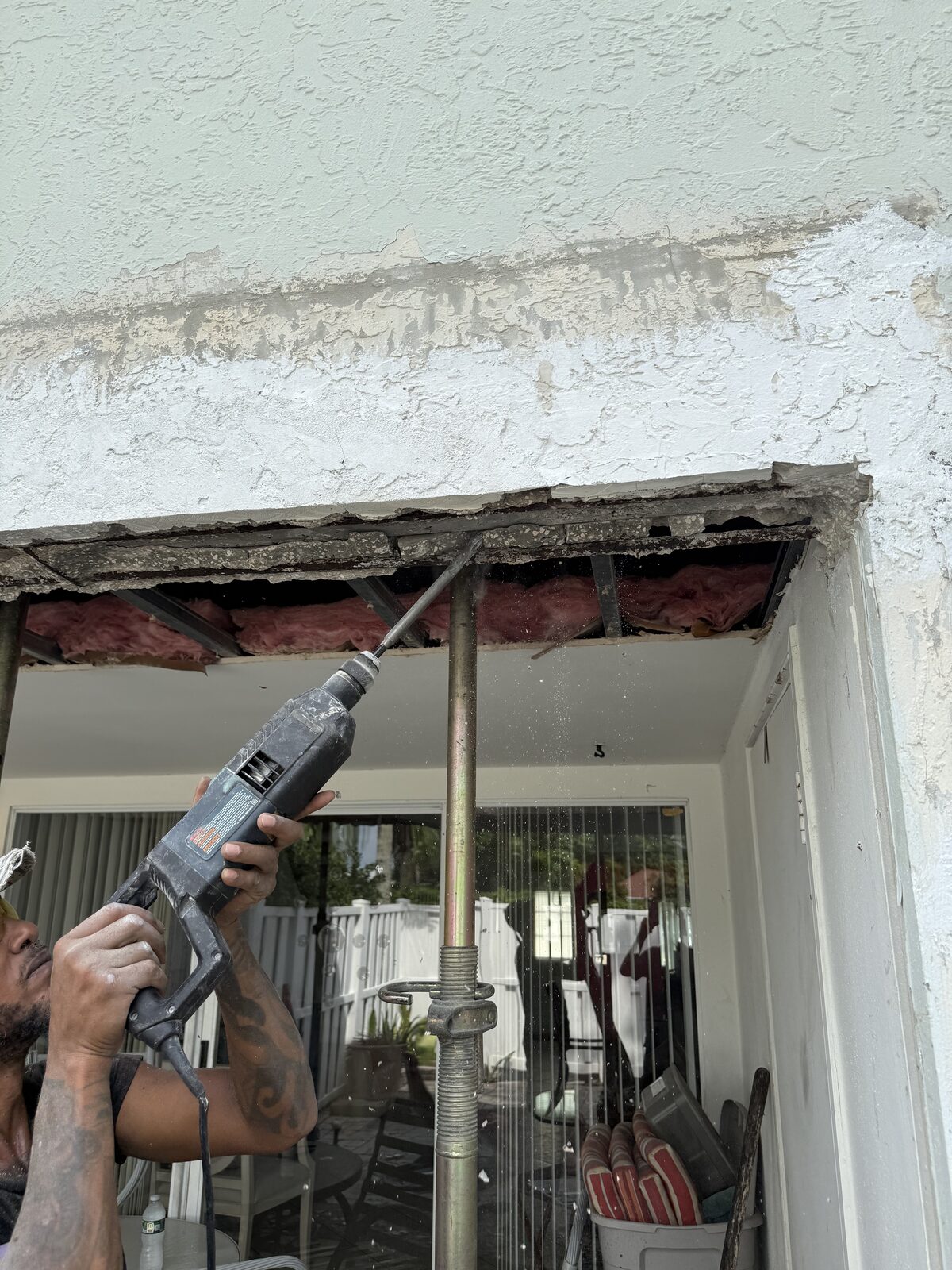
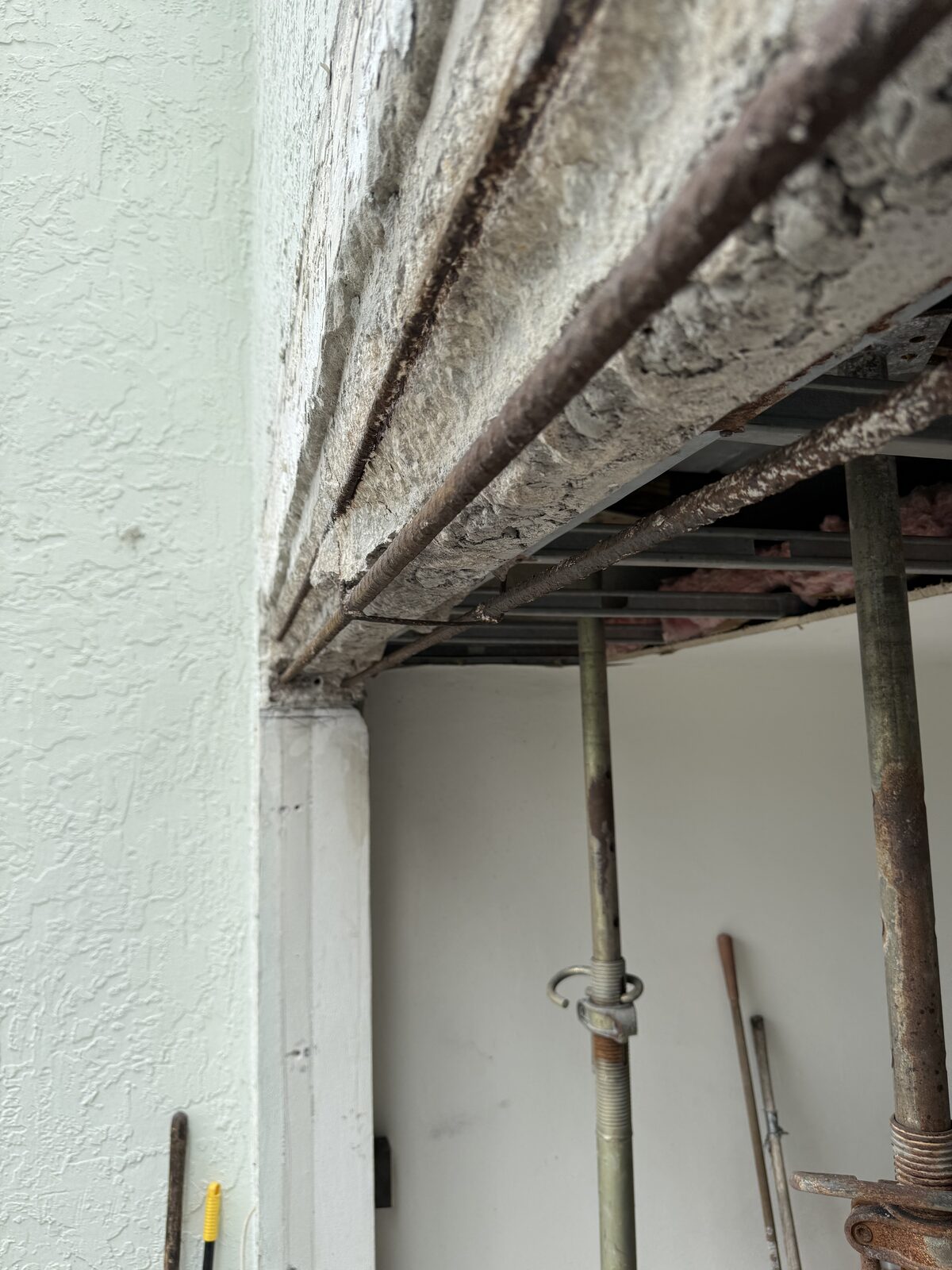
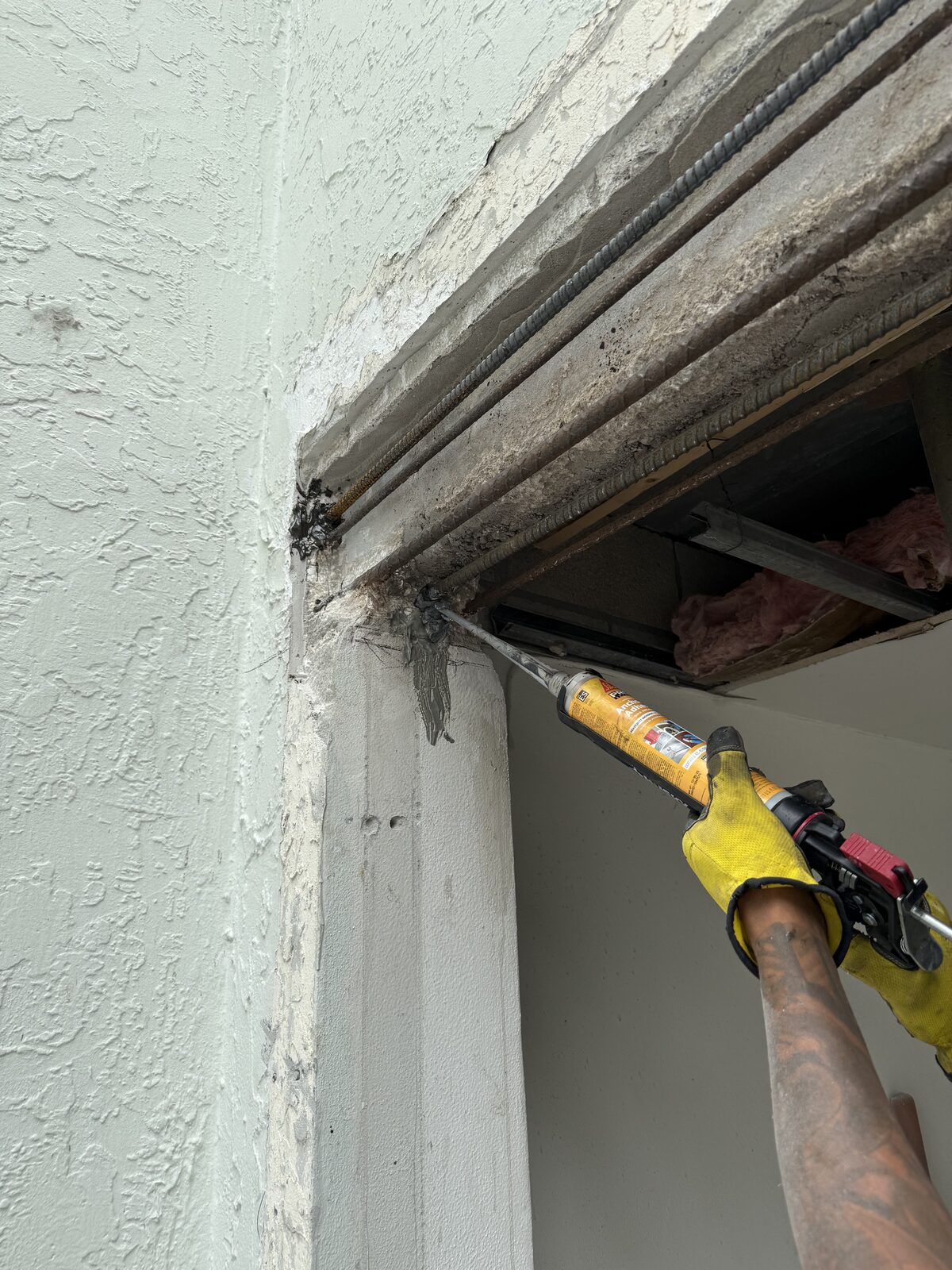
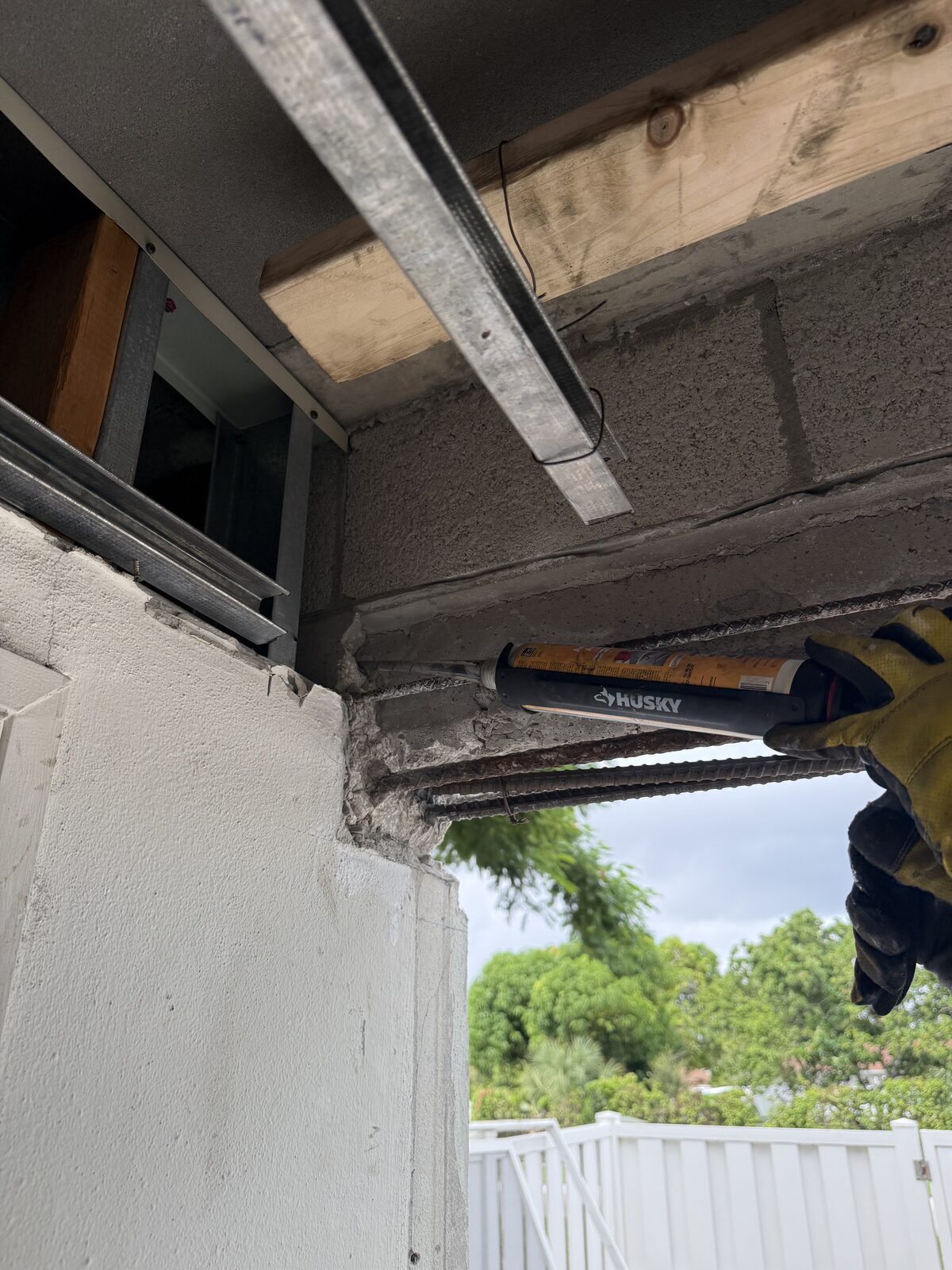
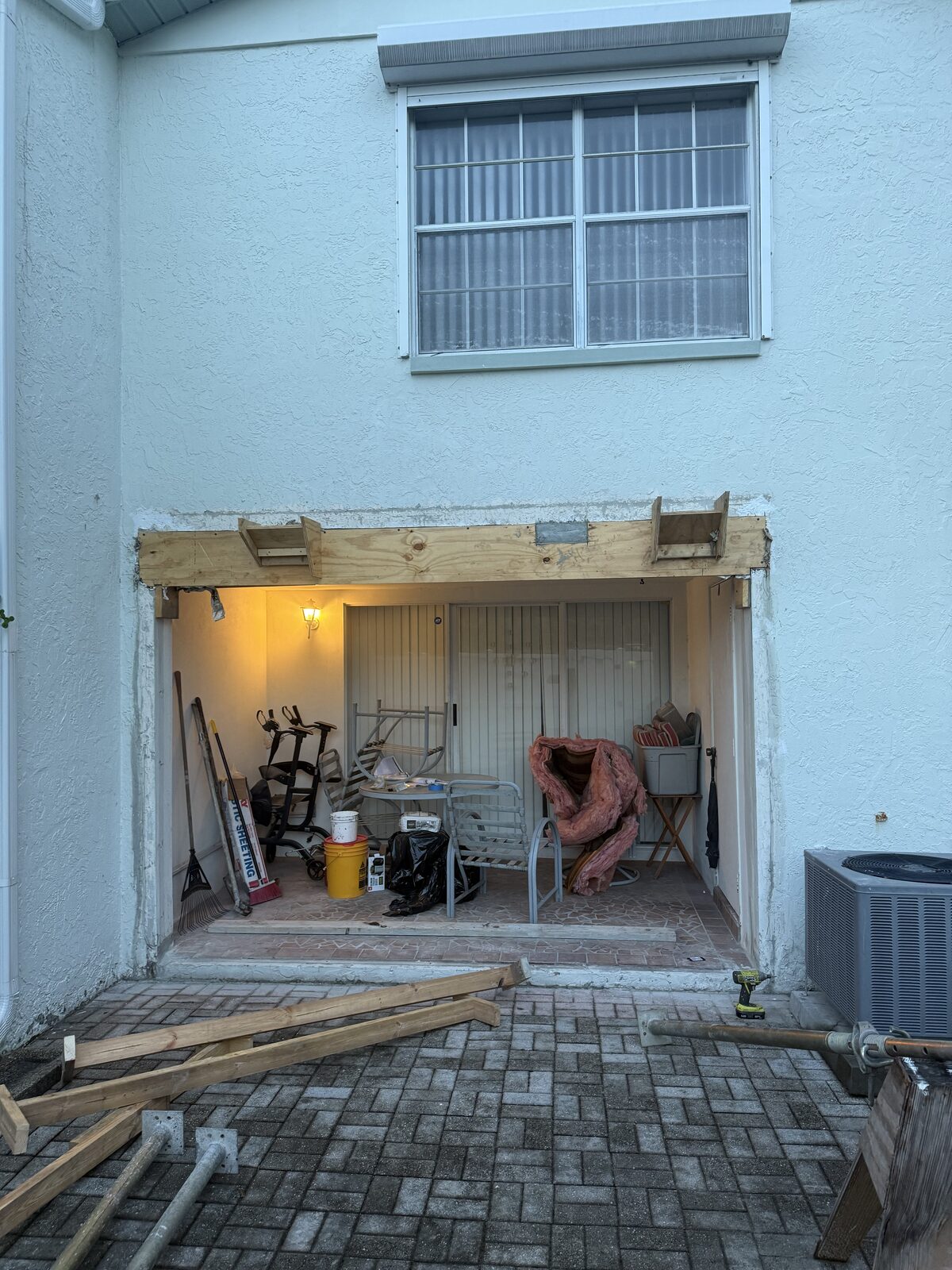
Structural beam restoration · West Palm Beach FL · 2025 · permit pulled through the Palm Beach County Building Department · CGC1528750
Featured Project · 02
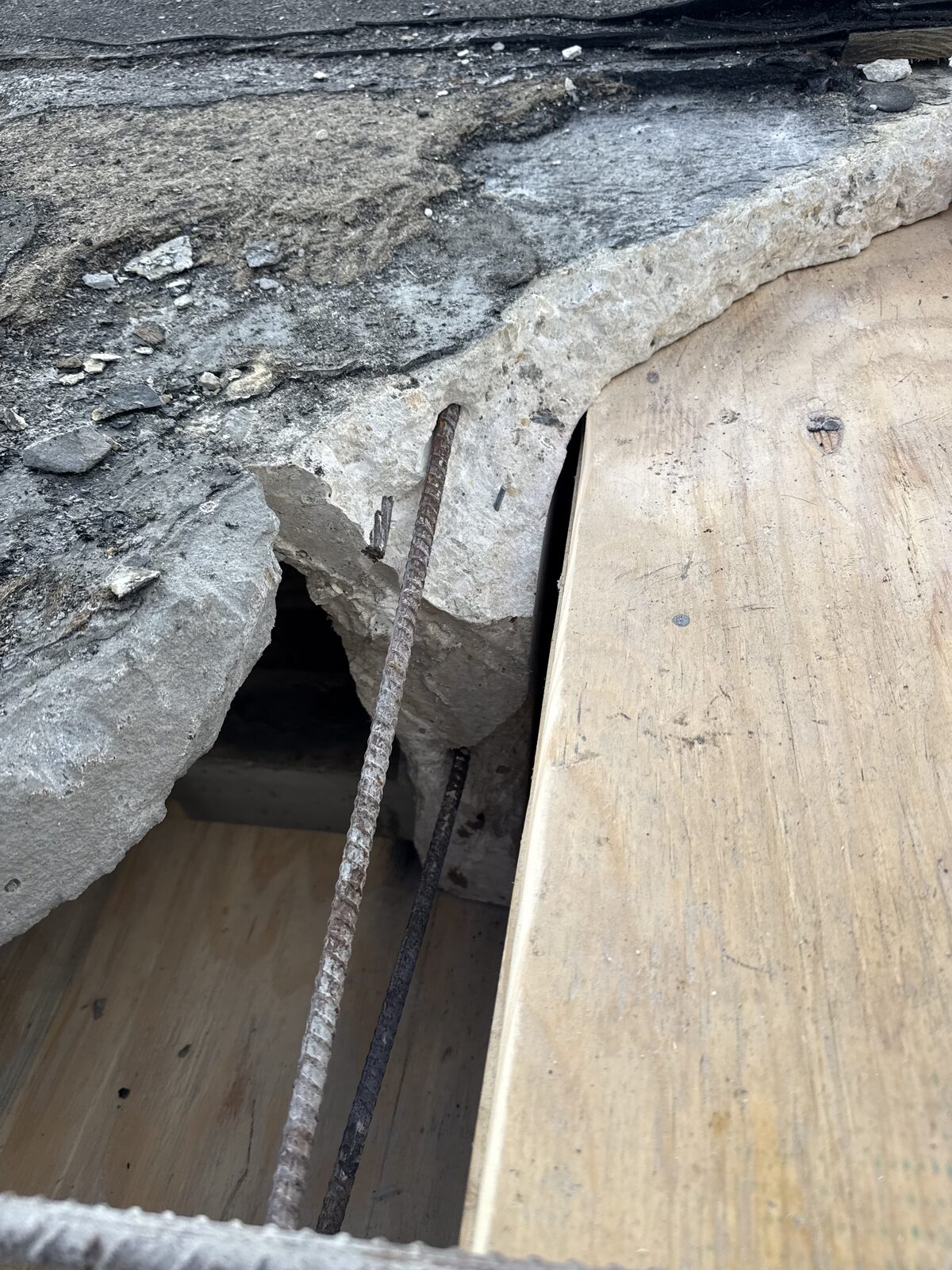
A resident carport at Greenway Village, an HOA community in Royal Palm Beach, had reached the stage every association dreads: the concrete edge beam carrying the carport roof had spalled through, and the reinforcing steel inside it was exposed and corroding in open air. Once the steel is bare, the clock speeds up — every rain reaches it directly, the rust expands, and the beam sheds more of itself each season. The photograph below is the moment the cover concrete came away and showed what was left of the bar.
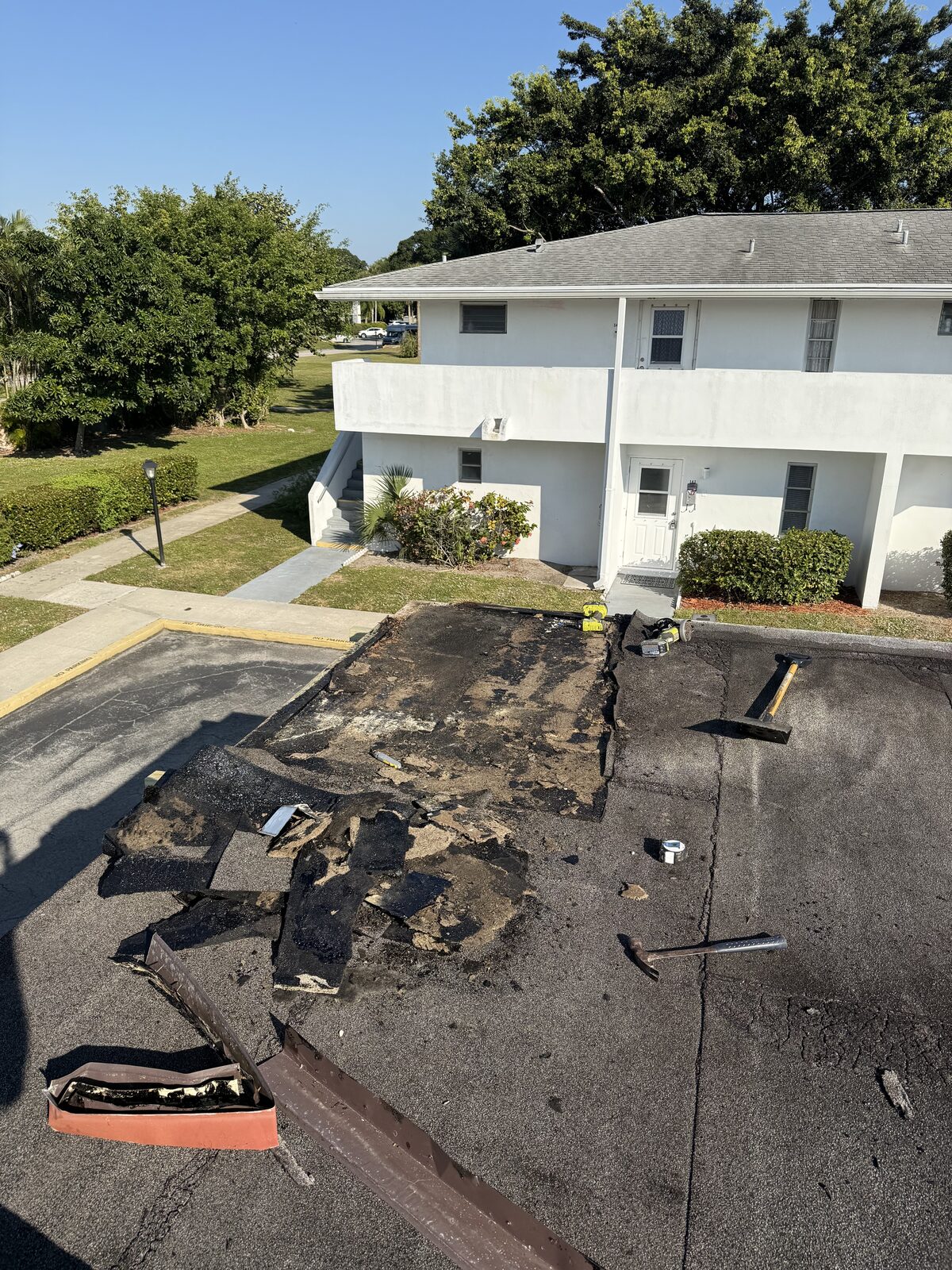
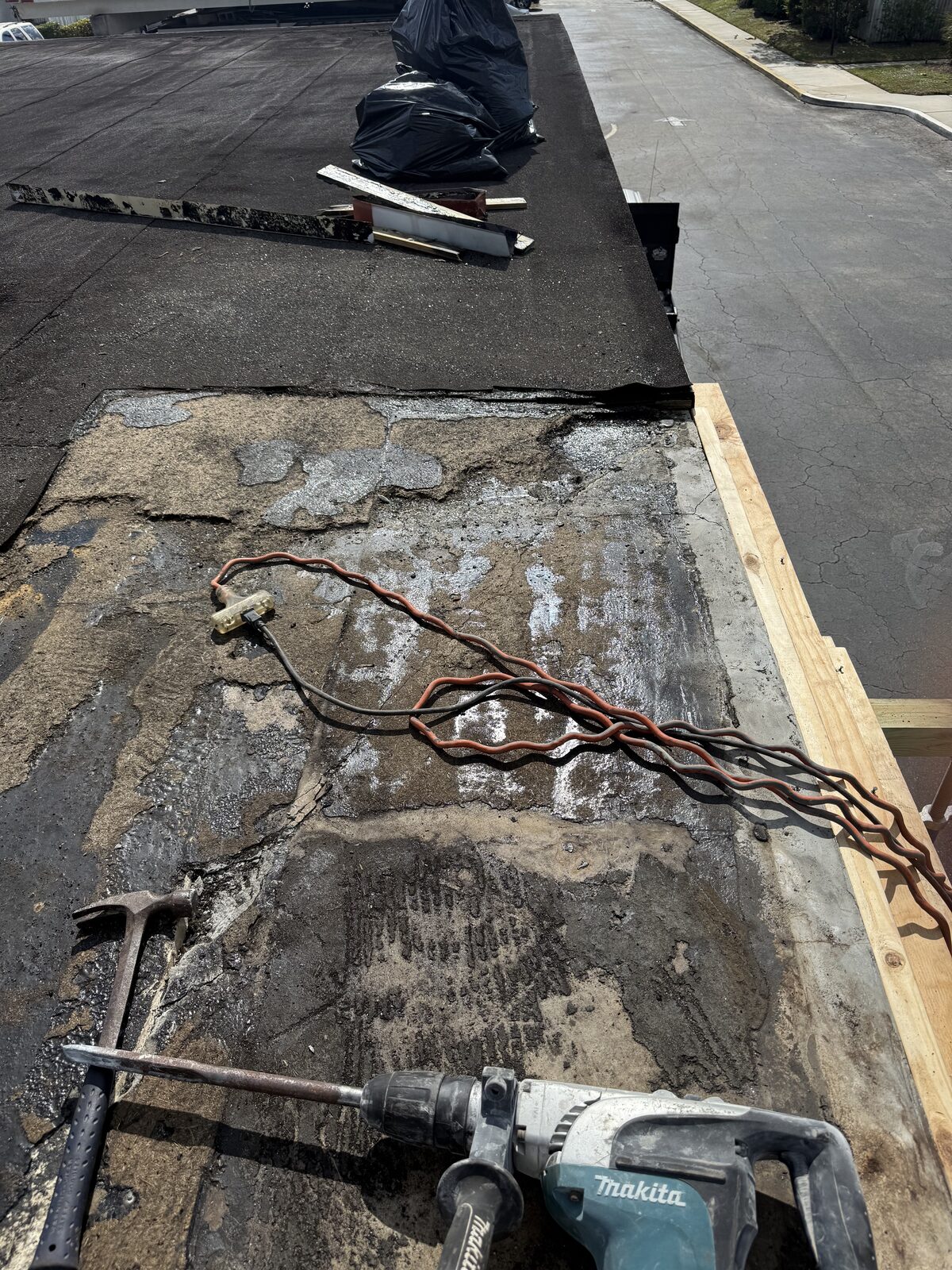
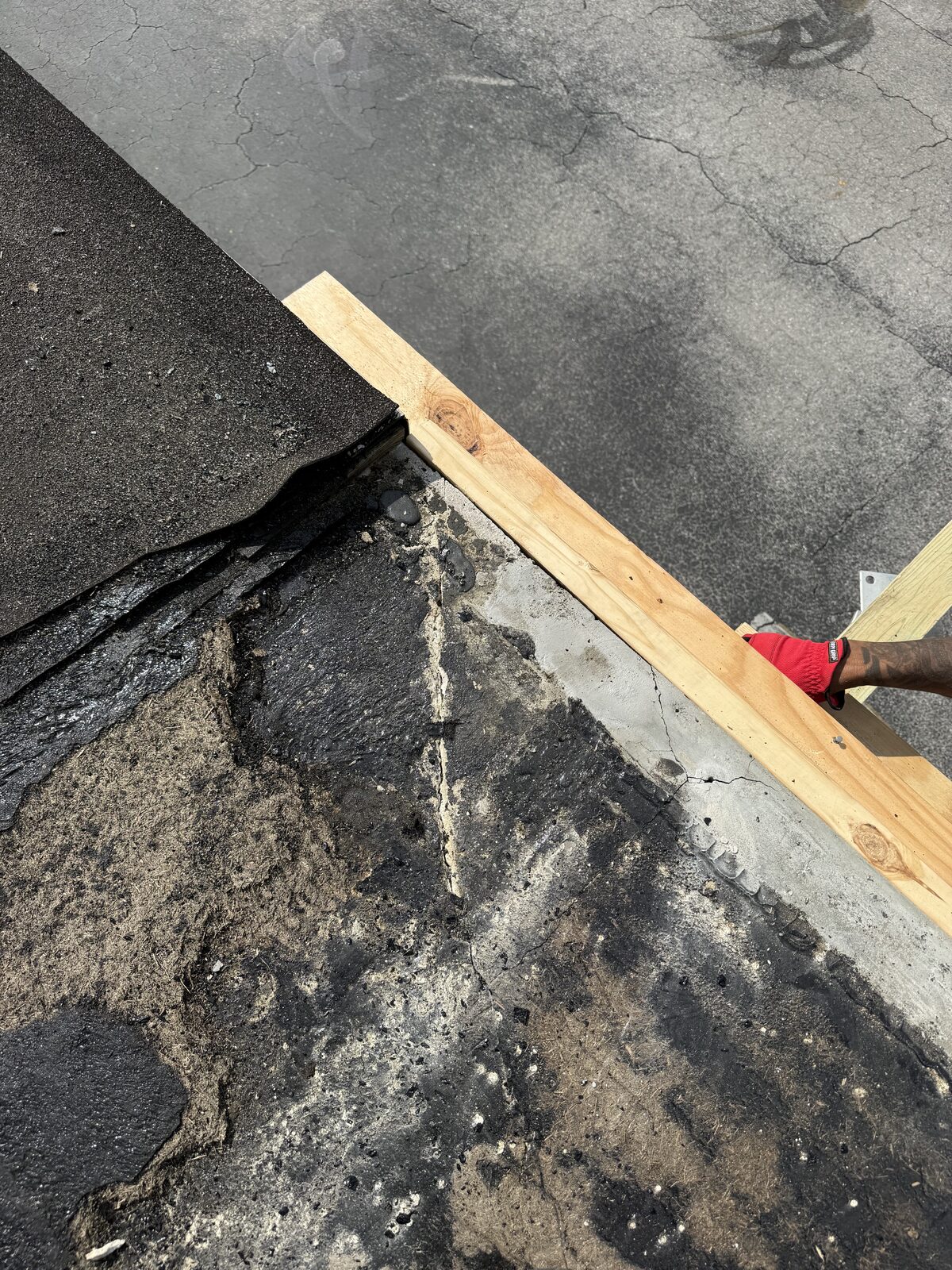
What made this one sit unrepaired is the same thing that makes it a good case study: it was two jobs, not one. The failed beam is structural concrete work. But the beam sat directly under an aged built-up roof whose membrane had to come off to reach it — and no responsible contractor opens a roof deck without being able to close it back up, properly, before the next afternoon storm. Most associations solve that by hiring a concrete contractor and a roofer, then spend the project refereeing who owns the seam between them. Bell Engineering holds both licences — Certified General Contractor CGC1528750 and Certified Roofing Contractor CCC1332751 — so the beam, the deck and the roof came in under one scope, one schedule, one crew and one warranty. Nobody argued about the tie-in, because the tie-in belonged to the same company.
The whole sequence above — failure, tear-off, rebuild, close-out — was photographed across a single week in November 2025, on an occupied community where residents park under that carport every day. This is the ordinary shape of concrete restoration in Palm Beach County — salt air gets to the steel, the steel breaks the concrete, and the repair is only permanent if somebody treats the cause instead of skimming the symptom. If your association has a carport, walkway, balcony or stair showing rust stains or hollow-sounding patches, the cheapest day to look at it is today. See also roofing & roof replacement and HOA & association management.
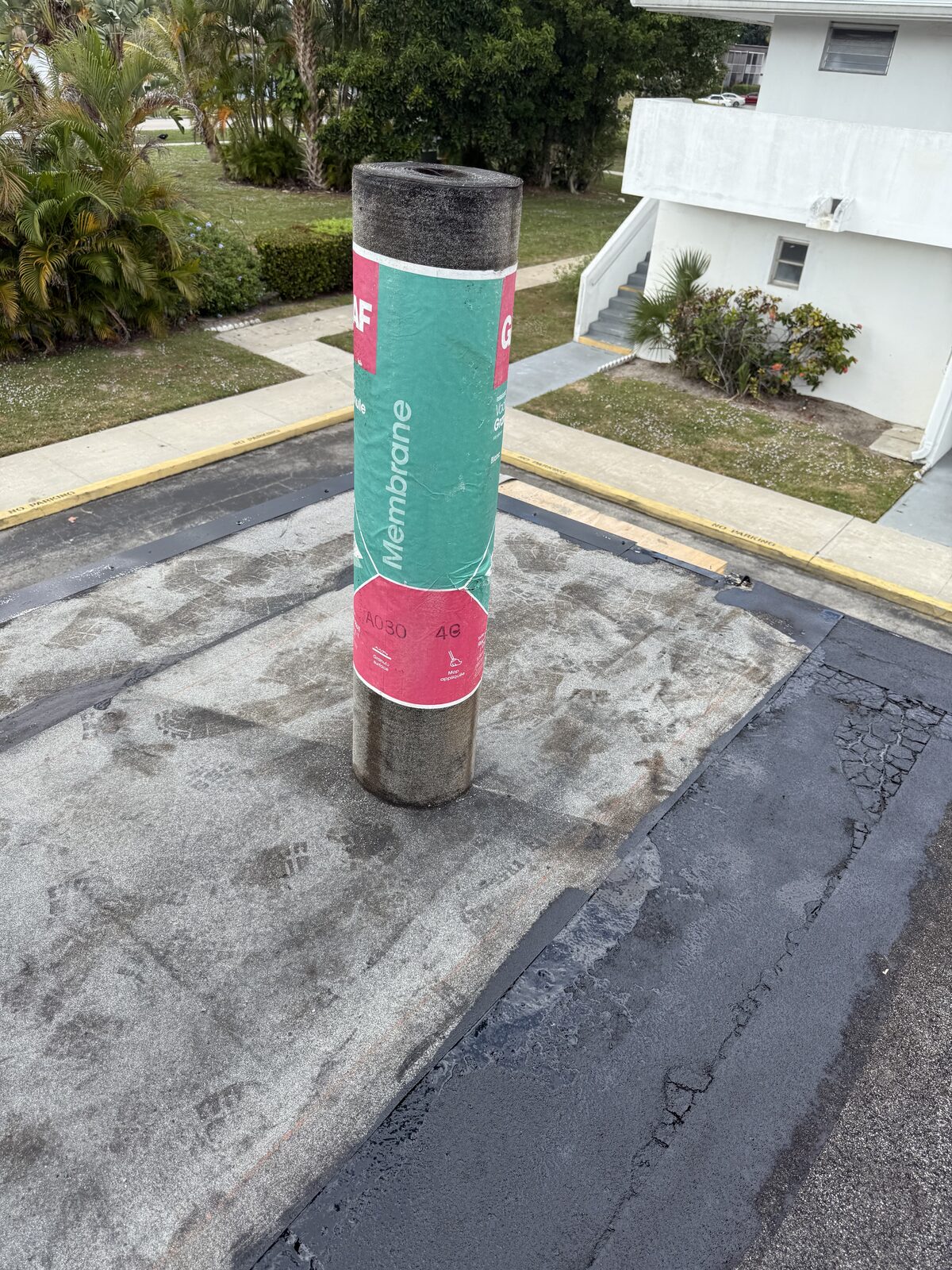
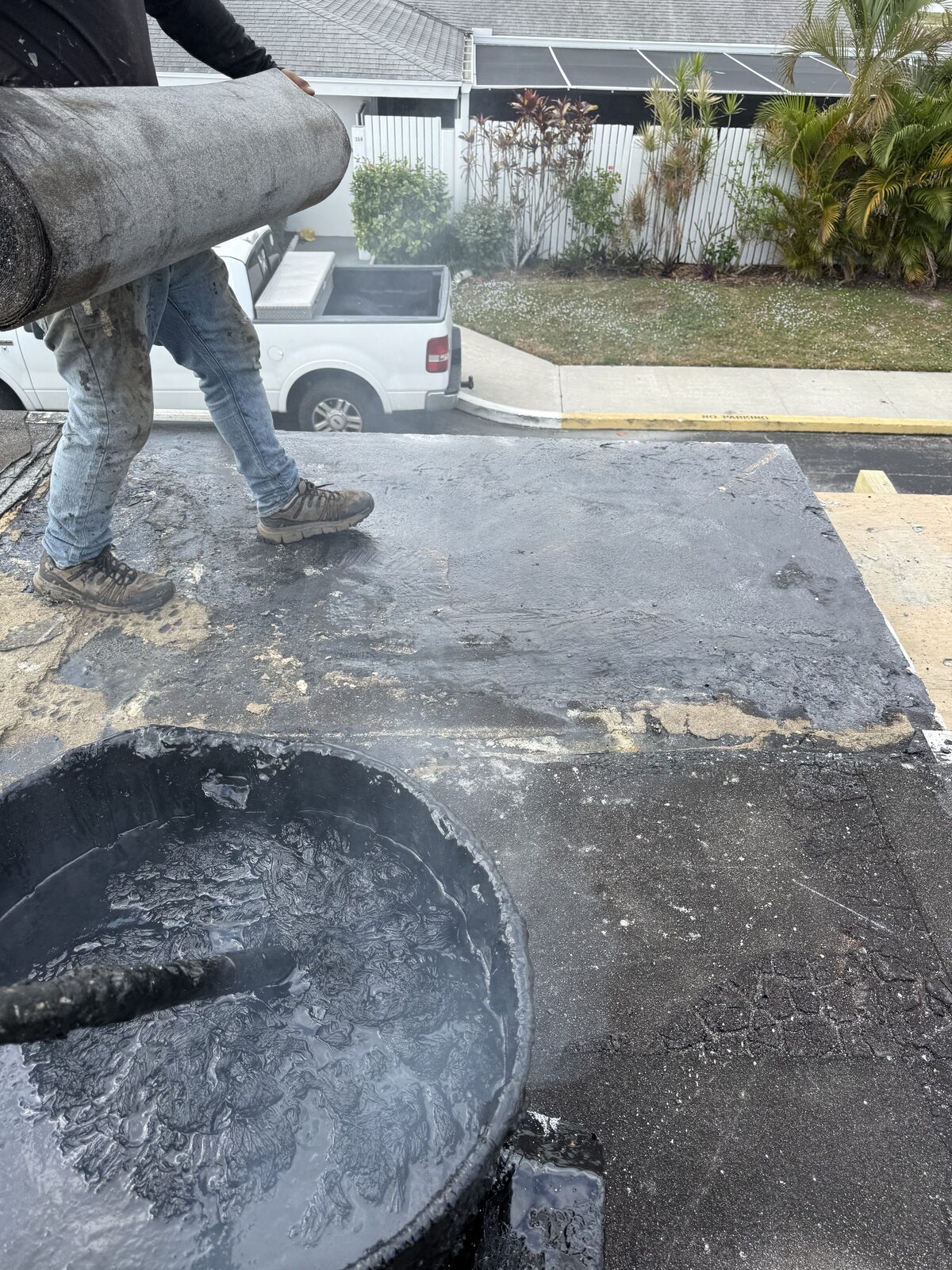
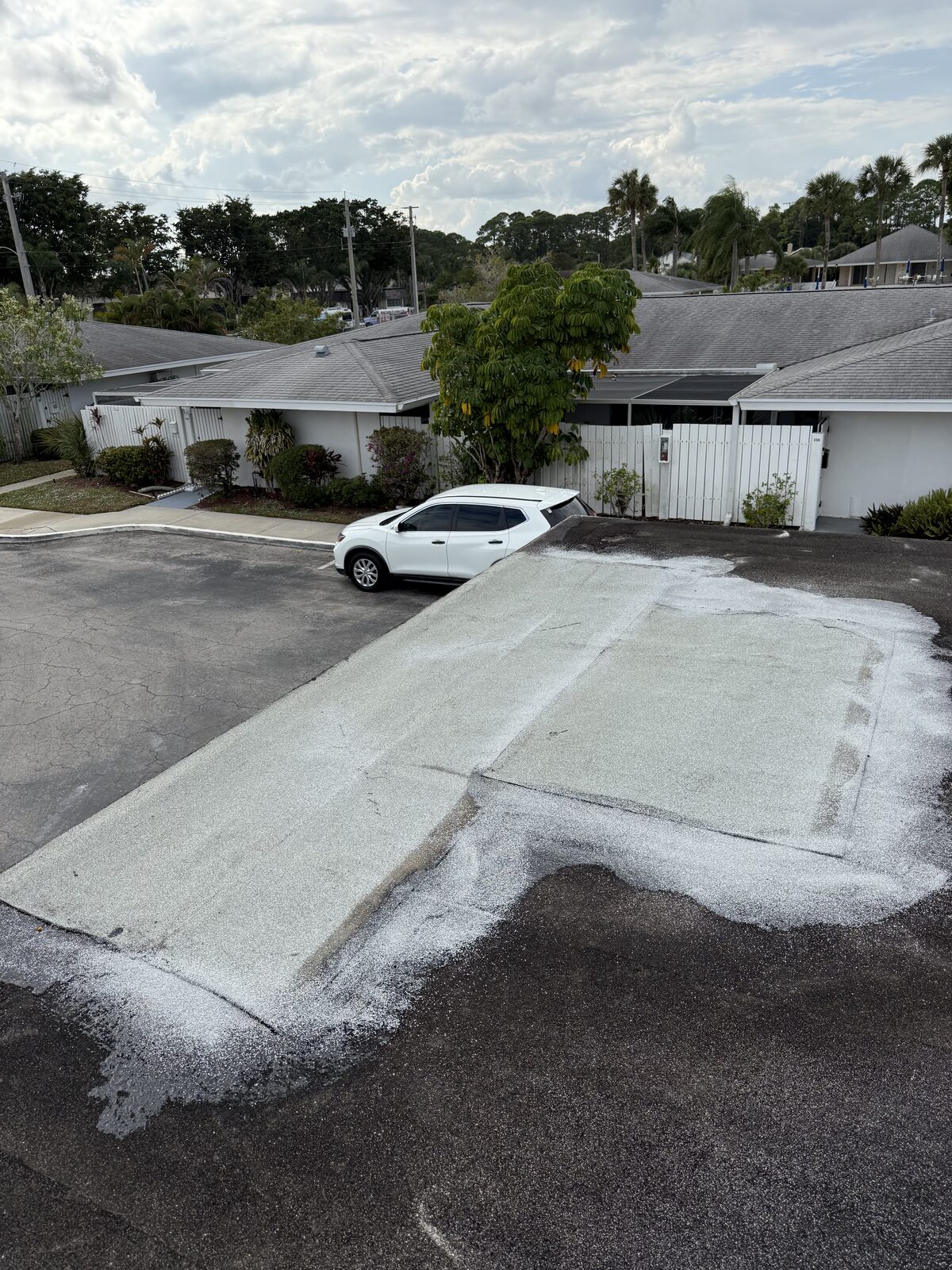
Greenway Village carport · Royal Palm Beach FL · structural concrete restoration & roof rebuild · November 2025 · CGC1528750 · CCC1332751
Featured Project · 03
The second job at Greenway Village in Royal Palm Beach was the opposite of the carport in every respect but one. No structural steel, no roof, no drama — a short section of resident walkway between a front door and the parking bay, cracked and sitting out of level between neighbouring slabs that were still perfectly sound. It is about the smallest concrete job there is. It is also the kind that quietly produces a board’s worst afternoon, because an uneven walkway panel on the path every resident uses between their door and their car is the classic slip-and-fall exposure, and it never improves on its own.
Replacing a panel inside an existing run is fussier work than pouring a new walk, not easier. The new concrete has to come out at the exact line, grade and thickness of the slabs on either side: a quarter of an inch high is a fresh trip hazard, and a quarter of an inch low is a puddle that sits there every time it rains. The control joints have to land where the existing joint spacing says they should, or the panel will crack where nobody put a joint. And all of it happens on a walkway that residents still need at eight the next morning.
So the failed slabs came out clean at the joint lines, the base was cut back and re-graded, welded wire mesh was set in the bay for crack control, and forms were pinned along the curb line to hold the edge true against the parking bay. The concrete was then mixed on site, on demand, in a continuous mixer fed with bagged high-strength mix — for two panels that is simply the right call. No ready-mix truck manoeuvring on a community’s aging drive lanes, no part-load standing in a drum, and no pressure to place more concrete than the crew can finish properly. Screeded flush to the neighbouring slabs, floated, jointed to match the existing spacing, and edged.
Then the part most people skip: it was taped off, coned and left alone. Fresh concrete does not care that it is Tuesday. The walk stayed closed until the pour could take foot traffic without printing, and the barricade stayed up the whole time — on an occupied community that protection is half the job, and cutting it short is how a good pour becomes a bad one. The final photograph below is the real reason this job is on the page: some weeks later, the repair is the least interesting thing in the frame.
Same community, two very different jobs. The carport above is structural concrete plus a rebuilt roof; this is two panels of flatwork. If your association has one of each — and most do — that is precisely the point: you do not need two contractors and two schedules to deal with them. See what we build in Royal Palm Beach, or how we work with HOA boards.
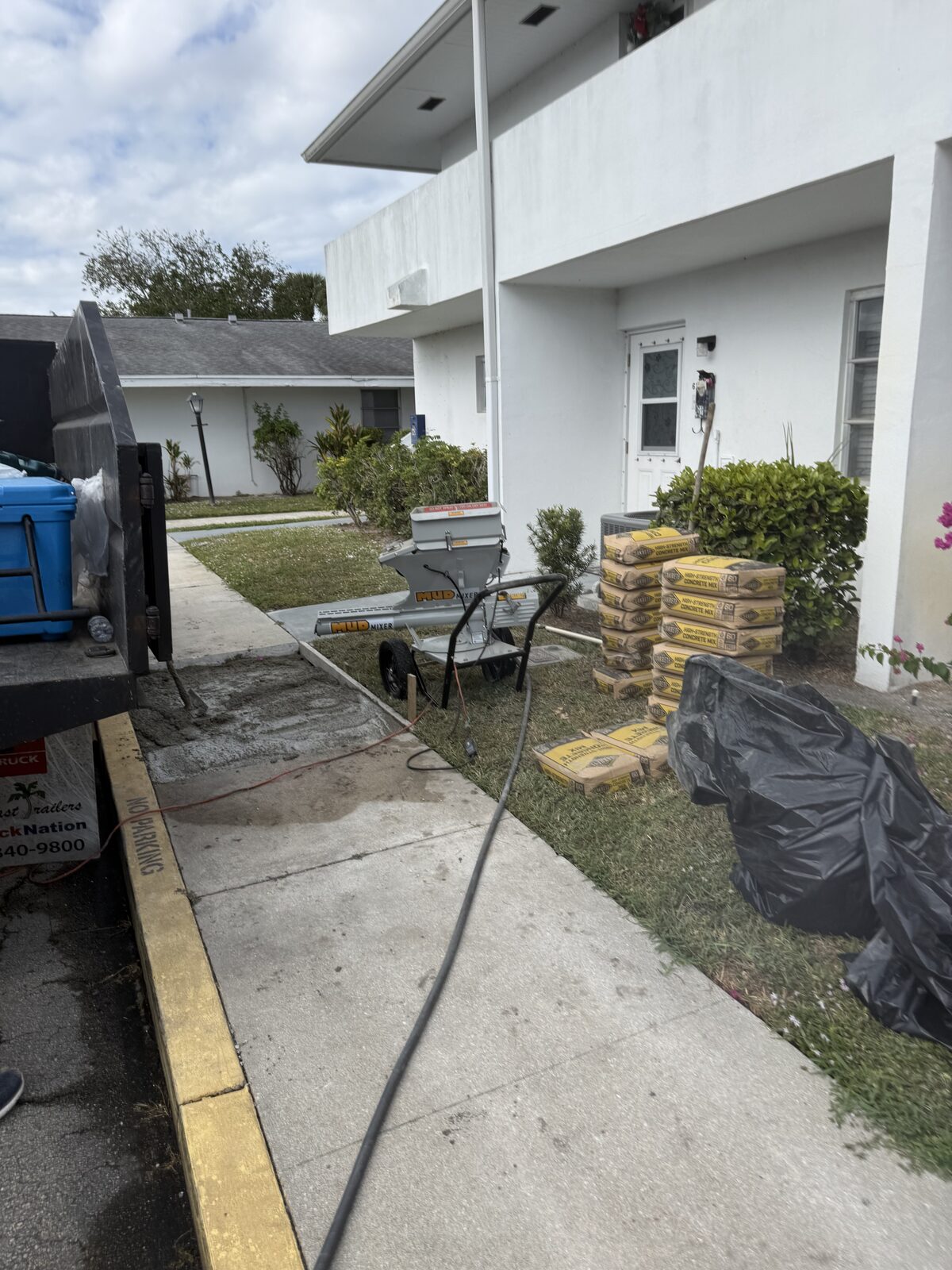
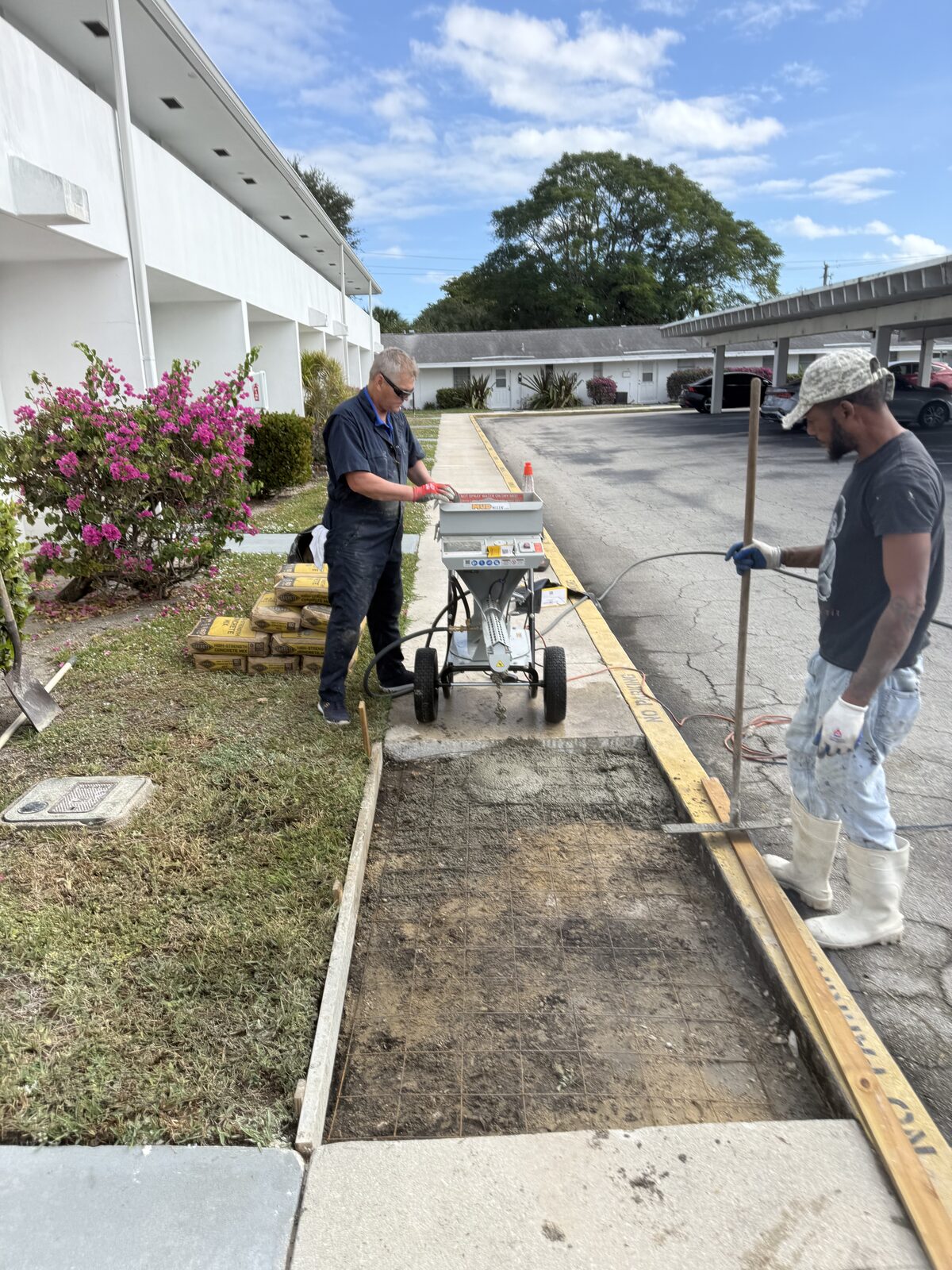
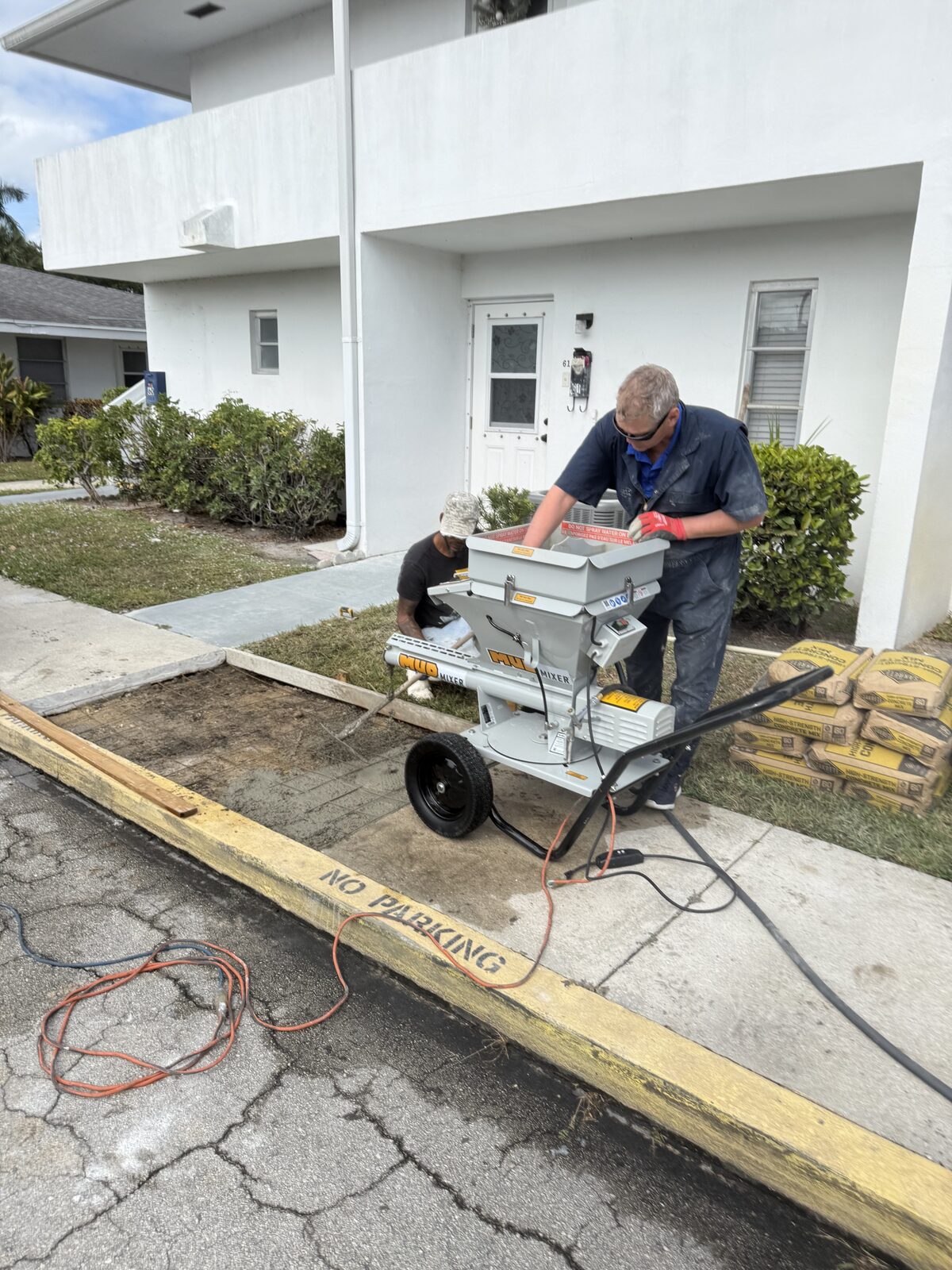
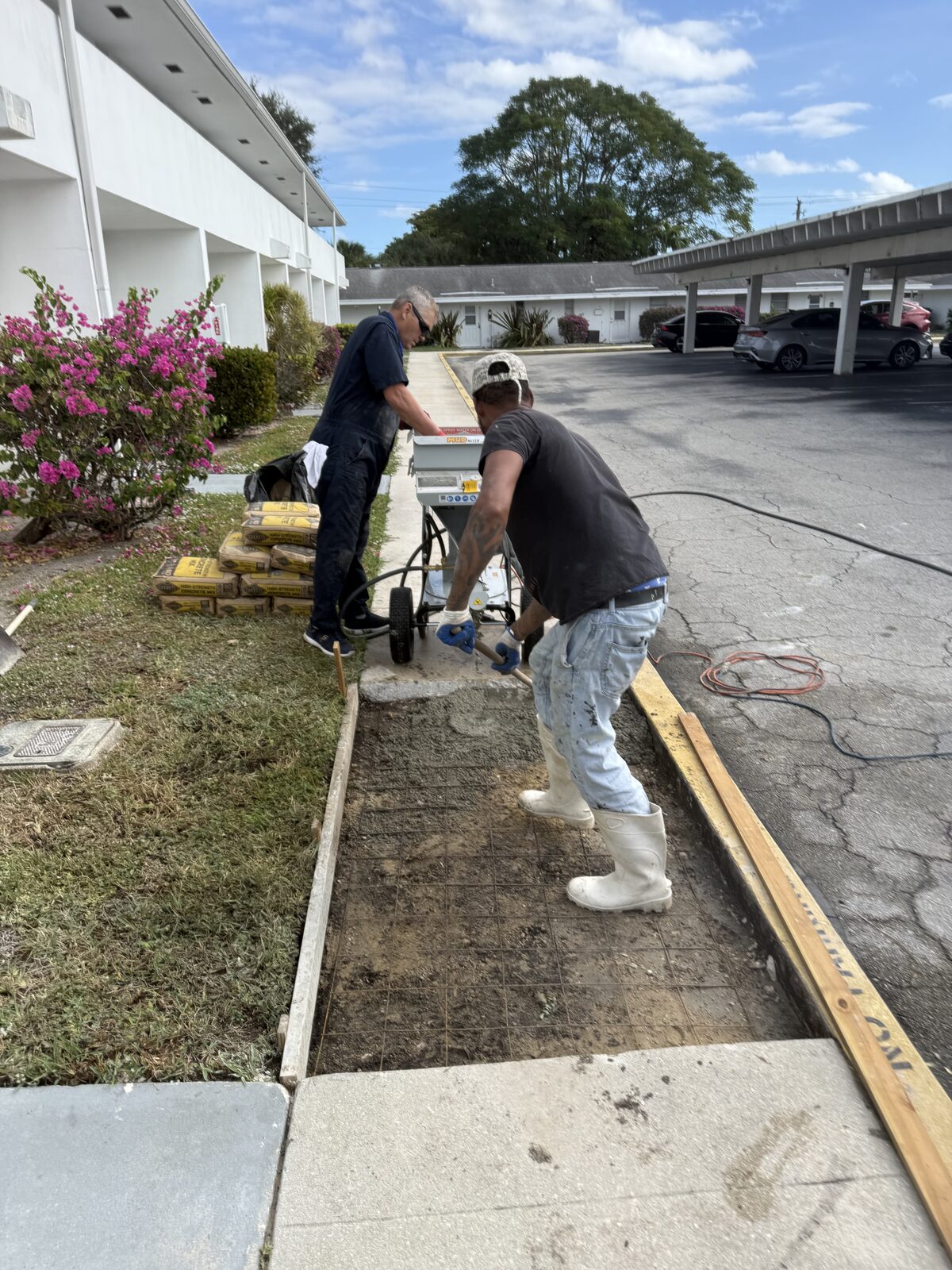
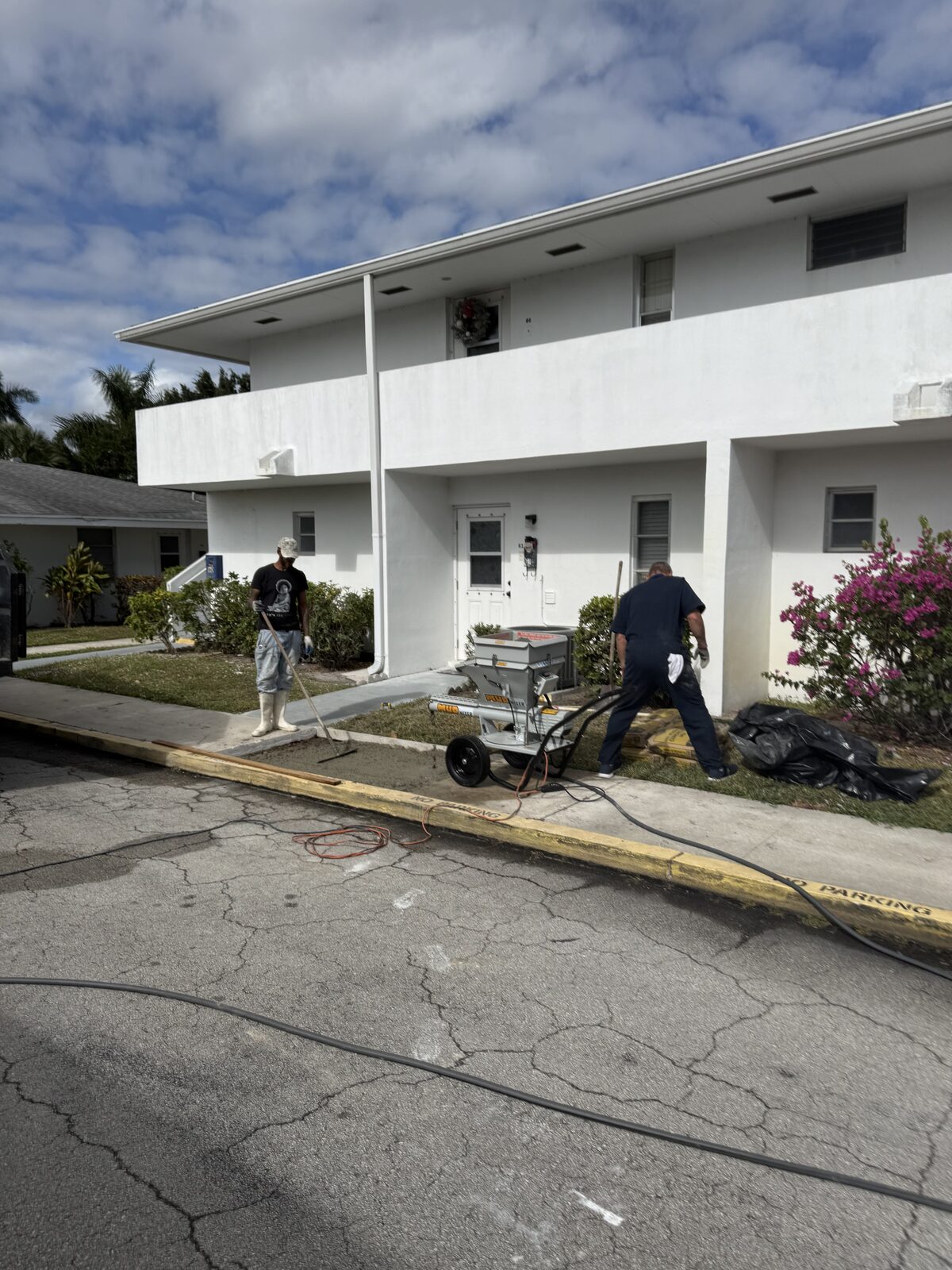
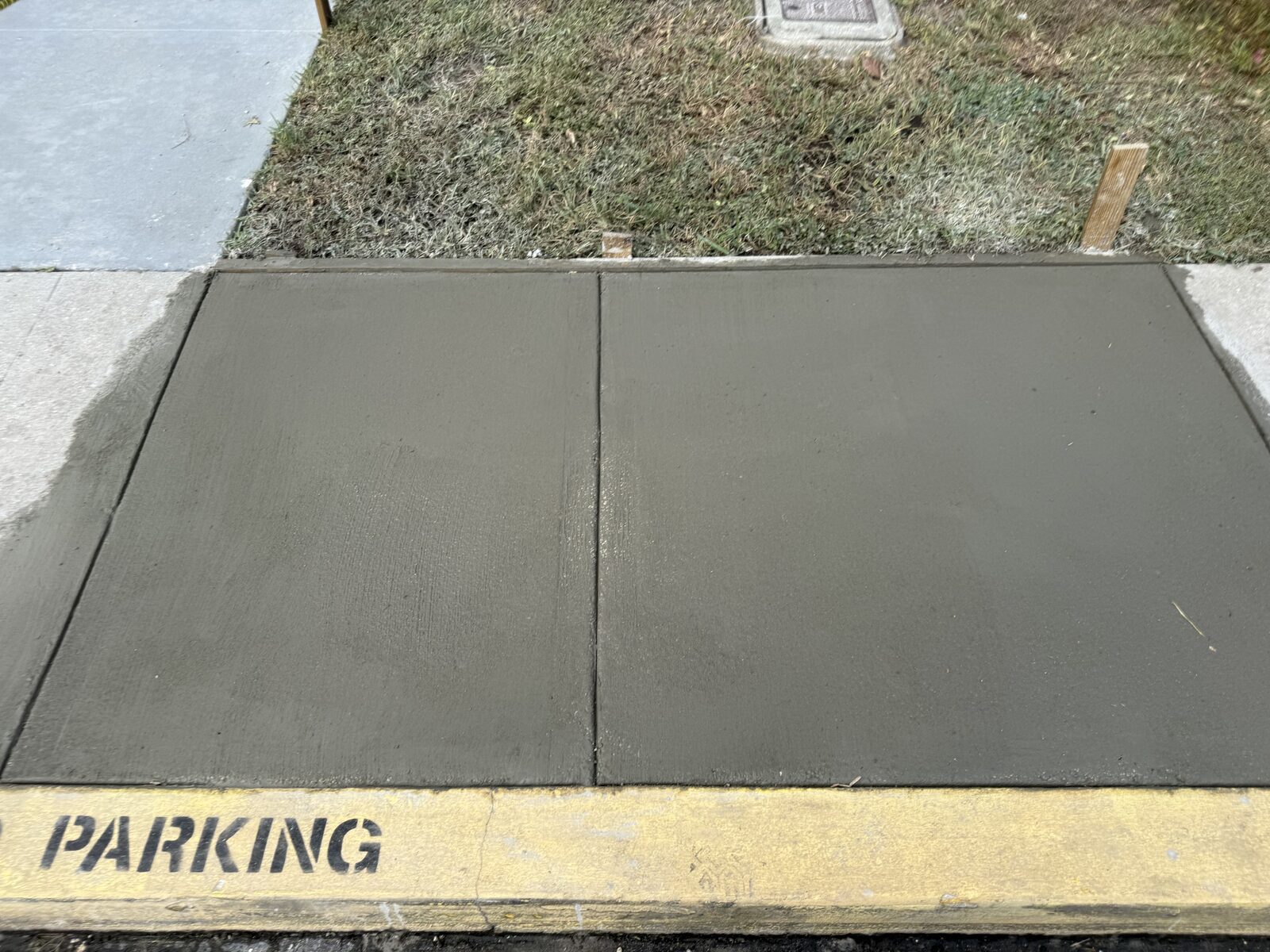
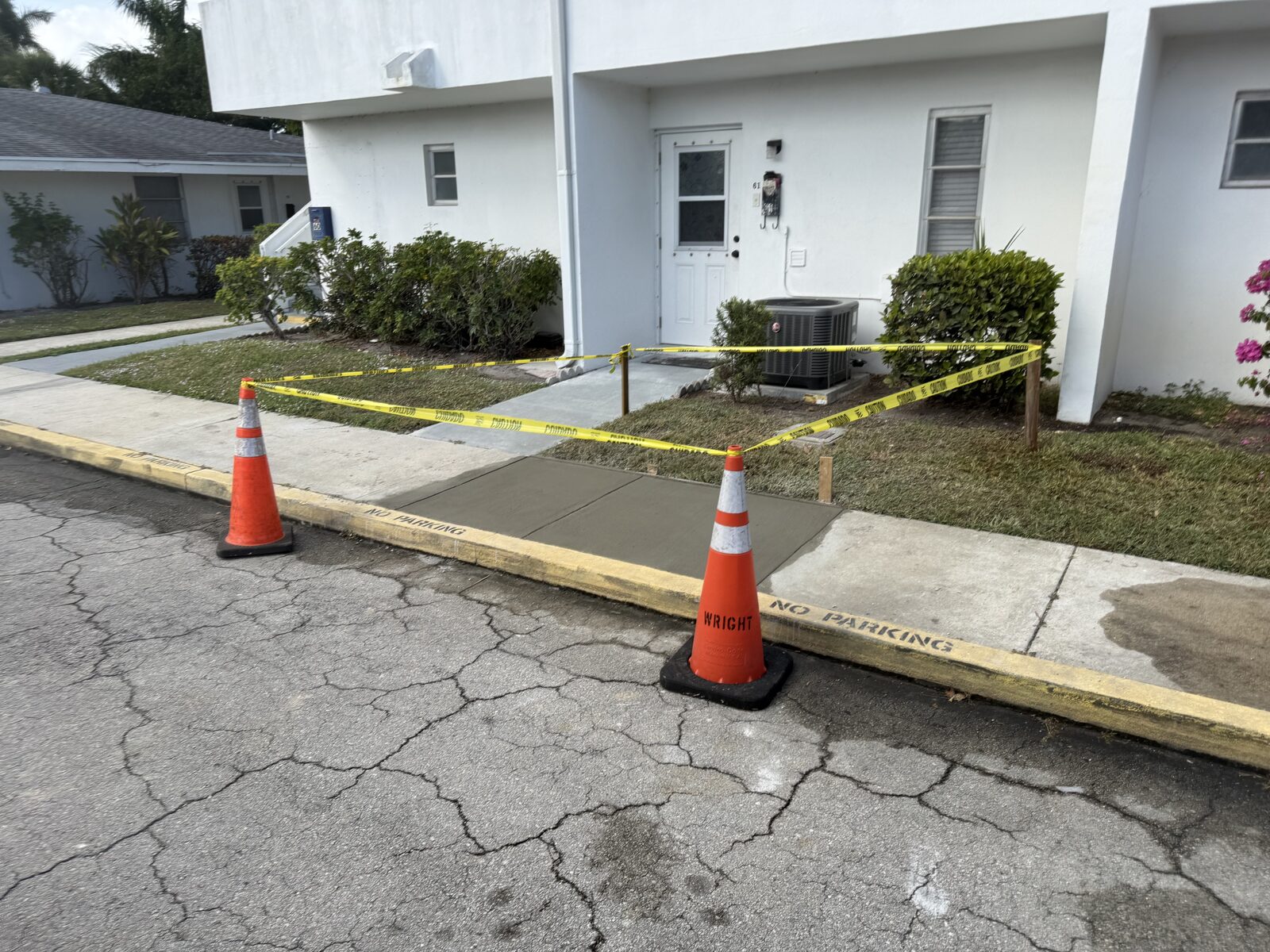
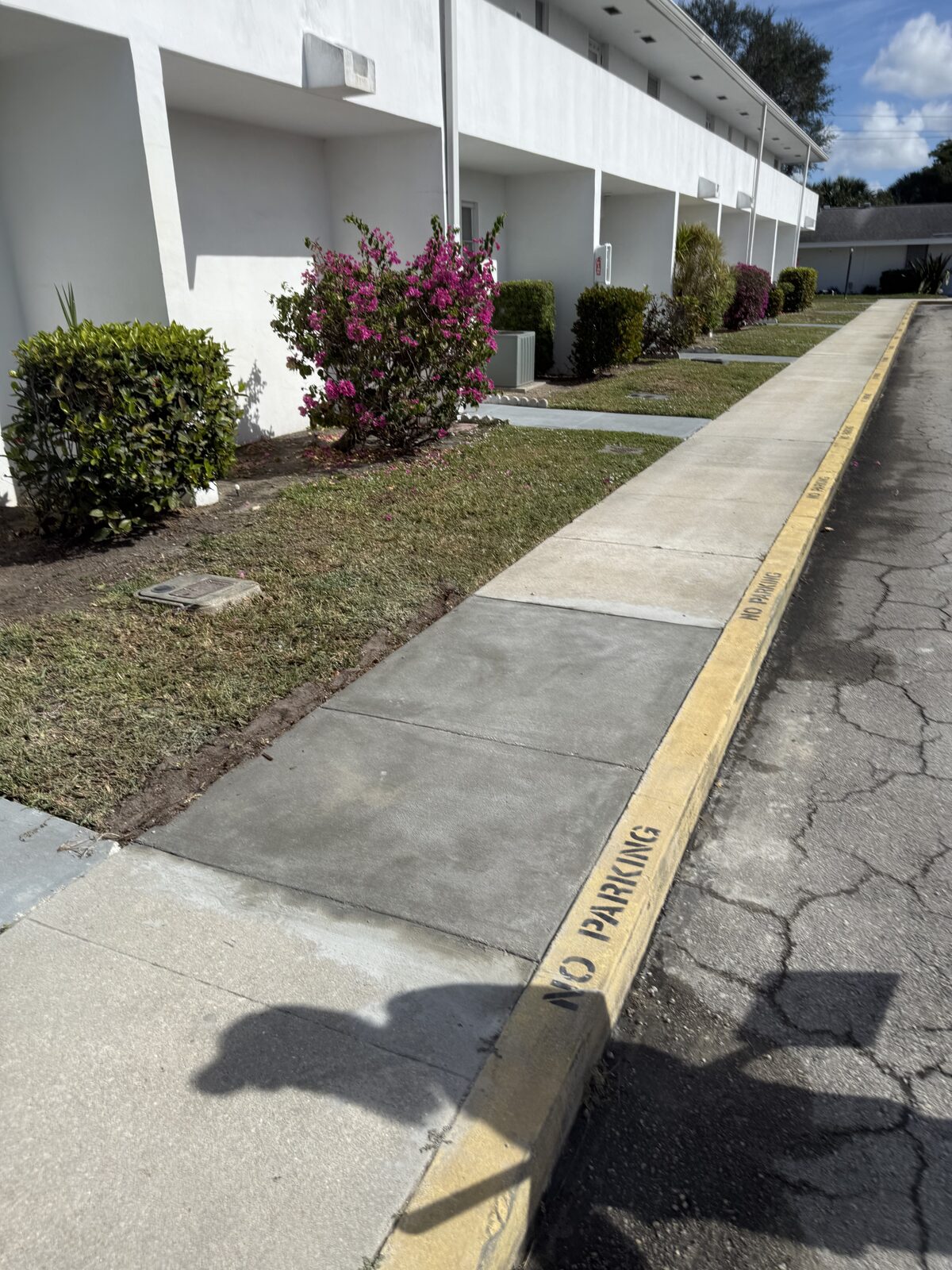
Resident walkway replacement · Greenway Village, Royal Palm Beach FL · 2025 · CGC1528750
Condo & West Palm Beach Concrete Restoration
Condo concrete restoration in Palm Beach County is spalling, exposed-rebar and slab repair on balconies, stairs, walkways, parking decks and pool decks, scoped by an engineer and executed by a licensed general contractor (CGC1528750) for the association. Concrete restoration in West Palm Beach is the same trade at single-family scale as well: our 2025 beam and lintel restoration over a patio opening there was shored, demolished, re-steeled, reformed and repoured under a permit pulled through the Palm Beach County Building Department. Call (561) 779-3213 for a quote.
Boards get a written scope, a phased schedule that keeps access open and a one-year written workmanship warranty. Homeowners get the same. The documented jobs are in the project log above; see also the milestone inspection section below.
By town: West Palm Beach · Palm Beach Gardens · Royal Palm Beach · Wellington · Loxahatchee · The Acreage · Boynton Beach · Delray Beach · Jupiter · Greenacres · Lake Worth · Palm Springs
The Local Problem
Concrete does not simply wear out here — it corrodes from the inside. Palm Beach County sits in one of the harshest environments in the country for reinforced concrete: salt-laden coastal air, year-round humidity, driving rain, and standing heat. Those chlorides work their way through the concrete cover and reach the steel reinforcing bar buried inside every slab, beam, balcony, and column.
When rebar rusts, it expands — up to several times its original volume. That pressure fractures the surrounding concrete from within, and it breaks away in sheets and chunks. That’s spalling. The rust stains, the hollow-sounding patches, the flaking undersides of balconies and the crumbling edges of pool decks are all the same failure at different stages. The moment steel is exposed, the corrosion accelerates, because now moisture reaches it directly.
This is why a hairline crack ignored for two seasons becomes a structural repair by the third. The damage you can see is almost always smaller than the damage inside. We sound out the full extent before we quote, so the price reflects the real repair — not a patch that fails again next year.
Condos & Associations
Since 2022, Florida law (SB 4-D, since amended) requires a milestone structural inspection for every condominium and cooperative building three or more habitable stories tall — at 30 years from the certificate of occupancy, or as early as 25 years if the building sits within three miles of the coastline. Many local governments, Palm Beach County included, also run separate recertification programs that reach other building types. When one of these inspections turns up spalling, cracked columns, or corroded rebar, the association needs a licensed contractor who can turn an engineer’s findings into finished, documented repairs.
If a Phase 1 inspection flags substantial deterioration, a Phase 2 assessment follows, and required repairs must be underway within the timeline the law sets. Boards are working against a clock, a reserve budget, and residents who still live in the building. We understand all three — because we also run BeacCorp Property Management and have sat on the association side of these projects. We execute the engineer-specified scope, phase the work so units stay accessible, protect walkways and parking, and hand back a clean paper trail for the association’s records and the county.
Call it what it is: condo concrete restoration in Palm Beach County is a board decision, not a homeowner one. The buyer isn’t a single family sounding out a cracked driveway — it’s a board spending reserve funds on behalf of every unit owner in the building, answering to residents who want to know why the walkway is barricaded and to a management company that needs the paperwork to match the budget. That changes what we hand over as much as how we build: an engineer-specified scope executed and documented, a certificate of insurance naming the association, and a phased schedule that keeps the building livable while the work is underway. Our West Palm Beach beam restoration and the Greenway Village carport and walkway jobs in the project log above were both exactly that kind of board-directed work, start to finish.
What it looks like from the board's side. In 2011 Randolph Scott Bell was the manager of North Ocean One, an oceanfront condominium in Palm Beach, and oversaw its balcony and column restoration from the owners' side of the table: shoring, access for residents, the contractor's schedule, and the board's questions. The photos below are from that project. It is why BeacCorp can tell a board what a restoration will actually involve before the first inspection report lands.
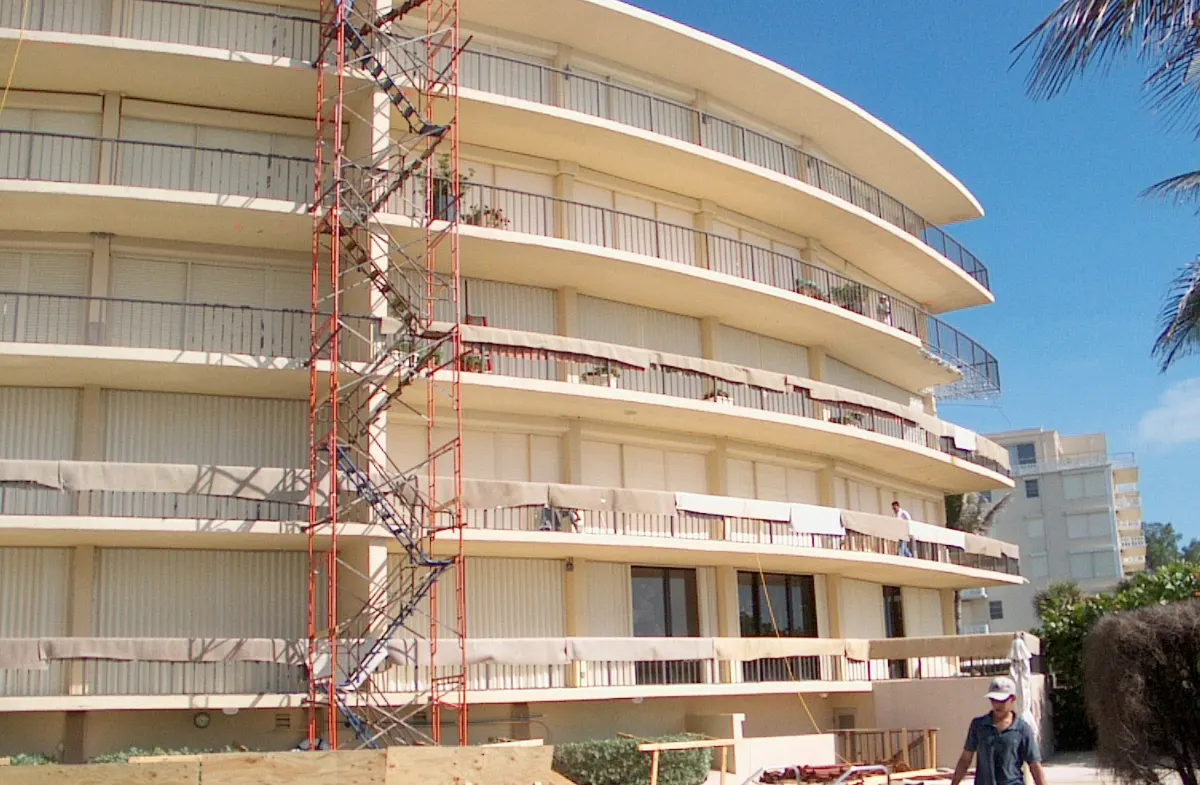
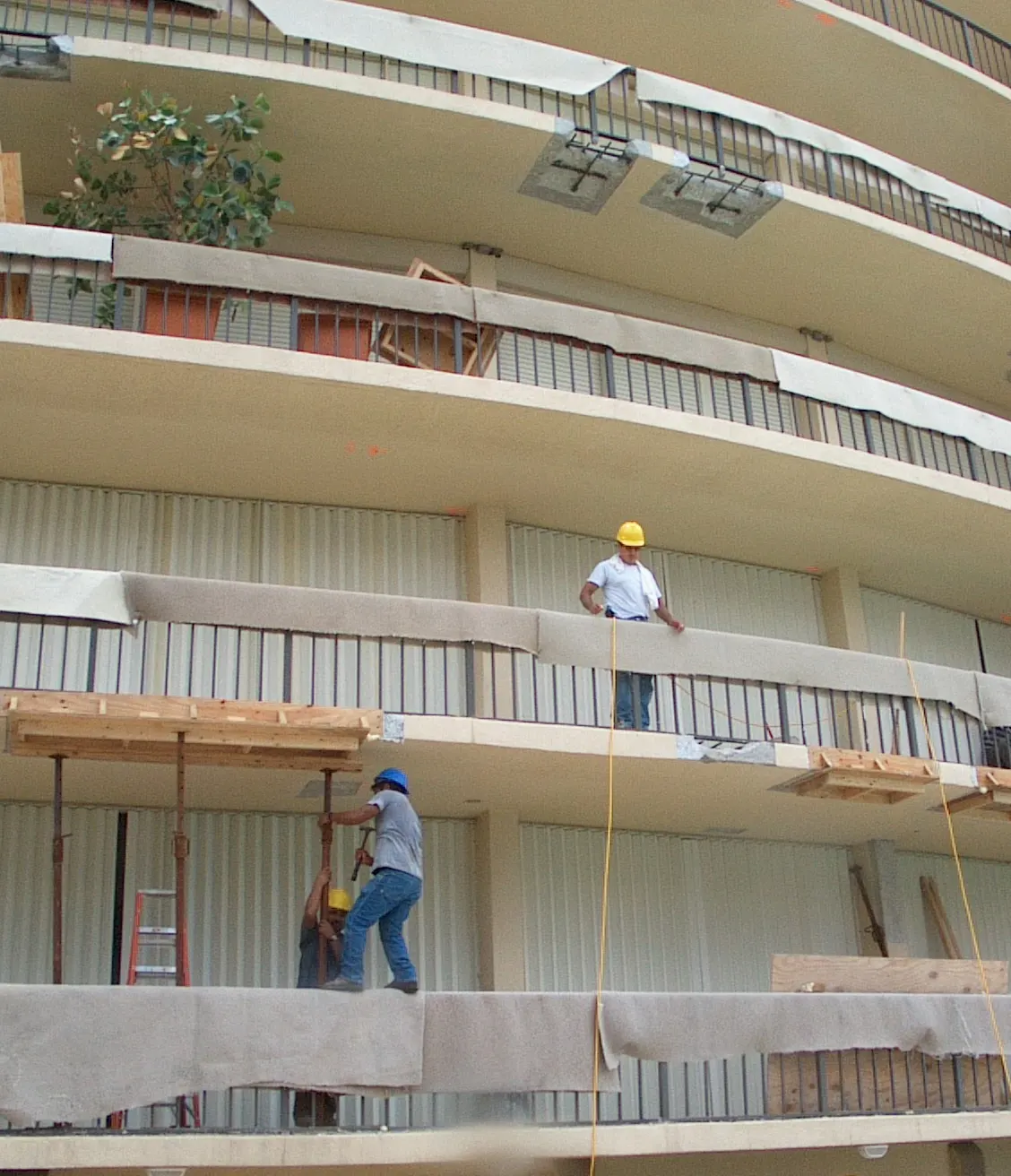
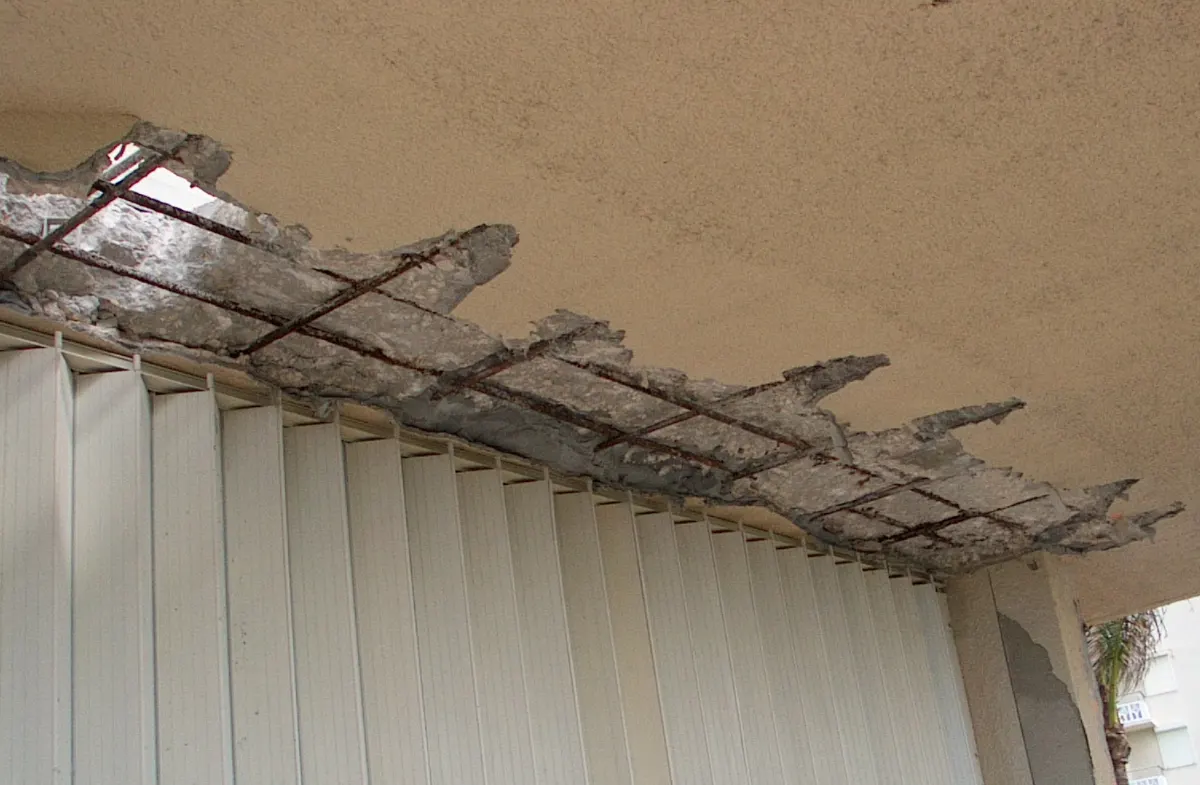
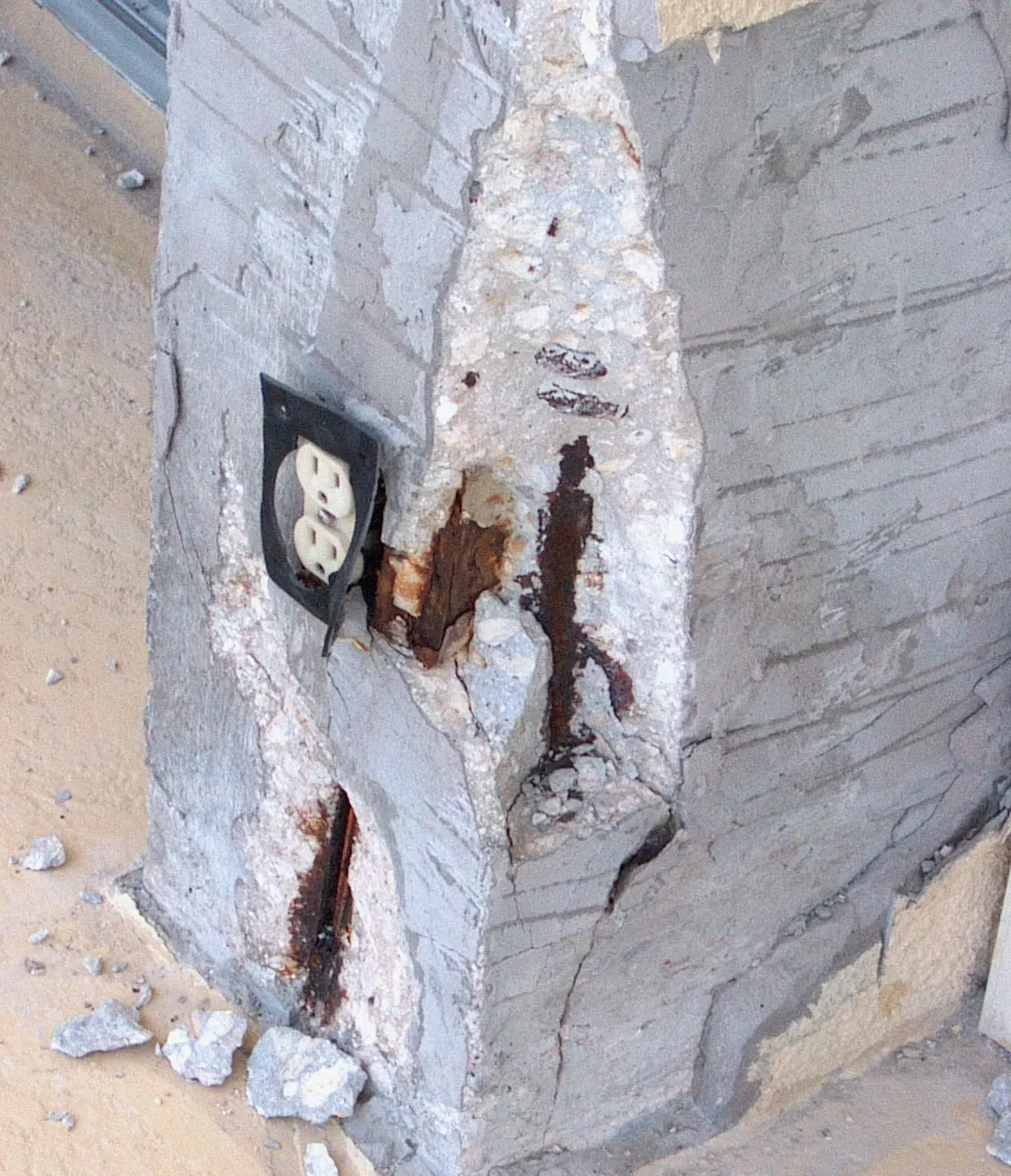
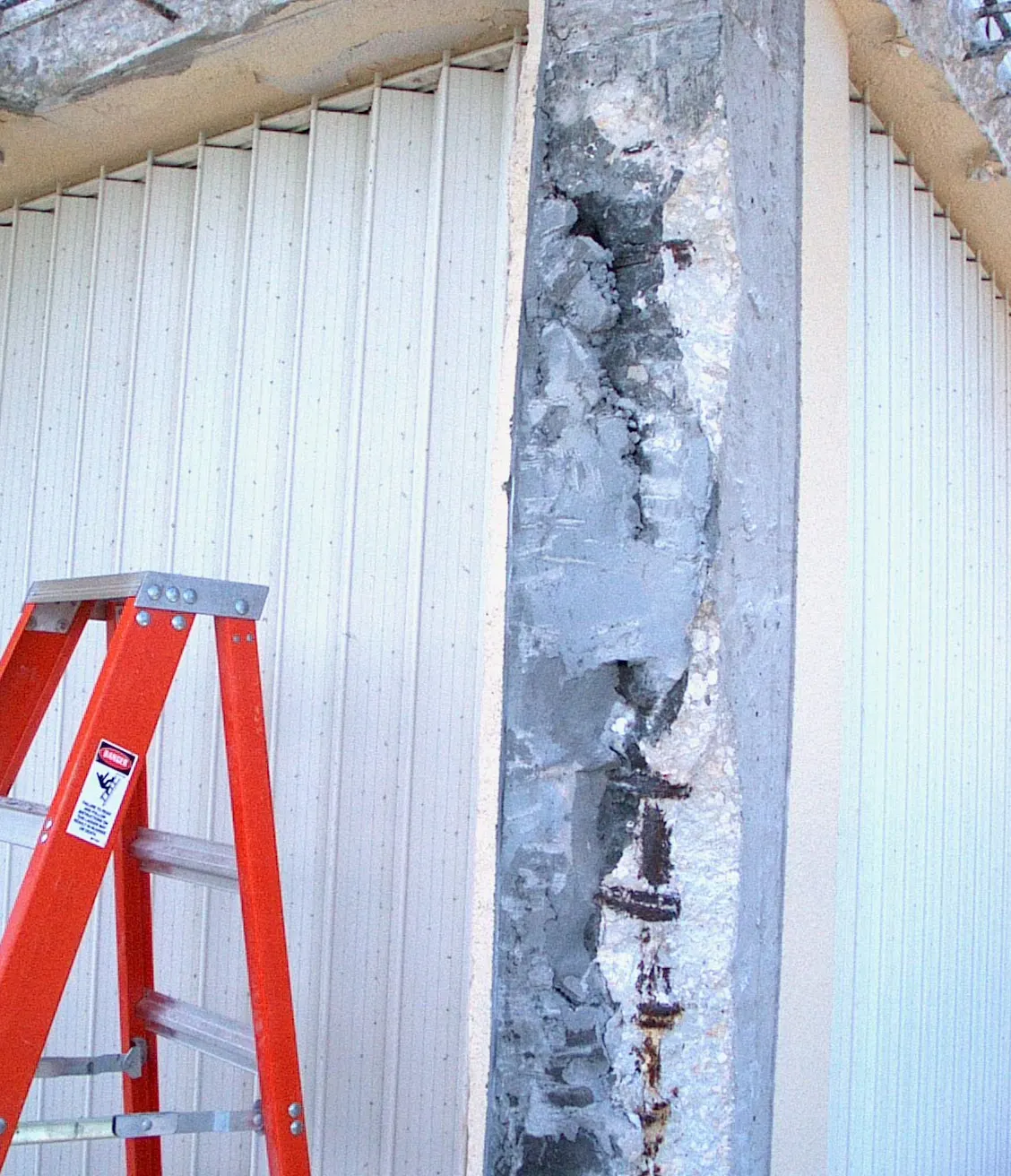
Balcony and column restoration · North Ocean One, Palm Beach FL · completed 2011 · managed and overseen by Randolph Scott Bell
Method
A lasting repair is about the steel as much as the concrete. Cosmetic patching over rusting rebar simply hides the problem until it pushes the patch back off. Our process is built to stop the corrosion, not cover it:
Every job comes with a written scope and schedule up front, and a licensed general contractor (CGC1528750) standing behind the work. Salt air will always be here — our job is to give your concrete decades more before it wins.
Repair, Resurface, or Replace
Not every damaged slab needs the same fix, and the right call depends on what’s actually happening below the surface. Scaling is shallow — a thin layer of the top surface peels or flakes away, usually from weathering, poor finishing, or years of pressure-washing. It’s cosmetic and it resurfaces cleanly. Spalling is different: it’s thick, broken-away chunks that expose the aggregate or the rebar underneath, and it comes from corrosion pressure building from the inside out. A patch or overlay placed on top of active spalling without treating the steel first will bond to a substrate that’s still failing, and it will crack loose again.
As a general rule: light surface chipping, discoloration, or shallow scaling can usually be resurfaced with a fresh overlay. Widespread or repeated spalling in the same area, cracks that have opened wide enough to see daylight or rebar, or any give underfoot on a balcony or stair usually means cutting back to solid material and rebuilding the section structurally before any cosmetic finish goes on. If a slab has lost structural integrity — noticeable movement, sinking, or a support member that’s failed — resurfacing won’t stop that, and replacement is the honest answer. We tell you which category your concrete is in before we quote, not after.
Pool Decks
Pool decks take more abuse than any other flatwork on a South Florida property. They carry constant sun and UV exposure, direct heat, chlorine or salt splash-out, and pool chemicals that shift the surface pH over time — on top of the same rebar-corrosion risk as every other slab in coastal air. That combination is why pool decks are often the first concrete on a property to show scaling, cracking, or an uneven, hollow-sounding edge near the coping.
Most pool deck damage is surface-level and a good candidate for resurfacing rather than a full tear-out — but only after any cracked or delaminating coating is fully removed and any spalled section is repaired down to sound concrete first. Skipping that step is the single most common reason a pool deck resurfacing job fails early. Done right, a properly repaired and resurfaced deck also gives you the chance to add a slip-resistant, cooler-underfoot finish — worth asking about if bare concrete around your pool gets uncomfortably hot in summer.
Repair, Protection, Durability
Salt air, summer humidity and daily rain keep working on concrete in West Palm Beach long after it was poured. Moisture reaches the steel inside, the steel rusts and swells, and the concrete around it cracks and breaks away. That is why most structural concrete repair is a matter of finding how far the damage runs, not only fixing the part you can see.
A repair that lasts follows the same order every time. The damaged concrete is cut back to sound material. The exposed steel is cleaned and treated, or replaced where it has lost section. The section is rebuilt to its original profile, and the surface is finished to match. Where the area is exposed to weather and foot traffic, such as a balcony, walkway or pool deck, a protective coating over the repaired surface helps keep water out of the next round of corrosion.
Different surfaces call for different repairs. A balcony slab or column is structural, so the work follows the engineer’s scope and is documented. A beam over a door or window opening is shored before anything is removed. A pool deck, driveway or sidewalk is more often a surface and flatwork job, though a spalled patch still gets cut out and rebuilt before anything cosmetic goes on top. We say which one you have before you spend anything, because the honest answer changes the repair.
If you are looking for balcony repair near me, or for concrete restoration near me for a condominium building, the first step is the same: call (561) 779-3213 or request a free estimate, and we will look at the concrete in person. See the project log above for three jobs we photographed start to finish, or read about selective and structural demolition when a failed section has to come out first.
Questions, Answered
Bell Engineering & Construction — a Florida state-certified general contractor (CGC1528750) and state-certified roofing contractor (CCC1332751), insured, and a BBB A+ Accredited Business. We handle spalling, exposed rebar, balconies, stairs, slabs and structural repair across Palm Beach County, with photographed jobs in West Palm Beach and Royal Palm Beach on this page.
Yes. Our 2025 West Palm Beach structural beam restoration — shored, permitted through the Palm Beach County Building Department, and rebuilt to spec — is photographed start to finish in the project log on this page. We also handle West Palm Beach spalling repair, balconies, stairs and slabs.
Spalling is concrete cracking and flaking off as the steel rebar inside rusts and expands — salt air and moisture drive it. Left alone it spreads and becomes structural. Caught early, it's a repair; caught late, it's a rebuild.
Yes. With Florida's milestone inspection requirements, associations need licensed contractors who can execute engineer-specified repair scopes and document the work. We also run BeacCorp Property Management, so we know exactly how boards and budgets work.
Yes. Condo concrete restoration in Palm Beach County is a board decision, not a homeowner one — the buyer is the association spending reserve funds on behalf of every unit owner, not a single family sounding out a driveway crack. That means an engineer-specified scope executed and documented, a certificate of insurance naming the association, and a phased schedule that keeps the building livable while the work is underway. Our West Palm Beach beam restoration and the Greenway Village carport and walkway jobs in the project log on this page were both board-directed work of exactly that kind.
Yes — stairs and balconies are our bread and butter, from form-and-pour new construction to cutting out failed sections and restoring them structurally. See the project photos below.
A small spalling repair can be days; a balcony run on an occupied building is phased over weeks. Every job gets a written schedule up front, and we protect access while we work.
Most spalling is repaired, not replaced. We cut out the damaged concrete back to solid material, treat or replace the exposed rebar, and rebuild the section to its original profile. Full replacement only comes into play when deterioration is widespread and structural — which is exactly why catching it early is so much cheaper.
It depends entirely on the extent — a single spalled step is a different job from a full balcony line or a parking-deck column. Because the hidden damage is often larger than what shows, we sound out the real scope before quoting so the estimate reflects the actual repair. Every estimate is free; call (561) 779-3213.
Yes. When an engineer’s milestone or recertification report specifies structural concrete repairs, we execute that scope as a licensed general contractor and document the work for the association and the county. We phase the job so residents keep access throughout.
We restore the section to its original profile and finish, and match texture and coatings as closely as the existing surface allows. On balconies, walkways, and decks we can also apply a uniform protective coating over the area so the repair reads as one continuous surface rather than a patch.
Yes — Bell Engineering & Construction is a licensed Florida general contractor (CGC1528750) and roofing contractor (CCC1332751), insured, and a BBB A+ Accredited Business. Structural concrete repair should always be done by a licensed contractor working to the engineer’s specifications; unlicensed patching can void warranties and fail inspection.
Scaling is shallow surface peeling or flaking — cosmetic, and it resurfaces cleanly. Spalling is deeper: thick chunks break away and expose the aggregate or the rebar underneath, driven by corrosion pressure from inside the slab. Scaling is a resurfacing job; active spalling needs the steel treated before anything cosmetic goes on top.
Usually, yes — most pool deck damage is surface-level. But any cracked or delaminating coating has to be fully removed and any spalled section repaired down to sound concrete first, or the new finish will fail early. We inspect the deck and tell you honestly whether it's a resurfacing job or needs structural repair underneath.
Hairline cracks with no movement, height difference, or exposed steel are typically cosmetic. Cracks wide enough to see daylight or rebar, cracks that keep growing, or any sinking, movement, or give underfoot are structural warning signs. If you're unsure, it's worth a look before it becomes a bigger repair — we'll tell you straight which one you have.
Structural concrete repair is generally permitted work, and which office issues that permit depends on where you are — several Palm Beach County municipalities run their own building departments, while unincorporated areas go through the Palm Beach County Building Division. On our 2025 West Palm Beach beam restoration the permit was pulled through the Palm Beach County Building Department. We prepare the permit package and carry the job through inspection, because a permitted structural repair is inspected work and leaves a record your insurer and the next buyer’s inspector can actually find.
Ordinary spalling turns up in isolated patches — a chunk here, a rust stain there. A failing beam or lintel turns up as a line: a horizontal crack running the length of a door or window opening, stucco lifting in a band directly above it, rust-coloured staining bleeding down out of that band, or a door or window that has started to bind in a frame that worked fine for thirty years. Anything running the length of an opening is the structural member talking, not the paint, and it is worth a look the same week.
Yes — the support goes in before the demolition does. A beam over an opening carries the wall, floor and roof above it every second of the day, so on our West Palm Beach job adjustable steel posts, steel channel and timber were packed tight under the second-floor slab first, and the failure was only cut out once that temporary structure was carrying the load. A contractor who proposes to open up a structural member without first telling you how the load will be carried in the meantime is telling you something important.
Yes, and we do. At Greenway Village in Royal Palm Beach we replaced a short section of resident walkway between slabs that were still sound. Panel replacement is fussier than a fresh pour, not easier — the new concrete has to match the line, grade, thickness and joint spacing of the slabs either side, because a quarter of an inch high is a new trip hazard and a quarter of an inch low is a puddle — but it costs far less than replacing a run that does not need replacing.
Not the same afternoon. Concrete sets within hours but keeps gaining strength for days, so a fresh walkway is taped, coned and closed until it can take foot traffic without marking, and the barricade stays up the whole time. We agree the reopening plan before we pour, and on occupied communities we phase the work so no resident is ever cut off from their own front door.
Both. The three jobs in the project log on this page run from two panels of resident walkway to a structural beam over an occupied home’s patio opening. A small job gets the same licensed contractor, the same written scope and schedule, and the same written one-year workmanship warranty as a large one.
Yes — with recent, photographed jobs in both, shown in the project log on this page. Bell Engineering and Construction is a Florida state-certified general contractor (CGC1528750) and state-certified roofing contractor (CCC1332751); state certification, as distinct from state registration, means we may contract anywhere in Florida without additional local licensure. We also hold local Business Tax Receipts in Palm Beach County and in the Village of Royal Palm Beach — a Business Tax Receipt is a local business tax registration, not a contractor licence; the licences are the state ones above.
Bell Engineering & Construction does, under Florida Certified General Contractor licence CGC1528750. For a condo association, concrete restoration is a board decision: an engineer's report or milestone inspection defines the scope, and we execute it as a licensed general contractor with a written schedule, phased access and documentation for the board.
Structural concrete restoration in West Palm Beach is permitted work. On our 2025 beam and lintel restoration over a patio opening there, the permit was pulled through the Palm Beach County Building Department. Which office issues a permit depends on the address, so we confirm it before we write the contract.
Yes. The Acreage is unincorporated Palm Beach County, so structural concrete permits go through the county. See our Acreage page for the local specifics on ITID, well and septic, and staging on acre-plus lots. We have no documented job there, and say so on that page.
On sound concrete, yes. A resurfacer is a thin cement-based coat that renews a worn or scaled surface such as a pool deck, patio or walkway. It does not fix what is wrong underneath: cracks that keep moving, spalled sections and corroding steel have to be cut out and repaired first, or the new surface fails early. We inspect the slab and tell you honestly whether it is a resurfacing job or a structural repair.
It depends on what is wrong with it. Stained or dull concrete is cleaned and sealed. Scaled or worn surfaces are resurfaced. Cracked or spalled sections are cut back to sound concrete, the steel is treated, and the section is rebuilt to its original profile, then a protective coating can unify the finish. The order matters: repair first, then resurface or coat, never the other way round.
We repair both. For condominium associations and building owners we carry out engineer-specified structural scopes as a licensed general contractor, with a written schedule and documentation. For homeowners it is the same licensed contractor, the same written scope and the same written one-year workmanship warranty. Every estimate is free.
Free estimate and a licensed contractor.