Buying a condominium in Florida is two purchases at once. You are buying a unit, and you are buying an undivided share of a corporation that owns a building. The unit is the easy part. The building, its reserves and its politics are what decide whether this was a good buy.
Do these five things, in this order:
- 1 · Count the habitable stories. Three or more, and the milestone inspection and the structural integrity reserve study both apply, and there are reports you can demand. Under three, neither applies and you have to reconstruct the same picture from the association's own records.
- 2 · Get every document the seller owes you under Florida Statute 718.503(2) — and note that your cancellation clock does not start until you have actually received them.
- 3 · Read the money, not the marketing. The reserve study, the current budget, twelve months of board minutes and the assessment history tell you what the next five years cost.
- 4 · Order the estoppel certificate early. It is the association's own written statement of what is owed on that unit, and the law puts it on a clock.
- 5 · Let your lender and your insurance agent look at the association before your inspection period ends. Both of them review the building separately from you, and either one can end the deal.
Everything below is general information to help you ask better questions of your agent, your attorney, your lender and the association — not legal, insurance or engineering advice. Florida's condominium statutes have been amended in nearly every session since 2022 and the details change; confirm the current requirements for your specific building before you rely on them. When you want one person who can read the documents and then walk the building, call (561) 779-3213.
Everything Florida has passed since the Surfside collapse — the milestone inspection at Florida Statute 553.899 and the structural integrity reserve study at 718.112(2)(g) — is written for condominium and cooperative buildings that are three habitable stories or more in height.
That single phrase splits this county's condo market in half. A high-rise on the Intracoastal and a 1978 garden building in Greenacres are governed by two different bodies of law and, in practice, require two completely different due-diligence jobs from a buyer. Note also that under the 2025 amendments, floors used only for parking, storage or mechanical equipment may not count toward the three-story threshold — so a building's story count is a question to confirm, not to eyeball from the parking lot.
- Milestone inspection report + inspector's summary
- Structural integrity reserve study (SIRS)
- Mandatory reserve funding for the SIRS items
- Repair deadlines that run whether or not the money exists
- No milestone inspection required
- No SIRS, and reserves may still be waived
- Roofs, walkways, plumbing and paint age anyway
- The special assessment arrives with no warning document
On a resale — a purchase from an ordinary unit owner rather than a developer — Florida Statute 718.503(2) requires the seller, at the seller's expense, to furnish the buyer a defined package of documents:
- 📕 The declaration of condominium — the document that says what you own and what the association owns.
- 📗 Articles of incorporation, bylaws and rules.
- 📊 The most recent year-end financial statement and the annual budget.
- 🏗️ The inspector-prepared summary of the milestone inspection report, where s. 553.899 applies to the building.
- 🧱 The most recent structural integrity reserve study — or a statement that the association has not completed one.
- 🔍 The turnover inspection report, for inspections performed on or after July 1, 2023.
- ❓ The "Frequently Asked Questions and Answers" sheet required by s. 718.504.
Then comes the part buyers routinely give away. The statute makes the contract voidable — the buyer may cancel within 7 days, excluding Saturdays, Sundays and legal holidays, running from the later of the date the buyer signs and the date the buyer receives the documents. (That seven-day version applies to contracts executed on or after July 1, 2025; older contracts ran on a three-day rule.) The right terminates at closing.
Two more documents are not on the statutory list and are worth more than most of the ones that are: twelve months of board meeting minutes and the association's insurance declarations page. Minutes are where a special assessment is discussed for a year before it is voted. The declarations page is where you find the master policy's deductible, which in a windstorm year is the number that becomes your bill.
The milestone inspection at s. 553.899 applies to condominium and cooperative buildings three habitable stories or more, by 30 years of age from the certificate of occupancy and every 10 years after that. A local enforcement agency may require it at 25 years for buildings in coastal areas near salt water. It must be performed by an architect licensed under Chapter 481 or an engineer licensed under Chapter 471 — a general contractor cannot perform one, which is exactly why we send clients to an engineer and read the result rather than pretending otherwise.
What you are looking for is which phase the building is in:
- Phase one is a visual examination of habitable and non-habitable areas and a qualitative assessment of structural condition. A clean phase one is genuinely good news. It must be completed within 180 days after the local notice.
- Phase two is only triggered when phase one finds substantial structural deterioration, and it may involve destructive or non-destructive testing. A phase two report progresses on its own 180-day clock, and repairs must commence within 365 days after the association receives that report.
Read those deadlines as a budget, not as trivia. A repair clock that runs regardless of the reserve balance is the mechanism by which a special assessment becomes unavoidable. If you are buying into a building with a live phase two, ask three questions in writing: what is the engineer's cost opinion, what has the board funded so far, and what is the assessment schedule per unit? "The board is still evaluating options" one year into a 365-day clock is an answer in itself.
The association must distribute the inspector-prepared summary to unit owners and post it conspicuously, and publish the report and summary on its website where it is required to maintain one. If nobody can produce the summary for a building that plainly qualifies, that is your finding — treat a missing document as information rather than a delay.
If you want to see the same process from the board's chair — every statutory clock, which age trigger Palm Beach County applies where, and what the association is obliged to do next — read our milestone inspection & SIRS guide for Palm Beach County boards. Knowing what the board is required to be doing is the fastest way to tell whether yours is doing it.
A structural integrity reserve study under s. 718.112(2)(g) is required for condominium and cooperative buildings three habitable stories or higher, at least every 10 years. It must cover the roof; the structure, including load-bearing walls and primary structural members; the floor; the foundation; fireproofing and fire protection systems; plumbing; electrical systems; waterproofing and exterior painting; and windows and exterior doors — plus any other item whose deferred maintenance or replacement cost exceeds $25,000 (or the inflation-adjusted figure set by the division, whichever is greater) where its failure would negatively affect one of those components.
Associations in existence before July 1, 2022 had to complete the initial study by December 31, 2025 — or by December 31, 2026 where the study is being done alongside a milestone inspection. So in 2026 "we don't have one yet" can still be lawful. The question to ask is which deadline the association is working to, and whether the engineer is engaged.
When you have the study, do the arithmetic nobody does. The SIRS says what the building needs to be putting away each year. The budget says what it is actually collecting. The difference between those two numbers, multiplied by the years it has been running, is the bill that has not been sent yet. Divide it by the number of units and you have your share of it. That single calculation is worth more than every photograph in the listing.
The old Florida habit of voting reserves down to nothing each year is over for the structural items. For budgets adopted on or after December 31, 2024, a unit-owner-controlled association may no longer vote to fund the SIRS components at less than the study requires.
The 2025 legislation added one narrow release valve: through December 31, 2028, a board may pause those contributions for no more than two consecutive annual budgets where a milestone inspection was completed within the prior two years and the money is going into the resulting repairs.
For a buyer, a pause is not a saving. It is a disclosure. It tells you the building is in the middle of structural work, that the reserve line has been temporarily redirected, and that the pause has an expiry date which may well fall during your ownership. Ask when the pause began, what it funded, and what the contribution returns to when it ends. The board side of this — how associations budget, commission and document all of it — is covered in depth on our property management board-compliance section and our HOA and condominium management page.
An estoppel certificate is the association's binding written statement of what is owed on that specific unit as of a specific date. It comes up at closing, but it should be ordered far earlier than that, because it is the one document where the association has to commit itself in writing.
Florida Statute 718.116(8) puts it on a clock and a price list. The association must issue the certificate within 10 business days of a written or electronic request from the owner, a mortgagee, or their designee. As the statute currently reads, the preparation-and-delivery fee may not exceed $250; if a delinquent amount is owed on the unit, an additional fee of no more than $150 is permitted; and an expedited certificate delivered within 3 business days may carry an additional $100. If the association misses the 10-business-day deadline, no fee may be charged at all. If the sale does not close within 30 days, the fee is refundable on request with documentation. A certificate delivered by hand or electronically is effective for 30 days; by regular mail, 35.
Read past the balance due. The certificate is also where you learn whether there is a special assessment already levied and how its installments run, whether the seller's account is delinquent, whether the association requires board approval of the purchaser, whether it holds a right of first refusal, and what insurance the association maintains. Any one of those can change your closing date.
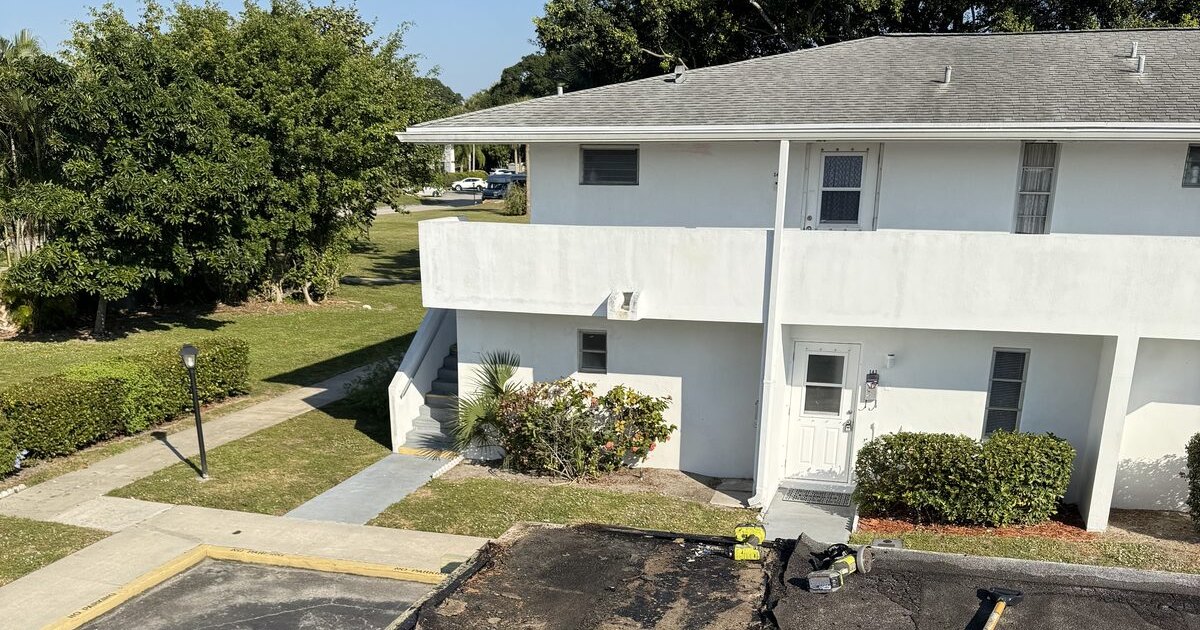
Much of the county's attainable condo inventory — a great deal of it 55+ — is two-story garden buildings put up in the 1970s and 1980s west of I-95, in Greenacres, Lake Worth, Palm Springs and Boynton Beach. Our own current listing is a 1978 building of exactly that kind. None of the structural statutes above reach it. Here is what to request instead, and it is not a short list because nobody else is generating it for you:
- 🧾 The reserve schedule, whatever they call it — even without a SIRS, most associations track roofs, paint and paving somewhere. If nothing exists, that is the answer.
- 📅 Assessment history for five years — regular assessments and every special assessment, with what each one paid for.
- 🏠 Roof age and the permit record for every building, not just yours. Roof age drives the association's insurance the same way it drives a single-family policy — see roof age and Florida homeowners insurance.
- 🧱 Concrete condition on stairs, walkways, balconies and carports — rust staining, a crack running in a straight line above an opening, or a patch that has been patched twice. That is where deterioration shows up first in two-story construction, and it is what our concrete restoration project log documents job by job.
- 💧 Exterior paint age — on block construction, paint is waterproofing. An association ten years past its paint cycle is carrying a water-intrusion liability it has not priced.
- 🚿 Original plumbing and electrical — cast iron drain lines, polybutylene supply, aluminum branch wiring and Federal Pacific or Zinsco panels are all insurance questions before they are repair questions.
- 🪟 Who owns the windows — read the declaration. If windows and doors are the unit owner's responsibility, opening protection is your bill, and the association's architectural rules govern what you may install. Our impact windows and doors page covers what code-approved replacement involves.
- 📜 Leasing and occupancy restrictions — minimum lease terms, waiting periods after purchase, age restrictions, pet and vehicle rules. In a 55+ community, verify the exact occupancy rule against the declaration rather than the sales sheet.
The general contractor's license (CGC1528750) is the part of the credential stack that matters most here. You are not going to get an engineer's report on a two-story building, but you can have someone walk the property who has spent seventeen years replacing exactly these components and can tell you what he is looking at.
Your lender reviews the association, not just you. Conventional financing requires the project to be eligible, which is a separate review from your credit and income. Significant deferred maintenance, unfunded critical repairs, an active special assessment, certain litigation, thin reserve funding and very high master-policy deductibles can all make a project ineligible — and there is no public database a buyer can search, because the eligibility tools are lender-facing. This matters on your timeline: ask your loan officer to run the project review during your inspection period, not after it. A condo that only works for a cash buyer is a fact about your resale as well as your purchase.
Your insurer reviews it too. Insurance has become the mechanism through which the structural laws bite: Citizens Property Insurance is barred from issuing or renewing policies for associations and unit owners where the association has not met its milestone inspection and reserve-study obligations. Verify the current rule with your own insurance agent before relying on it — but understand the direction of travel. Compliance is no longer only a legal question; it is an insurability question, and insurability is a value question.
Then there is your own policy. The association's master policy does not cover the inside of your unit; a unit-owner (HO-6) policy does, and the coverage that buyers most often skip is loss assessment — the coverage that responds when the association assesses owners after a covered loss. Ask your agent for it by name, and ask what the association's master deductible is before you choose a limit.
Seven business days is enough time if you spend it in the right order. Print this.
- Day 1. Confirm in writing exactly which documents you received and which are missing. Request the estoppel certificate and twelve months of minutes. Send the association package to your lender.
- Day 2. Read the declaration for the boundary: who maintains the roof, windows, doors, balconies, plumbing inside walls. Everything the unit owner maintains is your future budget.
- Day 3. Milestone summary and SIRS if the building is three stories or more. Identify the phase and the funding gap.
- Day 4. Budget versus reserve schedule. Do the arithmetic in section 4. Get the insurance declarations page and the master deductible to your own agent.
- Day 5. Minutes. Read them backwards from the most recent. Look for the words engineer, assessment, roof, paint, insurance renewal and attorney.
- Day 6. Walk the property with someone who builds. Not the unit — the property. Roofs, stairs, walkways, carports, drainage, paint, the age of the mechanical equipment.
- Day 7. Decide. Proceed, renegotiate on what you found, or exercise the cancellation right in writing before it expires.
Most condominium purchases in Palm Beach County involve three different professionals who never speak to each other: an agent who reads the contract, a manager who holds the records, and a contractor who eventually does the repairs. Here they are the same person.
- REALTOR® SL3247858 (LoKation) — writes the offer and the cancellation notice.
- Licensed Community Association Manager CAM34850 and management firm CAB3255 — reads association financials, minutes and estoppels from the inside.
- Certified General Contractor CGC1528750 and Certified Roofing Contractor CCC1332751 — walks the roofs, the concrete and the openings, and prices the work if you buy it.
- Born and raised in West Palm Beach; Bell Engineering and Construction Corporation has operated here continuously since February 2009.