What Your Board Can Actually Do When a Storm Comes
Association emergency powers, the debris paperwork nobody signs until it is too late, the hurricane-protection duty that arrived in 2024, and the insurance clock that starts at landfall. Written for Palm Beach County boards by Randolph Scott Bell — licensed Community Association Manager CAM34850, Certified General Contractor CGC1528750, Certified Roofing Contractor CCC1332751.
A Florida community association gets a second, much larger set of powers during a declared emergency — s. 718.1265 for condominiums, s. 720.316 for homeowners’ associations. The board can meet on short notice, shut off utilities, declare parts of the property uninhabitable, contract on an owner’s behalf, levy a special assessment with no owner vote, and borrow against association assets. None of it switches on until a state of emergency is declared for your area, and all of it switches off again when the emergency does.
The three things that actually decide how your community comes out the other side, though, are not powers at all. They are paperwork filed months earlier (the debris right-of-entry), a specification adopted in the quiet season (hurricane protection), and a deadline that runs whether or not the board is ready (notice of claim). This page is about those three, in that order, with the Palm Beach County layer underneath.
⚠️
This is a manager’s and contractor’s reading of the law, not legal advice. It is written by a licensed CAM who is also a licensed general contractor and roofer, not by an attorney, and it cannot account for your declaration, your bylaws, your policy or your municipality. Every statute is linked to the Legislature’s own text so you can read it yourself. Your association attorney gives the binding answer on your documents, and your local emergency manager gives the binding answer on debris.
The Six Laws That Run Hurricane Season for a Board
s. 718.1265
Condo emergency powers
Thirteen lettered powers, from remote meetings to borrowing money, all keyed to an emergency under s. 252.34(4) with a declaration under s. 252.36 “in the locale in which the condominium is located.”
s. 720.316
HOA emergency powers
The parallel section for homeowners’ associations — eleven powers, same trigger, one extra qualifier: unless specifically prohibited by the declaration or other recorded governing documents.
s. 718.113(5)
Condo hurricane protection
Every residential and mixed-use condominium board must adopt hurricane protection specifications per building. Installing to them is not a material alteration.
s. 720.3035(6)
HOA hurricane protection
The HOA twin. The board or architectural committee must adopt specifications, and may not deny a conforming owner application for hurricane protection.
s. 627.70132
The claim clock
One year to give notice of a new or reopened property claim, eighteen months for a supplemental claim — measured from the date the hurricane made landfall.
44 CFR 206.224 · 42 USC 5173
The debris rules
Federal law, not association law — but it is what decides whether anyone comes down your private roads, and it needs a signature from your board first.
01 · Nothing Unlocks Until Somebody Declares
The short version: emergency powers are not a mood the board can enter. Both statutes hang the entire list on an emergency as defined in s. 252.34(4) for which a state of emergency has been declared under s. 252.36 covering your area. Before that declaration, the board has exactly the authority its documents give it on an ordinary Tuesday.
The HOA version says it most completely, and the qualifiers matter as much as the grant:
Fla. Stat. s. 720.316(1) — verbatim
“To the extent allowed by law, unless specifically prohibited by the declaration or other recorded governing documents, and consistent with s. 617.0830, the board of directors, in response to damage or injury caused by or anticipated in connection with an emergency, as defined in s. 252.34(4), for which a state of emergency is declared pursuant to s. 252.36 in the area encompassed by the association, may exercise the following powers…”
Three things fall out of that sentence. First, “or anticipated” — the powers are available before landfall, not only after, once the declaration exists. A governor’s order routinely arrives days ahead of a Florida storm, which is precisely when a board most needs to cancel a meeting, close a clubhouse or pre-authorise a vendor. Second, for an HOA the powers can be switched off by your own recorded documents; the condominium section carries no equivalent opt-out, so HOA boards should have their attorney check the declaration before the season, not during it. Third, both sections end with a leash. The condominium version at s. 718.1265(2) limits the special powers “to that time reasonably necessary to protect the health, safety, and welfare” of the association and its people and to “mitigate further damage, injury, or contagion and make emergency repairs.” A board still using emergency authority nine months later is not exercising a power; it is inviting a challenge.
Note also what triggers the meeting flexibility: both statutes let the board conduct board, committee and membership meetings by telephone or real-time videoconference, and cancel and reschedule association meetings. That is the mechanism a manager reaches for first, because it is the one that keeps everything else legally clean.
02 · The Money Powers — and Their Leash
The short version: during a declared emergency a Florida association board can levy a special assessment without a vote of the owners, and can borrow money and pledge association assets as collateral to fund emergency repairs. For condominiums that is s. 718.1265(1)(l) and (m); for HOAs it is s. 720.316(1)(j) and (k). Both are written to override contrary language in the governing documents.
The assessment power
s. 718.1265(1)(l) permits the board to “levy special assessments without a vote of the owners,” and says so regardless of whether that authority appears in the declaration. It is the single most consequential line in the section, and the one most likely to end up in front of an attorney afterwards.
The borrowing power
s. 718.1265(1)(m) permits the board to “borrow money and pledge association assets as collateral to fund emergency repairs and carry out the duties of the association.” In practice this is how a community with a thin operating account gets a roof dried in before the second rain.
Contracting for an owner
s. 718.1265(1)(k) lets the board “contract, on behalf of any unit owner or owners, for items or services for which the owners are otherwise individually responsible.” Useful when an absent owner’s open window is soaking the unit below. Expect to have to account for it line by line.
Mitigation, including mould
Both sections authorise the board to mitigate further damage, injury or contagion — the condominium version expressly contemplates removing and disposing of wet drywall, insulation, carpet and cabinetry to stop fungal growth, even where the owner is the one obligated to insure or replace them.
Here is the part boards get wrong. These are emergency powers, and s. 718.1265(2) and s. 720.316(2) tie them to what is reasonably necessary to protect people and to make emergency repairs. Emergency stabilisation — tarping, dry-in, water extraction, drying, removing saturated material, making the building safe — sits comfortably inside that. A full re-roof of every building, specified and bid three months later, generally does not; that is ordinary reconstruction under your ordinary documents and your ordinary voting thresholds. The clean way to run it is to split the work in two from day one: an emergency scope authorised under the statute, and a reconstruction scope authorised the normal way. Two scopes, two authorisations, two paper trails. That is also exactly how the insurer will want to see it.
💡
Minutes are the cheapest insurance you will buy this year. Record the declaration you relied on, the date, the specific paragraph of s. 718.1265 or s. 720.316 the board is acting under, the scope authorised, and why it was reasonably necessary. A board that can point to that paragraph in the minutes is in a completely different position than one that simply acted.
03 · The Paragraph Nobody Reads — and Why Your Debris May Just Sit There
The short version: tucked into both statutes, at s. 718.1265(1)(e) and s. 720.316(1)(e), is a power that reads like housekeeping and is in fact the most valuable one in the list — the power to “enter into agreements with local counties and municipalities to assist counties and municipalities with debris removal.” The Legislature put it there because private roads are not public rights-of-way, and nobody is coming down yours by default.
Follow the money and it becomes obvious. Storm debris on public roads is cleared under the federal Public Assistance programme. 44 C.F.R. 206.224 allows that assistance where debris removal is in the public interest — to eliminate immediate threats to life, public health and safety, to eliminate immediate threats of significant damage to improved public or private property, or to ensure the economic recovery of the affected community to the benefit of the community at large. FEMA’s long-standing application of that test to private roads turns on access: where the public has unrestricted use of the road — no locks, no gates, no guards — and uses it frequently, removal is demonstrably in the public interest. Where access is restricted, or the road is open but rarely used by the public, the local government has to demonstrate the public interest case, community by community.
Then there is the signature. Under 42 U.S.C. 5173(b), before that federal authority is used the state or local government must “first arrange an unconditional authorization for removal of such debris or wreckage from public and private property” and, for private property, “shall first agree to indemnify the Federal Government against any claim arising from such removal.” That single sentence is the entire reason the Right of Entry form exists. Your city cannot legally push a truck through your gate on the strength of goodwill; it needs your board’s written permission and it needs to have accepted the liability. Neither of those happens at 6 a.m. the morning after a Category 3.
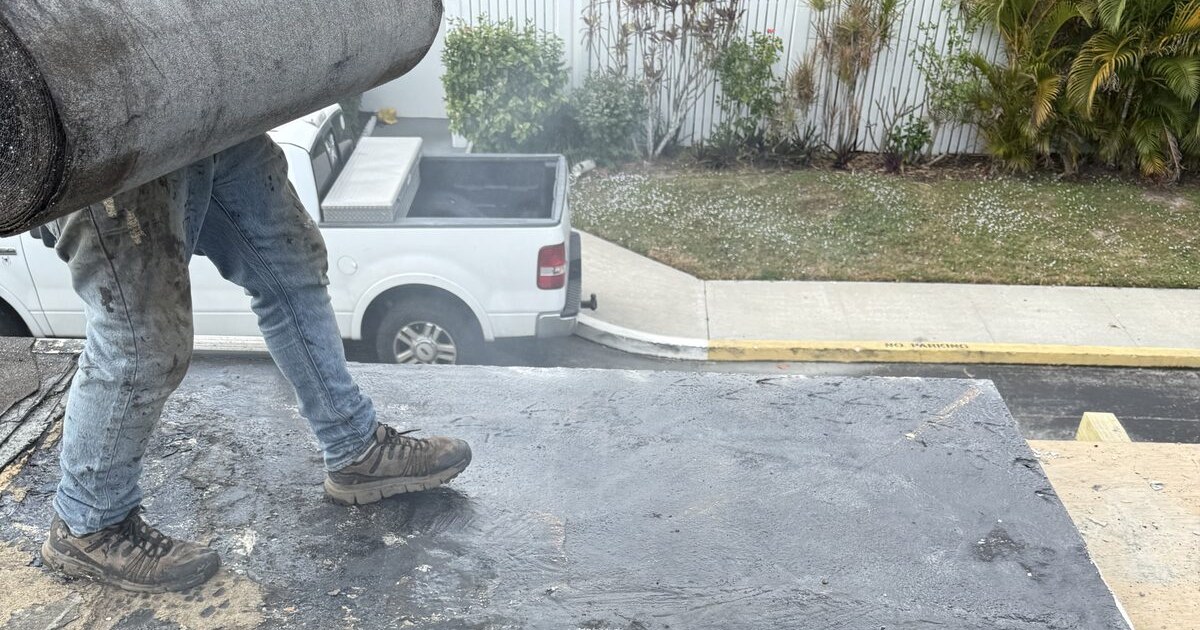
Common-element roofing at Greenway Village, Royal Palm Beach — the association’s carport roof being rebuilt in 2025. The full write-up is on the concrete restoration project log. This is the work that decides whether a storm gets into the building, and it is far cheaper in February than in October.
In Palm Beach County the answer to “who picks up our debris” depends on a question most boards have never asked: are you inside a municipality, or in the unincorporated county? Those are two different systems with two different pieces of paperwork, and being wrong about which one you are in costs you the whole season.
The City of Boca Raton publishes the clearest version of the municipal model, and it is worth reading even if you are nowhere near Boca, because it is what the model looks like when it is written down. The city asks each HOA with private roads to file a Right of Entry and Indemnification Form, signed by the HOA president, property manager or authorised signer. It only has to be done every five years, and it is to be completed prior to the start of hurricane season. Update it whenever the management company, the insurance carrier or the president changes. The city is blunt about both ends of it: debris must be an immediate threat to life, public health or safety; FEMA must approve and assess collection before the city can collect; completing the form does not guarantee collection — and communities without a completed form will not be eligible for debris collection at all.
In the unincorporated county, disaster debris runs through the Solid Waste Authority of Palm Beach County (7501 N Jog Road, West Palm Beach, 561-697-2700), which operates the county’s debris management sites and works from an interlocal structure with the municipalities. Multifamily communities on containerised service are the ones to watch here: routine collection at a condominium is not curbside collection, and a community whose waste is picked up from a compactor or dumpster enclosure should establish — in writing, now — who is expected to move storm debris from the interior of the property to a public right-of-way, and at whose cost. In many communities the honest answer is: you are, with a private hauler, out of association funds. That is a budget line, and it belongs in the budget before the season, not in an emergency assessment after it.
📌
Three phone calls, one afternoon, once a year. (1) Your municipality’s emergency manager, or the Solid Waste Authority at 561-697-2700 if you are unincorporated: “What do you need on file from us before a storm, and do you have our current form?” (2) Your association attorney: “Who is authorised to sign a right-of-entry and indemnification on the association’s behalf?” (3) Your insurance agent: “Does our policy cover debris removal on our own roads, and up to what limit?” The answers change when your board changes, which is why the Boca form has a five-year life and a change-of-officer trigger. Diary it with the annual meeting.
04 · Hurricane Protection Stopped Being a Preference in 2024
The short version: Florida now requires community association boards to adopt hurricane protection specifications — it is a duty, not an option — and forbids an architectural committee from denying an owner’s application that conforms to them. Condominiums: s. 718.113(5). Homeowners’ associations: s. 720.3035(6). If your board has never adopted a written specification, that is the single easiest compliance item on this page, and it is a quiet-season job.
The condominium section is expansive about scope. It applies to all residential and mixed-use condominiums in the state “regardless of when the condominium is created,” requires each board of administration to adopt specifications for each building it operates, allows those specifications to address colour, style and other factors the board deems relevant, and requires them to comply with the applicable building code. Critically, it also provides that installation, maintenance, repair, replacement and operation of hurricane protection in accordance with the subsection is not a material alteration or substantial addition to the common elements — which removes the procedural objection that used to stall these projects for years. Who installs and who pays still turns on your declaration and, where the declaration is silent, on a vote of the voting interests; and a board generally cannot make an owner tear out compliant protection and reinstall the same type unless it has reached the end of its useful life or has to come out to prevent damage.
The HOA section carries the list that boards actually need when they sit down to write a specification. Under s. 720.3035(6)(c), hurricane protection includes roof systems recognised by the Florida Building Code which meet ASCE 7-22, permanent fixed storm shutters, roll-down track storm shutters, impact-resistant windows and doors, polycarbonate panels, reinforced garage doors, erosion controls, exterior fixed generators, fuel storage tanks, and other hurricane protection products used to preserve and protect the structures or improvements on a parcel. Note what is on that list beyond shutters: roof systems, generators, fuel storage, erosion control. An architectural policy written in 2009 about shutter colour does not cover any of it.
And s. 720.3035(6)(b) is the sentence to read to your architectural committee: the board or committee “may not deny an application for the installation, enhancement, or replacement of hurricane protection by a parcel owner which conforms to the specifications adopted by the board or committee.” The committee’s remaining job is to write a good specification — because the specification, not the review, is now where the community’s aesthetic consistency actually gets decided.
🔨
Write the specification with a contractor in the room. A specification that names a product category with no Florida Product Approval or Notice of Acceptance reference, no fastener schedule and no substrate condition is a specification an owner cannot buy to and an installer cannot bid. This is the point where a board benefits from having someone who holds a roofing licence read the draft — see impact windows and doors and roofing for the two categories that dominate most association specifications, and the roof age and insurance piece for why carriers now care about the answer.
05 · The Clock That Starts at Landfall
The short version: under s. 627.70132, a claim under a property insurance policy is barred unless notice was given to the insurer within 1 year after the date of loss for an initial or reopened claim, and within 18 months for a supplemental claim. For a hurricane, the date of loss is the date the hurricane made landfall. The clock does not wait for your engineer, your attorney, or the next board meeting.
Associations lose claims to this provision in a very particular way, and it is not carelessness. The first inspection says the roof is fine. Eight months later the interior units start reporting stains. By the time the board has commissioned a consultant, argued about whether it is storm damage or age, and got a proposal in front of the membership, the year is gone — and the notice that would have preserved everything was a letter that could have been sent in week two. Notice is not the claim. Giving notice costs nothing and preserves the right; deciding later not to pursue it costs nothing either.
The other half of this is documentation, and it has to happen before the cleanup, which is in direct tension with the emergency powers in section 02 above. Both are true at once: the board must mitigate promptly to avoid a coverage fight about neglected damage, and must not destroy the evidence of what the storm did. The way out is discipline, not delay — photograph and video every elevation, every roof, every interior report and every pile of saturated material before it moves; date-stamp it; keep the invoices for the emergency work separate from everything else; and keep a written log of what was done, when, and on whose authority. A licensed manager should be producing that record as a matter of course. If nobody is, that is the gap.
06 · What the Board May Not Do After the Storm
The short version: emergency powers are broad but they are not a lockout. Subsection (3) of both statutes says that during a state of emergency declared by the Governor, an association may not prohibit owners, tenants, guests, agents or invitees from accessing the common elements or common areas for ingress and egress in connection with (a) the sale, lease or other transfer of title of a unit or parcel, or (b) the habitability of the unit or parcel, or the health and safety of the person — unless a governmental order or determination, or a public health directive from the CDC, prohibits it. Access remains subject to reasonable restrictions the association adopts.
The powers on the other side of that line are real and should be used properly. Both statutes let the board, on the advice of emergency management or public health officials, close common areas; the condominium section separately lets the board require evacuation of the condominium property in the event of an evacuation order in the locale, and determine whether the property or any portion of it can be safely inhabited, accessed or occupied. Read that habitability power carefully: it is a determination the board makes, and it should rest on a licensed professional’s written opinion, not on a director’s walk-through. A structural engineer, a licensed contractor, the fire marshal, the building official — someone whose name goes on a piece of paper. Telling residents they cannot go home is the most consequential decision a board will ever make, and it needs to be someone’s professional judgement, in writing, in the minutes.
07 · The Palm Beach County Layer
Statutes are statewide; evacuation is local, and it is the one thing residents will ask the board about first. Palm Beach County’s Division of Emergency Management uses lettered evacuation zones — A, B, C, D and E, plus Zone L for the Lake Okeechobee area. Zone A is the county’s first call: evacuate if you live in a manufactured or mobile home, have substandard construction, or live in a flood-prone area.
The distinction almost every community gets wrong is this one, and the county states it plainly: an evacuation zone is not a flood zone. Evacuation zones are areas that may be inundated by storm surge — the push of water ahead of the storm. Flood zones describe a broader risk including poor drainage, sheet flow and coastal tides. A community can sit outside every evacuation zone and still flood, and it can sit in Zone A with a perfect drainage record. Residents who conflate the two make bad decisions in both directions.
Look it up, per building
The county’s Evacuation Zone Look-Up Tool at ReadyPBC.org and the free PBCDART app both take an address. In a large community, run every building address, not just the clubhouse — zone lines do not follow property lines.
Watch vs warning
The county uses the standard definitions: a hurricane watch means hurricane conditions are possible within 48 hours; a warning means they are expected in 36 hours or less. Build your community’s notification plan around those two numbers, because they are what will actually be announced.
Trees, in the right month
The county’s own guidance is to do all major cutting and tree removal before June 1, from December through April. For an association that means the landscape contract needs the hurricane trim written into the winter schedule — trimming in August generates debris you then have to store somewhere.
Who to call
Palm Beach County Emergency Management’s information line is 561-712-6400; the Solid Waste Authority is 561-697-2700. Put both in the board packet and on the community notice board. The Atlantic hurricane season runs June 1 through November 30.
08 · The Board’s Calendar
Everything above collapses into six moves. Four of them happen when there is no storm anywhere near Florida, which is exactly why they get skipped.
Step 1 · December to April
File the debris paperwork and cut the trees.
Confirm whether you are municipal or unincorporated, get the right-of-entry and indemnification form signed by whoever your attorney says can sign it, and confirm the municipality has it on file. Same window for major tree work, per the county’s own guidance.
Step 2 · Before June 1
Adopt the hurricane protection specification.
Per building for a condominium, per structure type for an HOA. Cover the whole s. 720.3035(6)(c) list, not just shutters. Publish it, so owners applying to your architectural committee know what conformity looks like.
Step 3 · Before June 1
Write the emergency resolution now, adopt it later.
Have your attorney draft the board resolution that invokes s. 718.1265 or s. 720.316, with blanks for the declaration and the scope. A board reading a statute for the first time with a cone on the television is a board that makes mistakes.
Step 4 · At the watch
Photograph the property before, not just after.
A dated pre-storm walk of every elevation, roof, pool deck and common area is the cheapest evidence in a coverage dispute, because it proves condition. Send the resident notice with your shutter policy, balcony clearance, vehicle relocation and elevator plan.
Step 5 · After the all-clear
Document, then mitigate, then notice.
In that order and within days, not weeks. Emergency scope separate from reconstruction scope. Habitability determinations on a licensed professional’s written opinion. Notice of claim to the carrier early even if the extent is unknown.
Step 6 · The 12-month diary
Put the landfall date on the calendar.
One year for the initial or reopened claim, eighteen months for a supplemental claim, both running from landfall. Diary both dates the week of the storm and review at every board meeting until they pass.
The Manager and the Contractor Are the Same Phone Call
Most associations run this with two vendors who do not talk: a manager who can file the right-of-entry and keep the minutes straight, and a contractor who shows up after the storm with no history of the building. Randolph Scott Bell holds the Community Association Manager licence (CAM34850, firm CAB3255) and a Certified General Contractor licence (CGC1528750) with a Certified Roofing Contractor licence (CCC1332751). That means the person writing your hurricane protection specification is the person who can build to it, and the person who determines the roof is not safe is the person who can dry it in. BeacCorp Property Management serves Palm Beach County from Loxahatchee.
What a licensed manager is actually responsible for, the full scope of work, the ten questions to ask any firm your board interviews, and how to change management companies without losing the records.
The other compliance calendar every Palm Beach County board is now running — and the one that funds the roof and waterproofing this page keeps pointing at.
The individual-owner half of the same problem. Half your community may be in Ohio in September — this is what a vacancy clause does to their coverage, and what a real home watch visit checks.
The same building read from the purchaser’s side of the closing table — which documents the seller owes you, and how to read a reserve study before your cancellation window closes.
What managers really charge here, what is bundled, and the markups to look for before you sign — including who is doing the storm work and at what rate.
The equipment side of debris, including the 2017 Hurricane Irma disaster-debris work in Tampa and Ybor City that backs the storm cleanup offered here.
Board Hurricane Review
Tell us about the community and where the gaps are.
Frequently Asked Questions
Can a Florida HOA or condo board levy a special assessment after a hurricane without an owner vote?
Yes, during a declared emergency. Section 718.1265(1)(l) lets a condominium board levy special assessments without a vote of the owners, and section 720.316(1)(j) does the same for a homeowners association, in both cases regardless of contrary language in the governing documents. The power only exists in response to damage caused by or anticipated in connection with an emergency for which a state of emergency has been declared under s. 252.36 covering the association's area, and section (2) of each statute limits it to what is reasonably necessary to protect health, safety and welfare and to make emergency repairs. It is not authority to fund a full reconstruction project months later.
What triggers association emergency powers in Florida?
A declaration, not a board vote. Both s. 718.1265 and s. 720.316 key the powers to an emergency as defined in s. 252.34(4) for which a state of emergency is declared pursuant to s. 252.36 in the locale of the condominium or the area encompassed by the association. Because both statutes cover damage caused by or anticipated in connection with the emergency, the powers are available before landfall once the declaration exists, which is usually days ahead of a Florida storm. For a homeowners association there is one extra qualifier the condominium section does not carry: the powers apply unless specifically prohibited by the declaration or other recorded governing documents, so an HOA board should have its attorney check the documents before the season.
Will the county pick up hurricane debris from our private roads?
Not automatically, and often not at all without paperwork filed in advance. Federal Public Assistance for debris removal under 44 C.F.R. 206.224 requires the work to be in the public interest, and FEMA applies that test to private roads by asking whether the public has unrestricted access with no locks, gates or guards and uses the road frequently. Separately, 42 U.S.C. 5173(b) requires the state or local government to first arrange an unconditional authorization for removal from private property and to agree to indemnify the Federal Government against claims arising from it. That is why municipalities ask associations for a right-of-entry and indemnification form, and why a community that has not signed one may be ineligible for collection.
What is a right-of-entry form and when does our association have to sign it?
It is the association's written permission for a local government to enter private roads to collect storm debris, paired with an indemnification. The City of Boca Raton publishes a clear example: its Right of Entry and Indemnification Form is signed by the HOA president, property manager or authorized signer, only has to be done every five years, and is to be completed prior to the start of hurricane season, with an update whenever the management company, insurance company or president changes. The city also states that debris must be an immediate threat to life, public health or safety, that FEMA must approve and assess collection before the city can collect it, that completing the form does not guarantee collection, and that communities without a completed form will not be eligible for debris collection. Ask your own municipality what it requires, because the form and the deadline are local.
Who handles storm debris in unincorporated Palm Beach County?
Disaster debris in the unincorporated county runs through the Solid Waste Authority of Palm Beach County, at 7501 N Jog Road, West Palm Beach, 561-697-2700, which operates the county's debris management sites. Inside a municipality it runs through the city. The first thing a board should establish is which of the two applies to it, because the paperwork is different. Multifamily communities on containerised collection should also confirm in writing who is expected to move storm debris from inside the property to a public right-of-way and at whose cost, because in many communities that is the association's own expense with a private hauler, and it belongs in the budget rather than in a post-storm assessment.
Does our board have to adopt hurricane protection specifications?
Yes. For condominiums, s. 718.113(5) states that each board of administration of a residential or mixed-use condominium must adopt hurricane protection specifications for each building it operates, and the subsection applies regardless of when the condominium was created. For homeowners associations, s. 720.3035(6)(a) requires the board or its architectural or similar committee to adopt hurricane protection specifications for each structure or other improvement on a parcel governed by the association. In both cases the specifications must comply with the applicable building code and may address colour, style and other factors the board considers relevant. If your board has never adopted one in writing, that is a compliance gap you can close in the off season.
Can our architectural committee deny an owner's request to install impact windows or shutters?
Not if the application conforms to the association's own adopted specifications. Section 720.3035(6)(b) states that the board or committee may not deny an application for the installation, enhancement, or replacement of hurricane protection by a parcel owner which conforms to the specifications adopted by the board or committee. The practical consequence is that the specification, not the review, is now where a community's visual consistency is decided, so it is worth writing carefully and publishing it where owners and their installers can find it.
What counts as hurricane protection under Florida law?
Section 720.3035(6)(c) lists roof systems recognised by the Florida Building Code which meet ASCE 7-22 standards, permanent fixed storm shutters, roll-down track storm shutters, impact-resistant windows and doors, polycarbonate panels, reinforced garage doors, erosion controls, exterior fixed generators, fuel storage tanks, and other hurricane protection products used to preserve and protect the structures or improvements on a parcel. Boards are often surprised by how far past shutters that list goes: roof systems, generators, fuel storage and erosion control are all inside it, and an architectural policy written years ago about shutter colour does not cover any of them.
Is installing hurricane protection a material alteration that needs an owner vote?
Section 718.113(5) provides that the installation, maintenance, repair, replacement and operation of hurricane protection in accordance with that subsection is not considered a material alteration or substantial addition to the common elements or association property. That removes the procedural objection that used to stall these projects. It does not settle who installs and who pays, which still turns on the declaration and, where the declaration is silent, on approval by a majority of the voting interests. The section also generally protects an owner who has already installed conforming protection from being made to reinstall the same type, unless it has reached the end of its useful life or has to be removed to prevent damage. Read the subsection with your association attorney against your own declaration.
How long does an association have to file a hurricane insurance claim in Florida?
Section 627.70132 bars a claim under a property insurance policy unless notice of an initial or reopened claim was given to the insurer within 1 year after the date of loss, and notice of a supplemental claim within 18 months after the date of loss. For a hurricane, the date of loss is the date the hurricane made landfall. Notice is not the same thing as a completed claim, so a board that suspects damage should give notice early and decide later whether to pursue it. Diary both dates the week of the storm and review them at every board meeting until they pass.
Should we clean up before the insurer inspects, or wait?
Neither extreme. The association has a duty to mitigate, and the emergency powers statutes expressly contemplate removing saturated drywall, insulation, carpet and cabinetry to stop fungal growth, so waiting invites both further damage and a coverage argument about neglect. The answer is documentation before movement: photograph and video every elevation, roof, interior report and pile of wet material before it is touched, date-stamp everything, keep emergency invoices separate from reconstruction invoices, and keep a written log of what was done, when and on whose authority. A licensed manager should be producing that record as a matter of routine.
Can the board lock owners out of the property after a storm?
Only within limits. Subsection (3) of both s. 718.1265 and s. 720.316 provides that during a state of emergency declared by the Governor an association may not prohibit owners, tenants, guests, agents or invitees from accessing the common elements or common areas for ingress and egress in connection with the sale, lease or other transfer of title, or the habitability of the unit or parcel or the health and safety of the person, unless a governmental order or determination or a CDC public health directive prohibits that access. Any access allowed is still subject to reasonable restrictions the association adopts. The board does retain the power to close common areas on the advice of emergency management or public health officials, and a condominium board may require evacuation where an evacuation order has been issued for the locale.
Who decides whether the buildings are safe to reoccupy?
Section 718.1265(1)(i) gives a condominium board the power to determine whether the condominium property, association property or any portion of it can be safely inhabited, accessed or occupied. It is a board determination, but it should rest on a licensed professional's written opinion rather than a director's walk-through: a structural engineer, a licensed contractor, the fire marshal or the building official, someone whose name goes on a document. Telling residents they cannot go home is the most consequential decision a board will make, and it needs to be a professional judgement recorded in the minutes.
Is an evacuation zone the same as a flood zone in Palm Beach County?
No, and the county says so directly. Evacuation zones are areas that may be inundated by storm surge, the push of water ahead of a storm coming on shore. Flood zones describe a broader set of risks including poor drainage, sheet flow and coastal tides. Palm Beach County uses lettered evacuation zones A, B, C, D and E, plus Zone L for the Lake Okeechobee area, and Zone A is the first called: evacuate if you live in a manufactured or mobile home, have substandard construction, or live in a flood-prone area. Look up every building address in your community, not just the clubhouse, using the Evacuation Zone Look-Up Tool at ReadyPBC.org or the free PBCDART app.
When should our community do its hurricane tree trimming?
Palm Beach County's own guidance is to do all major cutting and tree removal before June 1, from December through April. For an association that means writing the hurricane trim into the winter landscape schedule rather than reacting in August, when the trimming itself generates a pile of vegetative debris you then have to store or haul at your own expense. It is also the same window in which to file or renew the debris right-of-entry paperwork, so the two jobs can share one board meeting.
Can BeacCorp help our board with this?
Yes, and the reason it is worth one call rather than two is the licence stack. Randolph Scott Bell holds the Community Association Manager licence CAM34850 with firm licence CAB3255, a Certified General Contractor licence CGC1528750 and a Certified Roofing Contractor licence CCC1332751. That means the person who files your right-of-entry, keeps the emergency minutes and drafts the hurricane protection specification is also licensed to build to it and to dry the roof in afterwards. BeacCorp Property Management serves Palm Beach County associations from Loxahatchee. Call (561) 779-3213 with your community name, whether you are municipal or unincorporated, and what is already on file. This is general guidance from a manager and contractor, not legal advice.