Operator Included
Pulls Stumps Whole
City Building Division
Palm Beach Gardens was planned as a garden city, and it still keeps a City Forester inside its Development Compliance and Zoning Division to protect the canopy. That changes what a tree job means here. The city regulates taking out trees and palms, and it regulates pruning too, so a crew that simply shows up with a saw can leave you holding the violation. We ask the permit question at the first look at the lot, before a machine is unloaded.
Once the paperwork path is clear, the work itself is straightforward. The T740 and its 60-inch grapple grip a trunk, lay it down where we want it, and then grip the stump and work the root ball loose, so the stump comes out whole instead of being ground in place. Brush and limbs go into a pile for haul-off. Estimates are free: tell us the address, the community and what is standing on the lot, and call (561) 779-3213.
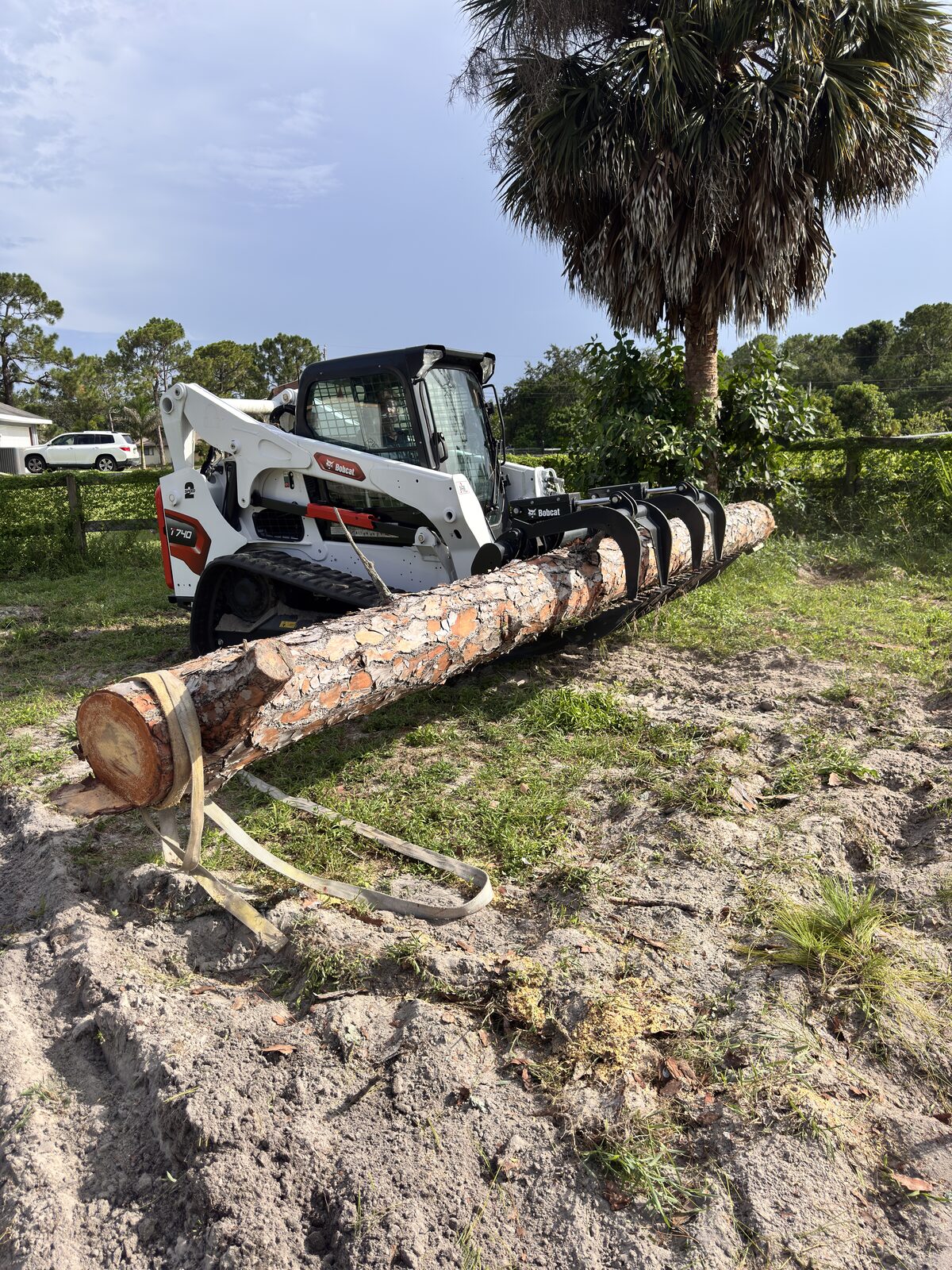
Most Palm Beach Gardens stump calls fall into two groups. On the older lots near the original grid, the stump belongs to a tree that outgrew its space years ago. On the golf and club-community lots, the stump is what is left after a storm or an approved removal, and it sits where a pool deck, a screen enclosure or a new driveway is supposed to go.
We use the grapple to pull the stump rather than grind it, which means the root mass comes out and the hole can be filled and graded in the same visit. If you want the ground level and ready for sod or a slab, say so on the call, and read our Bobcat grading in Palm Beach Gardens page for how that second step works. If the whole lot needs clearing and not a few trees, land clearing in Palm Beach Gardens covers it.
Inside the city limits there is one building department: the City of Palm Beach Gardens Building Division at 10500 N Military Trail, (561) 799-4210, with applications filed through its online permitting portal. Tree and palm removal, and pruning that goes beyond routine trimming, are reviewed by the City Forester. Many addresses with a Palm Beach Gardens mailing label sit outside the city limits, in unincorporated Palm Beach County or a neighbouring town, and those follow a different office, so we confirm the jurisdiction from the parcel before we price anything.
The second approval is often your association. PGA National, BallenIsles, Frenchman's Creek, Frenchman's Reserve, Eastpointe, Mirasol, Evergrene, Alton and Avenir each run their own architectural review, and a tree that is visible from the street or the golf course is usually something the board wants to see in writing before it comes down. Plan for the board's calendar, not just the city's.
Two checks ride along with every removal. First, protected wildlife: gopher tortoises are a state-threatened species, and the Florida Fish and Wildlife Conservation Commission generally requires a permit before a burrow is disturbed or a tortoise relocated. Sandy, open lots can hold burrows, so we look at the ground before the machine moves. Second, drainage: lots in the city drain through a mix of city, water-management district and, in some areas, special-district systems, so a machine that has to cross a swale, culvert or easement gets planned for and does not improvise on the day.
Where the tree sits matters as much as what it is. A trunk leaning toward a roof, a pool cage or a neighbour is a different job from a tree in an open back corner, and the estimate says which one we are looking at.
The invasive plants that take over lots in South Florida are the usual suspects: Brazilian pepper, melaleuca, and vines that climb whatever stands. On a Palm Beach Gardens lot they show up on the back half of a parcel that sat vacant, along a fence line and at the edge of a canal or lake. A pepper thicket is not one tree. It is a mass of multi-stem trunks with roots that resprout, so the job is pulling the root ball out whole rather than cutting at the surface.
That is what the grapple on the T740 does well: it grips the trunk, works the roots loose and lifts the stump out, then the brush goes to a pile for haul-off. Because the city regulates removing trees and palms, we ask the permit question first, and any invasive tree that is also a protected species or sits in a drainage area gets checked before it comes out. In a community with an architectural review board, the board may also want to know what is coming out and what is replanted.
Pulling is a one-time job, but regrowth is not, so the honest plan is to clear the root balls, haul or pile the debris and, if the owner wants, follow with a replanting plan for the bare ground. We do the clearing and say plainly what is outside it. Estimates are free: call (561) 779-3213 with the address and the community.
First we confirm who permits the lot. Inside the city limits that is the City of Palm Beach Gardens, and some Palm Beach Gardens mailing addresses sit outside it, so the parcel record settles the jurisdiction before a machine moves. Then 811 is called, the invasive growth is walked with you, and anything that may be protected or sits in a drainage area is flagged and left until it is checked.
Next the grapple works through the thicket. Each trunk is gripped and the root ball worked out whole, because a pepper or melaleuca cut at the surface resprouts from what is left. Brush is piled for haul-off, and the holes can be filled and graded in the same visit. Debris handling, the number of stumps and access to the back of the lot are what move the day count, and the day rate stays the same: $1,385 with an operator.
Local conditions matter. Palm Beach Gardens lots sit beside canals, lakes and golf courses, and edge-of-water ground is soft in the wet season, so a lot that looks easy in March can be harder in August. Community associations such as PGA National, Mirasol and Evergrene run their own review, and a written approval before clearing saves a stop-work conversation later. Nearby pages cover Jupiter, the tree and stump removal guide and lot clearing in Palm Beach Gardens.
Not every Palm Beach Gardens lot needs the roots pulled. A back section of thin brush and vines that you only want knocked down can be ground where it stands, which leaves the mulch on the ground and skips the haul-off; our forestry mulching in Palm Beach Gardens page explains that route. Thick pepper or melaleuca that will resprout, or ground that has to be clean for a pool, slab or fence, is the case for pulling the root balls whole, which is what this page covers. Tell us which result you want when you call and we say which method fits the lot.
Once the trees are down, the lot usually needs one of four things next: a roof, windows or a remodel that the clearing opened up (construction in Palm Beach Gardens), a new roof over the same ground (roofing in Palm Beach Gardens), association help when the board has to approve the change (property management in Palm Beach Gardens), or food for the crew and the open house afterwards (food truck catering in Palm Beach Gardens).