Operator Included
Pulls Stumps Whole
Footprint
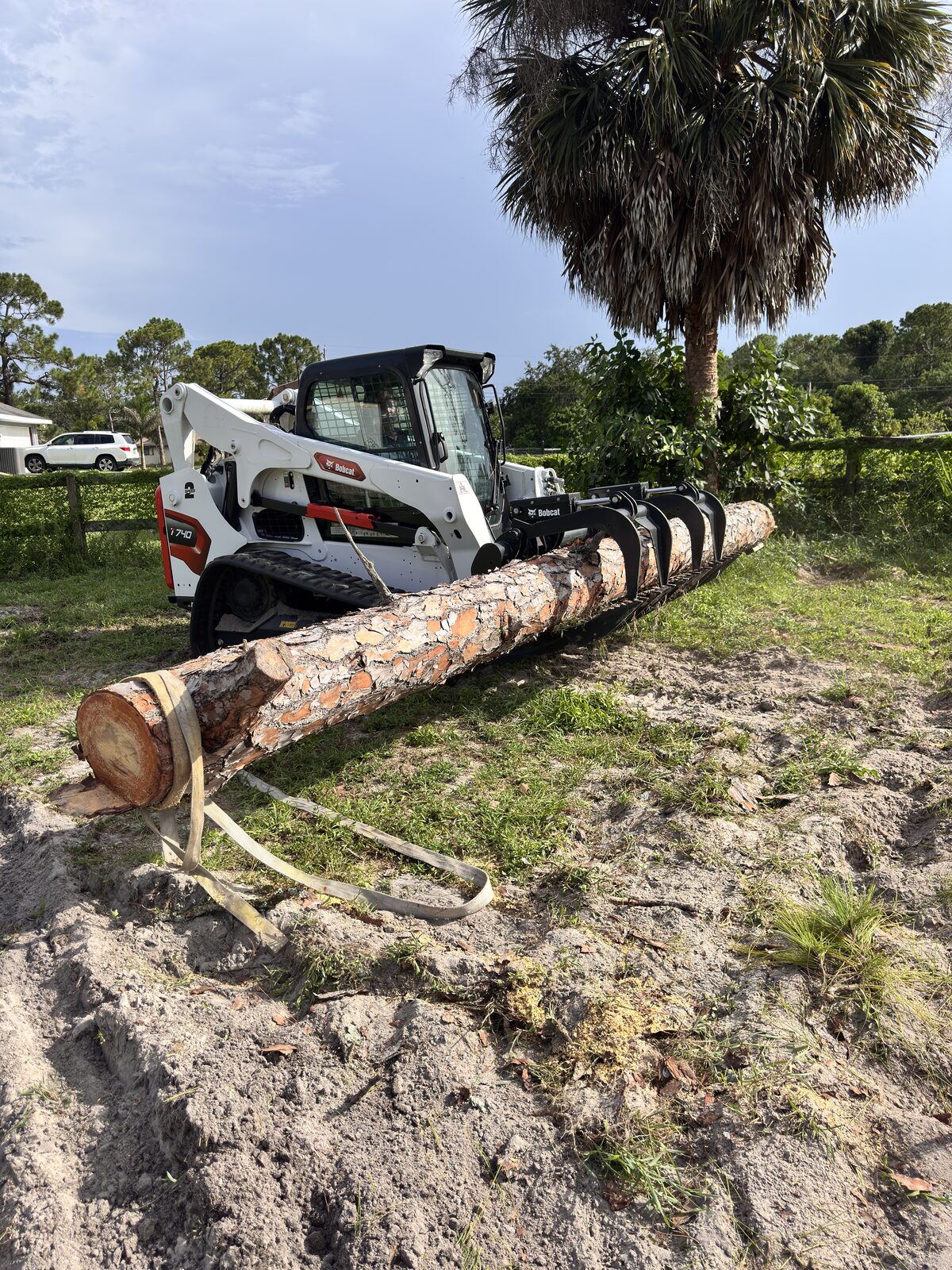
There is no per-tree or per-stump price. The machine is $1,385 a day with an operator for the T740 and its grapple, and one tree or one stump is usually a few hours of that day. What changes the number is the size and species of the tree, how many stumps there are, how far the machine has to travel across the lot, whether it must cross a roadside swale and culvert to get in, and whether the wood is hauled away or stacked on your acre. We look at the lot, then give you a free estimate before any figure is written down.
Tell us the address and what is standing on it. (561) 779-3213. Our own yard is at 16140 Okeechobee Blvd in Loxahatchee, on the same side of the county as The Acreage.
Who regulates your lot. The Acreage is unincorporated Palm Beach County, so there is no Acreage city hall. Native vegetation is handled by the county's Environmental Resources Management under ULDC Article 14.C, and the invasive-plant list under Article 14.D. Trees, palms and pines that code or an earlier approval required fall under the Tree Removal & Replacement Permit, ULDC Article 7, through the Zoning Division. When removal is tied to a structure, a driveway or a grading change, the county Building Division, 2300 North Jog Road, issues and inspects the permit. Taking out invasive exotics is usually the easy case; removing native pines, oaks or cabbage palms is where review begins.
The drainage district. The Indian Trail Improvement District (ITID), 13476 61st Street North, is a special taxing district, not an HOA. It maintains the roads, canals and roadside swales across about 37 square miles, and it approves work that disturbs a swale, a culvert or its right-of-way, separately from the county. Most Acreage lots have no homeowners' association, though some newer enclaves do carry deed restrictions, so we check your parcel instead of assuming. A tree on the far side of a swale means a machine crossing a culvert, and that crossing is planned before the T740 is unloaded.
Protected species. Gopher tortoises are state-threatened and their burrows are protected: a permit from the Florida Fish and Wildlife Conservation Commission is generally needed before a burrow is disturbed or a tortoise moved. Dry sandy lots here can hold burrows, so we look before a stump is pulled. And Florida law requires a call to 811 for a free utility locate before anything is dug.
This is general guidance, not permitting advice. Our Palm Beach County permits and regulations guide lists the offices, and we confirm the right one for your parcel before booking.
We do not have a confirmed, named Acreage tree-removal project to point to, and we would rather say so than dress up a job. What we can show is the credential stack: Florida Certified General Contractor CGC1528750, a statewide certification, a Palm Beach County Business Tax Receipt, which covers unincorporated county land like The Acreage directly, a BBB A+ Accredited Business rating and a written one-year workmanship warranty on every job. Bell Engineering and Construction Corporation has operated continuously since 2009.
Once a tree is down, the next call is often a different trade. If the clearing is for a build or a remodel, the construction team's Acreage page covers permits and the county Building Division. If a storm took the tree and the roof with it, see roofing in The Acreage. If you own the home through an association or a rental, property management in The Acreage is the next page to read. And for a party under the trees you just cleared, there is America, our food truck, in The Acreage.