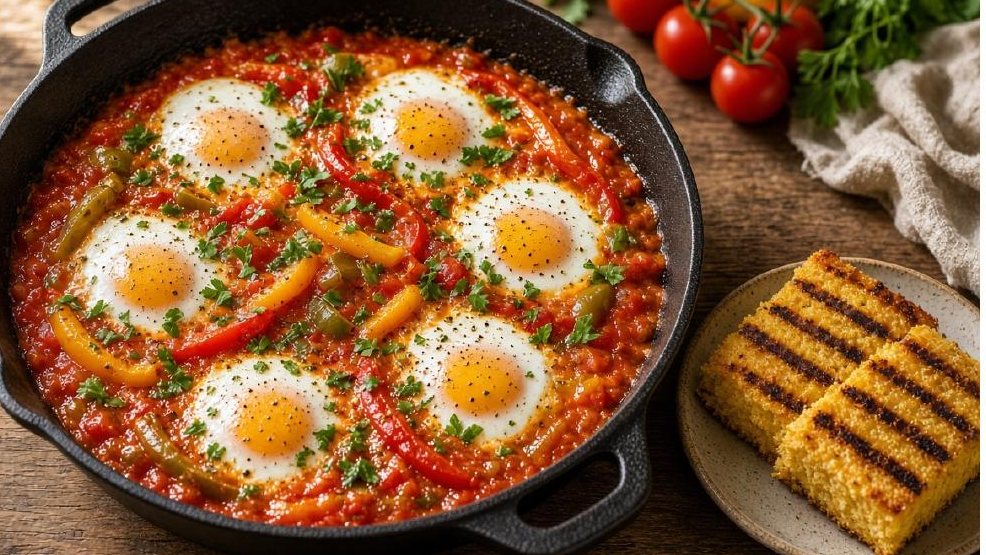
This is the dish that opens America's winter board, and the one that makes the strongest case for cooking with the calendar instead of against it. Three of its ingredients — tomatoes, bell peppers, eggs — are at their best in Palm Beach County between November and February, and all three can be bought within a few miles of the farm the truck is anchored to. Below is the recipe exactly as we run it, the technique notes that make the difference at home, and the local shopping list.
Shakshuka travels well because it asks very little: a pan, a heat source, and tomatoes worth simmering. That last condition is the whole argument. A shakshuka made from a February tomato in most of the country is a dish built on cold storage and a long truck ride. Made in Palm Beach County in February, it is built on a tomato picked down the road that week.
South Florida's growing year runs opposite the rest of the country's — the limiting factor here is heat and water, not cold — so November through February is our peak harvest, not our off-season. Tomatoes, bell peppers, onions and the brassicas are all running hard through those months. This county grows more sugarcane, fresh sweet corn and sweet bell peppers than any other county in the United States. A dish whose two headline vegetables are winter tomatoes and bell peppers is, in this specific place, the least exotic thing on the menu.
The eggs close the loop. Six of them sit in the middle of the pan, and they are the ingredient people taste the difference in first — a pasture-raised yolk from a farm five miles away behaves differently in a hot sauce than one that has been in a distribution chain for two weeks. That is the entire reason this dish leads the winter board instead of sitting in the middle of it.
One note on what makes our version ours: we serve it with griddled cornbread rather than the pita or crusty bread you will see on most shakshuka recipes. Cornbread is what a Florida farm kitchen actually has, it griddles fast on a flat-top with a hard edge on it, and it stands up to the sauce longer than bread does when a guest is holding a plate outdoors. It is a practical choice before it is a stylistic one.
Bell Farm Tomato Shakshuka · Serves 4 · About 15 minutes prep, 30 minutes cook · One pan, one burner. This is the recipe as printed on page 2 of America's seasonal menu, unchanged.
The recipe above is complete and you can stop there. These are the things we have learned running it several hundred times off a truck window, offered as general kitchen guidance rather than gospel.
Every recipe on America's menu carries a "source locally" line, because a farm-to-table claim that cannot name the farm is just a font choice. These are the growers we actually buy this dish from, and all of them are open to the public.
One honest caveat, and it is on the menu's own call sheet: the dry goods and dairy in a menu like this — cornmeal, cheese, rice, tortillas — are not part of the local sourcing plan and come through a standard wholesale distributor. We would rather say that plainly than let a "farm-to-table" label do work it has not earned. The produce, the meat and the eggs are the local part, and those are the parts that decide how the food tastes.
This dish runs off the window from November through February, and it is one of the easiest things on the board to serve to a mixed crowd — vegetarian by default, hot off a pan, and eaten standing up without a knife. America the Food Truck is a state-licensed Mobile Food Dispensing Vehicle (MFD1654011) working out of The Bell Farm in Loxahatchee, and the winter calendar is the busiest one we run.
Private catering starts at $800 per event, wedding and event packages start at $2,500, and a seated private farm dinner at The Bell Farm is $150 per guest with a ten-guest minimum. The catering cost guide walks through what actually drives a quote, and the winter menu page covers what a November-to-February date means for weather, daylight and where a truck can park.
Eggs poached directly in a simmered tomato and pepper sauce, spiced and served straight from the pan with something to scoop it up. It is a one-pan dish eaten across North Africa and the Middle East and now on breakfast menus everywhere, and it survives translation well because the technique is simple and the ingredients are wherever you are. Our version is built on Palm Beach County winter tomatoes and bell peppers and served with griddled cornbread instead of pita.
About 45 minutes start to finish for four servings — roughly 15 minutes of prep, which is almost entirely dicing an onion and slicing a pepper, and about 30 minutes of cooking on one burner. The cooking breaks down as 6–8 minutes softening the vegetables, a minute on the spices, 12–15 minutes simmering the sauce, and 6–8 minutes with the eggs in.
Yes — the recipe is written for either: one 28-ounce can, or six fresh tomatoes, crushed. Which is better depends entirely on the month. Between roughly December and February, fresh Palm Beach County tomatoes win easily. Outside that window a good can beats an out-of-season fresh tomato. Fresh tomatoes carry more water, so plan on simmering toward the long end of the 12–15 minutes.
Almost always because the sauce was not reduced far enough before the eggs went in. Eggs give off water as they cook, so a sauce that looks right beforehand thins out by the end and the wells collapse. Simmer until a spoon dragged across the pan leaves a track that closes slowly. Fresh tomatoes and a lid that traps steam both push in the same direction, so reduce harder when you are using either.
Go by the whites, not the timer. The range is 6–8 minutes covered, but egg size, pan weight and simmer strength all shift it. You want whites fully opaque with no clear jelly at the edges and yolks that still wobble when you shake the pan. Pull it there: a heavy pan carries enough residual heat to keep cooking the eggs on the way to the table, which is how yolks end up firm when you waited for them to look perfect in the pan.
The widest heavy pan you have, with a lid — a 12-inch cast-iron skillet is ideal. Six eggs need six wells that do not run into each other, and a heavy pan holds its temperature when six cold eggs go in at once. A thin, narrow pan crowds the eggs and drops heat, which stretches the set time and overcooks the yolks.
Yes as written — vegetables, eggs, olive oil and spices, with cornbread on the side. It is the vegetarian anchor of the winter board, which is the reason it earns its place at an event: one pan feeds the vegetarians in the crowd without a separate cook line. Check the cornbread if you are cooking for someone strict about it, since recipes vary.
Make the sauce ahead, never the eggs. Steps one through three hold in the fridge and taste better the next day. Steps four and five do not hold at all — poached eggs keep cooking and go rubbery on a reheat. For a crowd, build the sauce in advance, bring it back to a simmer, then poach eggs to order in batches. That is exactly the workflow on the truck.
Practicality first. Cornbread is what a Florida farm kitchen keeps, it takes a hard griddle mark in under two minutes on a flat-top, and it holds together under sauce longer than bread does when someone is eating off a plate outdoors at an event. Pita is perfectly correct if you are making it at home — the recipe does not depend on it either way.
Tomatoes and bell peppers from Swank Specialty Produce on North Road in Loxahatchee, a mile and a half from the farm, or from Bedner's Farm Fresh on Lee Road in Boynton Beach, which also runs U-pick. Eggs from Charmed Life Farm in Loxahatchee, about five miles out, which is where ours come from. Those are the same growers named on the menu page for this dish.
November through February, when its ingredients are harvesting here. America runs a seasonal board rather than a fixed one, so the winter dishes come off when the winter crops do. The winter menu page has the month-by-month crop calendar behind that decision, and the full seasonal menu has all 26 dishes with their recipes.
Yes, in season. Private catering starts at $800 per event and wedding and event packages start at $2,500; a seated farm dinner at The Bell Farm is $150 per guest with a ten-guest minimum. America is a state-licensed Mobile Food Dispensing Vehicle (MFD1654011) and an FDACS-registered agritourism operation at 16140 Okeechobee Blvd, Loxahatchee, FL 33470. Call (561) 779-3213.