Broccoli & Cheddar
Hand Pie
Florida Winter Brassicas
The sixth and last item on America's winter board, and the only one you eat standing up with no plate, no fork and nothing assembled at the window. Five ingredient lines, four sentences of method, one oven temperature. It looks like the simplest thing on the menu and it is quietly the most engineered, because a sealed pastry with wet vegetables inside it is a small pressure vessel — and every single instruction in this recipe, from the blanch to the crimp, is there to manage water. Below is the recipe as printed, why the blanch is not about cooking, why a quarter cup of cream cheese is holding the whole thing together, why one ingredient line names two different vegetables, and where to buy them in Palm Beach County.
4
Servings — two cups of filling, one pound of dough
400°F
Hot and fast, because the filling is already cooked
18–22 min
The only timing the menu actually specifies
Dec–Mar
Florida's brassica window, per FDACS
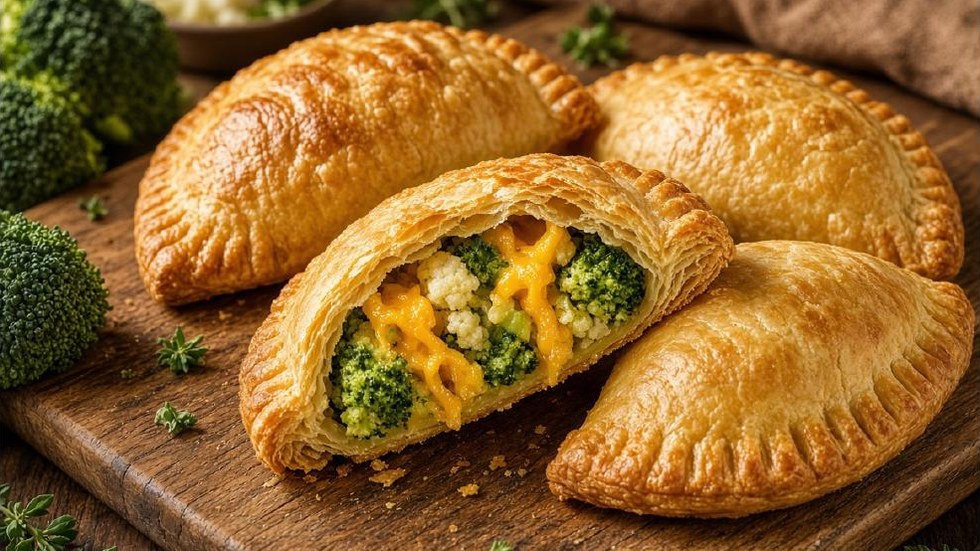
Page 7 of America's seasonal menu. Look at the broken one: the filling is a solid slice, not a spill. That is the quarter cup of cream cheese doing its job, and it is the whole difference between a hand pie and a mess.
One Ingredient Line, Two Vegetables, and Why That Is Deliberate
The first ingredient reads "2 cups broccoli & cauliflower" — one line, one quantity, two vegetables, no ratio given. Most recipes would split that into two lines and tell you how much of each. This one does not, and there is a good reason for it that starts with botany and ends with the calendar.
Broccoli and cauliflower are not relatives. They are the same plant. Both are cultivated forms of a single species, Brassica oleracea, which is also cabbage, kale, collards, Brussels sprouts and kohlrabi — one wild Mediterranean plant that several thousand years of selective breeding pushed in half a dozen different directions. Broccoli and cauliflower sit closest of all: both are the flower head, one caught green and one blanched white, and gardeners have long crossed them freely because there is no species barrier between them to overcome. So a recipe that treats them as one ingredient is not being lazy. It is being accurate.
Then the calendar. The Florida Department of Agriculture's Florida Crops in Season calendar lists broccoli as January through March and cauliflower as December through April. Those windows overlap, but they are not the same window — and neither of them covers the whole of a winter board that runs November to February. A dish specified as "broccoli" alone would be off the menu for the first two months of its own season. Written as broccoli and cauliflower, with no fixed ratio, it can lean cauliflower in December, run both through January and February, and finish on broccoli in March. Whatever the intention was when the line was typed, that is what makes it work: two harvest windows stitched into one ingredient.
The winter menu page makes the wider argument — that in Palm Beach County the winter is the growing season rather than a gap between them. Brassicas are the clearest evidence for it. These are cool-season crops that bolt, turn bitter and refuse to head up in heat, which is why the rest of the country grows them in autumn and this county grows them in January.
The Recipe
Broccoli & Cheddar Hand Pie · Serves 4 · A pot of boiling water, a bowl of ice water, a chopping board, a mixing bowl, a baking sheet and a fork · This is the recipe as printed on page 7 of America's seasonal menu, unchanged. The menu gives one time and one temperature — 18 to 22 minutes at 400°F — and nothing else. Reckon on about half an hour of work ahead of that, which is our estimate rather than the menu's.
Ingredients — serves 4
- 2 cups broccoli & cauliflower, finely chopped, blanched
- 1 cup sharp cheddar, shredded
- 1/4 cup cream cheese
- Salt, pepper, pinch nutmeg
- 1 lb pie dough, portioned
Five lines and three of them carry instructions inside the line itself — finely chopped, blanched, shredded, portioned. The egg for the egg wash appears only in the method and never on this list, which is the one omission worth knowing about before you start.
Method — four sentences on the menu, four steps here
1 · Blanch and chop
Blanch and finely chop broccoli/cauliflower.
2 · Mix the filling
Mix with cheddar, cream cheese, and seasoning.
3 · Fill, fold, crimp, wash
Fill dough rounds, fold and crimp, egg wash.
4 · Bake
Bake at 400°F for 18–22 min until golden.
Note what the method never says: cool the filling. It is the single most common way this recipe fails, and note 4 below is about it.
Source locally: Broccoli & cauliflower — Bedner's Farm Fresh or Naga Gardens. That line is printed on the menu page itself, and it is the only dish on the winter board whose sourcing line names two farms rather than one. Addresses and phone numbers are in the shopping list further down.
Cook's Notes — Every Instruction Here Is About Water
The recipe above is complete and you can stop there. What follows is the reasoning underneath it, offered as general kitchen guidance rather than gospel. If you read only two notes, read the first two. Between them they explain the two things nobody tells you about a savoury hand pie: that a sealed pastry is a pressure vessel, and that the cheese doing the important work is not the cheddar.
1 · A sealed pie is a pressure vessel, and broccoli is mostly water
Start here, because it explains the rest of the list. Broccoli and cauliflower are overwhelmingly water by weight — they are cool-season vegetables built out of it. Put them raw into a pastry case, seal the edge and put it in a hot oven, and that water turns to steam with nowhere to go. Three things follow, all bad: the steam softens the pastry from the inside and you get the wet, pale, structurally hopeless base people call a soggy bottom; the pressure finds the weakest point of the crimp and opens it; and the filling boils rather than bakes. Every instruction in this recipe is a countermeasure to that. Blanching moves the water out before the pastry is sealed. Chopping fine gets rid of the pockets it collects in. The cream cheese binds what is left. The crimp holds. Once you see the recipe as water management rather than as cooking, none of it is arbitrary.
2 · The quarter cup of cream cheese is structural, not a flavour
A cup of cheddar against a quarter cup of cream cheese looks like a garnish quantity, and it is the reason the pie in the photograph cuts as a solid slice. Aged cheddar is a firm cheese with a tight protein network and a lot of fat; heat it past melting and that network tightens and squeezes the fat out, which is why a cheddar-only filling separates into an oil slick and a rubbery curd and then runs out of the crimp onto the sheet, where it burns. Cream cheese is a fresh, soft, emulsified cheese — the fat is already dispersed and stabilised through it — so it holds the melted cheddar's fat in suspension, glues the chopped vegetable into one mass, and sets again firmly as the pie cools. It is a binder wearing a cheese's name. Leave it out and you have not made a leaner version of this recipe; you have made a different and much leakier one.
3 · Blanch, then dry — the step the menu does not spell out
Blanching means a brief plunge into fast-boiling salted water, then straight into ice water to stop it. It is doing three jobs: it part-cooks the vegetable so that the short bake only has to finish it, it sets the chlorophyll so the broccoli in the photograph is bright green rather than the drab olive of long cooking, and it softens the florets enough to pack densely. But there is a fourth thing, and the menu leaves it to you: blanched vegetable comes out of the water wet. Drain it hard, spread it on a towel, and get it as dry as you have patience for before it meets the cheese. Every drop you leave on the outside of a floret is a drop that becomes steam inside a sealed pie. This is the single highest-value thirty seconds in the whole recipe, and it is the one no recipe writes down.
4 · Cool the filling before it goes anywhere near the dough
The method never says it, and it is the most common way this recipe goes wrong. Warm filling melts the butter in the pie dough on contact. Pastry is layers of solid fat between sheets of flour and water; the flake comes from that fat staying solid until the oven turns the water in it to steam and pushes the layers apart. Melt it early on the bench and you have destroyed the mechanism before baking starts — the result is greasy, dense and short rather than flaky. So blanch, chill, dry, mix, and if the mixing bowl still feels warm, put the filling in the refrigerator until it does not. On a busy day we make the filling well ahead for exactly this reason. Cold filling into cold dough, then straight into a hot oven, is the whole trick of pastry stated in nine words.
5 · "Finely chopped" is a structural instruction, not a knife-skills flourish
The ingredient line says finely chopped and it means it. A whole floret inside a hand pie is a small lever: it has a stalk, and when you fold the dough over it or when somebody bites down, that stalk concentrates all the force on one point of the pastry and punctures it. It also traps water in the hollows between its branches, exactly where you least want it. Chopped fine, the vegetable packs into a dense even layer with no voids, gives the cheese far more surface to grip, spreads to the edge of the round so no bite is all pastry, and lets you fill the pie fuller without straining the seam. Chop the stalks too — peeled and finely diced, broccoli stalk is sweeter than the head and it is a quarter of what you paid for.
6 · The egg wash does three jobs and only one of them is the colour
Everybody knows egg wash makes pastry shine. Two of its jobs here matter more. First, it is glue: a wet brush along the inside of the border before folding is what actually makes the seal, and crimping without it is pressing two dry surfaces together and hoping. Second, the egg proteins set into a continuous skin, which is one more barrier between the filling and the outside world for the twenty minutes that matter. Third is the colour, which comes from the proteins and sugars browning — that deep even gold in the photograph is not achievable with milk or with nothing. Practical points: it goes on after crimping as well as before folding, a whole egg beaten with a splash of water brushes more evenly than yolk alone, and keep it off the cut edges of the pastry where it will glue the layers shut and stop them lifting.
7 · Why there is nutmeg in a broccoli pie, and why the word is "pinch"
It reads like a typo and it is the oldest idea on the ingredient list. Nutmeg with dairy and brassica is a pairing that goes back through every cauliflower cheese, every gratin and every béchamel ever made, and the reason it survived is that it works on the sulphur. Cooked brassicas give off sulphurous aroma compounds — the smell people mean when they say cabbagey — and nutmeg's warm, faintly resinous aromatics sit on top of them and read as richness instead. It also gives a filling that is otherwise fat, salt and vegetable something to be interesting about. But the menu says pinch, and pinch is exact: nutmeg turns from background warmth into soapy, medicinal and unmistakably dominant across a very short distance. Grate it fresh, grate less than you think, and taste the filling cold before it goes into the dough.
8 · 400°F is hot because the oven is baking pastry, not vegetables
Eighteen to twenty-two minutes would not cook raw broccoli through inside a pastry shell, and it does not have to — step one already did that. The bake has exactly one job: pastry. That is why the temperature is high. Flaky pastry needs enough heat, fast enough, to flash the water in its cold butter into steam and lift the layers before the fat simply melts and leaks; a moderate oven gives you the leak instead of the lift. So: oven fully preheated, ideally with the tray already hot, and the pies going in cold from the refrigerator, which widens the gap between dough temperature and oven temperature and gives you more lift. Golden is the actual finish line, not the clock — the four-minute spread the menu gives is there because ovens differ by more than that.
9 · Cut a vent, or do not — but know which one you chose
The menu does not mention vents, and that is a defensible choice for a hand pie rather than an oversight. A couple of small slits in the top let steam out on purpose so it does not choose its own exit through your crimp, and they are cheap insurance if your filling went in slightly wet or slightly warm. The cost is that a vent is also a door: melted cheddar finds it, climbs out and burns onto the sheet, and you lose filling and gain washing up. An unvented pie keeps everything inside, which is why the ones in the photograph are smooth and whole. Our own rule is simple and worth borrowing — if the filling is properly dry and properly cold, seal it shut; if you are not certain it is, cut two small slits and accept the smaller failure over the larger one.
10 · Crimp with a fork, and leave a real border
Look at the edges in the photograph: those are fork tines, and a fork is the right tool. It presses the two layers together over a wide band rather than pinching them at a line, so there is more glued area holding against the steam, and it is fast enough to matter when you are making forty. What decides success, though, is what you did before the fork arrived — leave a clear border of about half an inch and keep filling out of it entirely. A single crumb of cheese in the seam is a channel, and a channel becomes a leak the moment the cheddar melts. Fill slightly less than feels right, brush the border, fold, press the air out from the middle outwards so you are not sealing a bubble in, then crimp. Chill the finished pies for a few minutes before they go in if the kitchen is warm.
Variations, Substitutions, and the Make-Ahead That Actually Works
For the vegetables: the whole of Brassica oleracea is available to you, and it is a big family. Cabbage, collards and kale are the same species and all three grow in this county in the same months — Bedner's list on our own call sheet names kale and collards specifically. Leafy brassicas need a different treatment from florets, though: blanch, then squeeze, hard, because a leaf holds far more water than a floret and will not give it up to draining alone. Romanesco behaves exactly like cauliflower. Broccolini and sprouting broccoli work but need their stalks chopped small. What we would avoid is anything with a high sugar and high water content that browns rather than binds — sweet potato and squash both make good pies, but they make a different pie, and the Winter Squash & Kale Plate on the same board is already where squash lives.
For the cheese: sharp is specified and sharp matters — a mild cheddar disappears entirely behind pastry and vegetable, and you will taste salt and nothing else. Aged Gruyère, Comté and a good aged Gouda all work and all behave the same way in the oven. Whatever you choose, shred it yourself. Pre-shredded cheese is dusted with starch or cellulose to stop it clumping in the bag, and that coating is designed to interfere with exactly the smooth melt this filling depends on. The cream cheese is the line we would not change; if you must, thick ricotta or a mild soft goat cheese binds acceptably, and neither holds as well.
For the pastry: a pound of pie dough is roughly four generous rounds. Shortcrust is what the photograph shows and it is the sturdy choice — it holds a filling and travels. Rough puff gives you a lighter, taller, more dramatic pie and a more fragile one, which is a fair trade at a table and a poor one in a paper bag. Ready-made dough is entirely legitimate here and the menu's "portioned" implies it; roll it a little thinner than the packet suggests and rest it cold before baking. Gluten-free pastry is the harder substitution — it tears when folded, so roll it between two sheets of parchment and patch rather than re-roll.
The make-ahead, and it is the good one: this recipe freezes better than anything else on the winter board. Assemble the pies completely, up to and including the crimp but not the egg wash, freeze them solid on a tray, then bag them. They bake from frozen at the same 400°F with roughly ten minutes added — egg wash them straight from the freezer — and they come out better than refrigerated ones do, because a rock-cold pie hitting a hot oven gets the maximum lift out of its butter. This is the entire reason a hand pie is on a food truck menu at all, and it is the version of the recipe most worth having at home. Frozen unbaked, they keep for weeks.
The allergen note, plainly: there is wheat in the pastry, dairy in three separate places — the cheddar, the cream cheese and the butter in the dough — and egg on the outside. The egg wash is the one people miss, because it never appears on the ingredient list. There is no quiet substitution that keeps this dish itself: it is a cheese pie in a butter crust. A dairy-free version is not a modification, it is a different recipe. At an event this is a plate we name out loud, and the Fresh Citrus Agua Fresca on the same board — four ingredients, no allergens at all — is deliberately standing next to it. Tell us about allergies on the booking call, not on the day.
Why It Works Off a Truck Window
This is the operational answer to a problem every other dish on the board has. A bowl needs a bowl, a fork and somewhere to stand; the strawberry shortcake has to be assembled from three components the second it is ordered. A hand pie needs none of that. It is baked before the event, held hot, and handed over in a square of paper — no plate, no cutlery, no assembly, no waste stream of clamshells at the end of the night. Service time is the time it takes to pick one up. That makes it the fastest thing on the winter board and the right answer for the two situations that break a food truck: a cocktail-hour pass where guests have a drink in one hand already, and a crowd of two hundred with forty minutes to feed them.
Being able to bake ahead is what buys that speed, and it comes with the obligation that goes with it. A pie full of cheese and vegetable is a food that has to be held at a safe hot temperature from the oven to the window — the food code the health inspector applies puts that line at 135°F, and the inspector with jurisdiction gives the binding answer. This is not incidental detail; it is most of what a licence is about. America is a hand-converted 1979 Blue Bird bus and a state-licensed Mobile Food Dispensing Vehicle, MFD1654011, operating from an approved commissary and working out of The Bell Farm in Loxahatchee.
It is also the item that quietly fixes the vegetarian problem at a mixed event. The winter board already has a vegetarian main in the squash and kale plate, but a main is a commitment; a hand pie is something a guest can pick up without announcing anything or asking anybody. Order a tray of these alongside whatever else you book and nobody at your event has to have the conversation at the window. At a seated private farm dinner they come out warm and whole in a basket at the start of the table.
Where to Buy the Ingredients — the Local Shopping List
Every recipe on America's menu carries a "source locally" line, because a farm-to-table claim that cannot name the farm is just a font choice. These come off the call sheet printed on the back page of the menu — and this is the only dish on the winter board whose sourcing line names two farms, which is exactly what you want for a crop with a short and weather-dependent window.
Bedner's Farm Fresh
First stop. General produce and U-pick, and the broadest winter list on our call sheet — tomatoes, squash, kale, corn, collards, watermelon, strawberries, blueberries and citrus. It is named first on this dish's sourcing line, and it is where the substitutions in the section above come from: the kale and the collards on that list are the same species as the broccoli, growing in the same months, in the same fields.
Naga Gardens
The backup, and it is on the sheet specifically for cauliflower. A specialty and tropical grower our call sheet lists as backup for corn, okra, jackfruit and cauliflower — and it is in Loxahatchee, minutes from the farm rather than the half-hour run down to Boynton Beach. Worth being straight about one thing: broccoli is not named on either farm's line of the call sheet, although page 7's sourcing line names both farms for the dish. Cauliflower is explicitly Naga's. In practice that is another argument for writing the ingredient as broccoli and cauliflower and taking whichever is good that week.
Bell Farm (on-site)
Nothing here goes in this pie. The farm grows and presses its own sugarcane along the west boundary — the ingredient behind the
Sugarcane Glazed Pork Bowl on this same board — and the call sheet notes raw honey once the apiary is operational, targeted November 2026. Neither belongs in a savoury cheese filling, and neither is in this recipe as written. The brassicas are bought, from the two farms above.
The cheese and the pastry — a distributor, and we will say so
Named as a gap on the menu's own call sheet
Buy where you normally buy. The back page of our menu lists its own gaps in plain type, and one reads: dry goods and dairy are "not part of the local produce/meat sourcing plan; these come through a standard wholesale food distributor." That covers the cheddar, the cream cheese and the flour and butter in the dough. So the local claim on this dish is precise and limited: the vegetables are Palm Beach County in season, and the cheese and pastry are not. By weight the filling is mostly vegetable, which makes this a better local story than the dessert two pages back — but the claim still stops where the ingredient list stops.
Would Rather Someone Else Made Them?
These run off the window from November through February with the rest of the winter board, and they are the item we suggest first when a booking has a big head count on a tight clock, a standing cocktail hour, or a guest list with vegetarians on it. America the Food Truck is a state-licensed Mobile Food Dispensing Vehicle (MFD1654011) working out of The Bell Farm in Loxahatchee, and winter is the busiest calendar we run.
Private catering starts at $800 per event, wedding and event packages start at $2,500, and a seated private farm dinner at The Bell Farm is $150 per guest with a ten-guest minimum. The catering cost guide walks through what actually drives a quote, the wedding catering guide works through service speed by guest count — which is the arithmetic this dish is the answer to — and the winter menu page covers what a November-to-February date means for weather, daylight and where a truck can park. Mention wheat, dairy and egg allergies on that first call.
Broccoli & Cheddar Hand Pie — FAQ
What is in a broccoli and cheddar hand pie?
Five things: two cups of broccoli and cauliflower blanched and finely chopped, one cup of shredded sharp cheddar, a quarter cup of cream cheese, salt, pepper and a pinch of nutmeg, and a pound of pie dough portioned into rounds. The vegetables are blanched and chopped, mixed with both cheeses and the seasoning, spooned into dough rounds which are folded, crimped and egg washed, then baked at 400°F for 18 to 22 minutes until golden. That is the hand-held item on America the Food Truck's winter board in Loxahatchee, Florida.
How long does the whole recipe take?
The menu specifies only the bake — 18 to 22 minutes at 400°F. Reckon on about half an hour of work ahead of that for blanching, cooling, chopping, mixing and filling, which is our estimate rather than the menu's, so around fifty minutes in total for four pies. The filling can be made a day ahead and refrigerated, and assembled pies freeze raw, so almost none of that time has to happen on the day you want to eat them.
Why do I have to blanch the broccoli first — can I use it raw?
Raw is the main reason home hand pies fail. Broccoli and cauliflower are overwhelmingly water by weight, and inside a sealed pastry in a hot oven that water becomes steam with nowhere to go — it softens the base into a soggy bottom, forces the crimp open at its weakest point, and boils the filling instead of baking it. Blanching drives water out and part-cooks the vegetable before the pastry is ever sealed, which is also why an 18-to-22-minute bake is enough. It sets the colour too, which is why the broccoli in the photograph is bright green rather than drab olive.
How long should I blanch broccoli and cauliflower for?
Briefly — a short plunge into fast-boiling salted water and then straight into ice water to stop the cooking, as general kitchen guidance rather than a formula from the menu. You are aiming for bright colour and a floret that still has some resistance, not for tenderness, because the oven finishes the job. The step that matters more than the timing is what comes after: drain hard and dry the vegetable on a towel before it meets the cheese. Every drop left on a floret becomes steam inside a sealed pie.
What does the cream cheese do — can I leave it out?
Leave it out and you have made a leakier recipe, not a leaner one. The quarter cup of cream cheese is structural. Aged cheddar has a tight protein network and a lot of fat, and heating it past melting tightens that network and squeezes the fat out, so a cheddar-only filling separates into oil and rubbery curd and runs out of the crimp. Cream cheese is a fresh, soft, emulsified cheese whose fat is already dispersed and stable, so it holds the cheddar's fat in suspension, glues the chopped vegetable into a single mass, and sets firm again as the pie cools. It is a binder that happens to be a cheese.
Why is there nutmeg in a savoury broccoli filling?
Because nutmeg with dairy and brassica is one of the oldest pairings in cooking — it is in every cauliflower cheese, gratin and béchamel — and it survived because it works on the sulphur. Cooked brassicas release sulphurous aroma compounds, the smell people call cabbagey, and nutmeg's warm resinous aromatics sit over them and read as richness instead. The menu says pinch and pinch is exact: nutmeg goes from background warmth to soapy and medicinal across a very short distance. Grate it fresh, use less than you think, and taste the filling cold before it goes into the dough.
How do I stop hand pies leaking or bursting in the oven?
Four things, in order of how much they matter. Dry the blanched vegetable thoroughly, because water becomes steam and steam is what forces a seam. Cool the filling completely before it touches the dough. Leave a clear border of about half an inch and keep filling entirely out of it — a single crumb of cheese in the seam becomes a channel once it melts. And press the air out from the middle outwards before crimping, so you are not sealing a bubble inside. If you are not confident the filling went in dry and cold, cut two small slits in the top and take the smaller failure over the larger one.
Should I cut vents in the top?
The menu does not mention them, and for a hand pie that is a defensible choice rather than an oversight. A vent lets steam out on purpose so it does not choose its own exit through the crimp, but it is also a door that melted cheddar will find and climb out of, burning onto the tray. Our own rule: if the filling is genuinely dry and genuinely cold, seal it shut, which is why the pies in the menu photograph are smooth and whole. If you are not sure, cut two small slits — losing a little steam beats losing the seam.
Why does the filling have to be cold before it goes into the pastry?
Because warm filling melts the butter in the dough on contact, and that butter is the entire mechanism of flaky pastry. Pie dough is layers of solid fat between sheets of flour and water; the flake happens when oven heat flashes the water in that cold fat into steam and pushes the layers apart. Melt the fat on the bench instead and the layers are gone before baking starts, leaving a greasy, dense, short crust. So blanch, chill, dry, mix, and if the bowl still feels warm, refrigerate the filling until it does not. Cold filling into cold dough, then straight into a hot oven.
Can I make these ahead or freeze them?
Yes, and this freezes better than anything else on the winter board. Assemble the pies completely, up to and including the crimp but not the egg wash, freeze them solid on a tray and then bag them; they keep for weeks. Bake them from frozen at the same 400°F with roughly ten minutes added, egg washing them straight out of the freezer. They come out better than refrigerated ones, because a rock-cold pie hitting a hot oven gets the maximum lift out of its butter. The filling alone also keeps a day in the refrigerator, which is how we make it.
What is the egg wash actually for?
Three jobs, and the shine is the least important. First it is glue — brushing the inside of the border before folding is what actually makes the seal, and crimping dry pastry onto dry pastry is pressing and hoping. Second, the egg proteins set into a continuous skin, one more barrier between the filling and the outside for the twenty minutes that matter. Third is the deep even gold, which comes from proteins and sugars browning and which milk will not give you. A whole egg beaten with a splash of water brushes more evenly than yolk alone, and it goes on after crimping as well as before folding.
Are broccoli and cauliflower really the same vegetable?
They are the same species. Both are cultivated forms of Brassica oleracea, which is also cabbage, kale, collards, Brussels sprouts and kohlrabi — one wild Mediterranean plant that thousands of years of selective breeding pushed in different directions. Broccoli and cauliflower are the closest pair of all, both being the flower head, one green and one white, and they cross freely because there is no species barrier between them. That is why this recipe treats them as a single ingredient line with no ratio given, and why you can swap the proportions week to week without changing the dish.
When are broccoli and cauliflower in season in Florida?
The Florida Department of Agriculture's Crops in Season calendar lists broccoli as January through March and cauliflower as December through April. They overlap but they are not the same window, and neither one covers a winter board that runs November to February on its own — which is exactly why the ingredient is written as broccoli and cauliflower together. It lets the dish lean cauliflower in December, run both through January and February, and finish on broccoli in March. Both are cool-season crops that bolt and turn bitter in heat, which is why this county grows them in winter.
Where can I buy Florida broccoli and cauliflower in Palm Beach County?
The menu's sourcing line for this dish names two farms, which is unusual on our board. Bedner's Farm Fresh at 10066 Lee Rd in Boynton Beach, (561) 733-5490, is general produce and U-pick with the broadest winter list on our call sheet. Naga Gardens at 3160 D Road in Loxahatchee, (561) 247-4423, is a specialty grower our sheet lists as backup for corn, okra, jackfruit and cauliflower, and it is minutes from the farm. Worth saying plainly: broccoli is not named on either farm's own line of the call sheet, though page 7's sourcing line names both farms for the dish.
Can I use other vegetables or other cheeses?
The whole Brassica oleracea family is open to you — cabbage, collards and kale are the same species and grow here in the same months, though leafy ones must be blanched and then squeezed hard, because a leaf holds far more water than a floret. Romanesco behaves exactly like cauliflower. For the cheese, sharp is specified for a reason: mild cheddar disappears behind pastry and vegetable. Aged Gruyère, Comté or aged Gouda all work. Shred it yourself, though — pre-shredded cheese is dusted with starch or cellulose to stop it clumping, and that coating interferes with the smooth melt this filling depends on.
Is this vegetarian, and can it be made vegan or gluten-free?
Vegetarian, yes. Vegan, no — and it is worth being blunt about that rather than pretending. This is a cheese pie in a butter crust: there is dairy in the cheddar, in the cream cheese and in the pastry, wheat in the pastry, and egg on the outside in the wash, which is the one people miss because it never appears on the ingredient list. A dairy-free version is a different recipe rather than a modification. Gluten-free pastry does work but tears when folded, so roll it between two sheets of parchment and patch rather than re-roll. Tell us about allergies on the booking call, not on the day.
Why is a hand pie on a food truck menu at all?
Because it is the only item on the winter board that needs no plate, no fork and no assembly. It is baked before the event, held hot, and handed over in a square of paper, so service time is the time it takes to pick one up — which makes it the fastest thing on the board and the right answer for a standing cocktail hour or a large crowd on a short clock. It is also the easy vegetarian option that a guest can take without asking anybody for it. Baking ahead brings the obligation with it: a cheese and vegetable filling has to be held at a safe hot temperature from oven to window, which the food code puts at 135°F, and the inspector with jurisdiction gives the binding answer.
Can you serve these at a wedding or a private event?
Yes, and they are the first thing we suggest for a big head count on a tight clock or a standing cocktail hour, because nothing has to be assembled at the window. They run November through February with the rest of the winter board. Private catering starts at $800 per event and wedding and event packages start at $2,500; a seated farm dinner at The Bell Farm is $150 per guest with a ten-guest minimum, where these come to the table warm and whole in a basket. America is a state-licensed Mobile Food Dispensing Vehicle (MFD1654011) and an FDACS-registered agritourism operation at 16140 Okeechobee Blvd, Loxahatchee, FL 33470. Call (561) 779-3213, and mention wheat, dairy or egg allergies on that call.