Winter Squash
& Kale Plate
Kale · Squash · Onion
The third dish on America's winter board, the only vegetarian plate on it, and the one that teaches the most about cooking. Six ingredients and no sauce to hide behind — which means the whole dish is decided by heat. The squash wants a hot dry oven, the onions want a low slow pan, the kale wants a few seconds and nothing more, and the egg on top is the only sauce in it. Get those three timelines right and it is the best thing on the board. Cook them all in one pan and it is a pile of vegetables. Below is the recipe as we run it, the technique notes that decide which one you get, the substitutions, and the local shopping list.
4
Servings — one squash, one bunch, one onion, four eggs
~20 min
Prep — peeling, cubing, stemming, slicing
25–30 min
In a 425°F oven — the onions run alongside it
Nov–Feb
When it belongs on the board
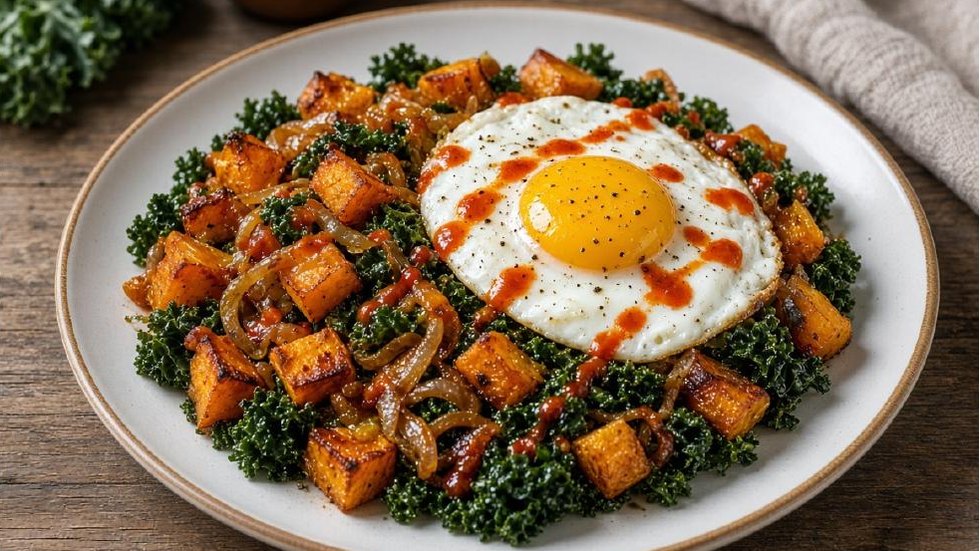
Page 4 of America's seasonal menu — the hot sauce is in the bowl behind the plate, where it belongs until the last second.
Why This Is a Winter Dish Here
Everywhere else in the country this is an autumn plate. Butternut squash and kale are the two vegetables Americans photograph in October, alongside a sweater and a pumpkin. In Palm Beach County they are January food, and that is not a stylistic choice — it is the calendar.
South Florida's growing year runs backwards from the rest of the country's. Our killing heat is the summer, not the winter, so the cool-season crops that a northern grower puts in the ground in spring go in here in the fall and come out of the field in our mildest months. UF/IFAS puts the South Florida winter-squash planting window at roughly August through March — which lands the harvest squarely in our cool months rather than in a northern fall. Kale is a cool-season crop on the same logic, and it is at its best here from about November into March. Onions are in the same window. The FDACS Florida Crops in Season calendar is the list we actually build the board from, and in these months it hands us all three ingredients at once.
So the seasonal argument for this plate is unusually clean. There is no meat in it, no long braise, no imported sweetener, nothing shipped and nothing preserved. Take away the eggs, the oil and the hot sauce and what is left is three vegetables, all of them harvesting within a few miles of the truck at the same moment. That is about as close to the definition of a seasonal dish as a menu gets, and it is the reason a plate this plain earns a place on the board between a shakshuka and a glazed pork bowl.
It is also the one dish on the winter board with a job the other five cannot do. Every catering event we run has vegetarians in the line, and a truck window that offers them a side dish is a truck window that has quietly told them they are an afterthought. This plate is a main course that happens to be vegetarian, not a vegetarian version of something else — and dropping one ingredient makes it vegan. More on that below, because it changes how you cook it.
The Recipe
Winter Squash & Kale Plate · Serves 4 · About 20 minutes prep, 25–30 minutes in the oven with the onions going on the stove alongside · Two pans and a sheet tray. This is the recipe as printed on page 4 of America's seasonal menu, unchanged.
Ingredients — serves 4
- 1 butternut squash, cubed
- 2 tbsp olive oil, salt, pepper
- 1 bunch kale, stemmed and torn
- 1 onion, thinly sliced and caramelized
- 4 eggs, fried
- Hot sauce
Method — about 50 minutes, two things at once
1 · Roast the squash
Roast squash at 425°F, tossed in oil/salt/pepper, 25–30 min until caramelized.
2 · Caramelize the onions
Caramelize onions low and slow, 20 min.
3 · Massage the kale
Massage kale with a little oil and salt.
4 · Wilt the kale
Wilt it briefly in the hot pan.
5 · Plate and top
Plate squash, kale, onions; top each plate with a fried egg and hot sauce.
Source locally: Squash, kale & onion — Swank Specialty Produce or Honeybee's Hydroponic (for the kale). Eggs — Charmed Life Farm. That line is printed on the menu page itself, and the addresses and phone numbers are in the shopping list further down.
Cook's Notes — Three Kinds of Heat
The recipe above is complete and you can stop there. What follows is the reasoning underneath it, offered as general kitchen guidance rather than gospel. If you only read one note, read the first: it is the note that separates this plate from the sad roasted-vegetable medley it can so easily become.
1 · Three vegetables, three heats — never one pan
This is the whole dish. The squash needs hot, dry, spacious heat — 425°F, uncrowded, half an hour — to drive water off and brown the cut faces. The onions need the opposite: low, slow, covered-ish heat for twenty minutes so their sugars concentrate instead of scorching. The kale needs almost no heat at all — seconds in an already-hot pan. Three requirements that actively contradict each other. Put them on one sheet pan together and the kale is ash before the squash is soft, and the onions are raw. The plate looks like one dish; it is cooked as three.
2 · The squash is a spacing problem, not a temperature problem
Look at the photograph: those cubes have hard brown edges and hold their shape. That comes from every cube touching hot metal with air around it. A crowded pan traps the steam the squash is releasing, and steamed squash goes pale, soft and wet — it will be cooked in the same 25–30 minutes and it will not be caramelized, which is the word the recipe actually uses. One layer, gaps between the cubes, and use two trays rather than piling one. If you must choose, choose the bigger pan over the higher heat.
3 · Peel it at the neck, and cut cubes that match
Butternut is the friendliest of the winter squashes because the long neck is solid flesh with skin thin enough for an ordinary vegetable peeler. Cut the squash where the neck meets the bulb, peel and cube the neck, then halve the bulb, scoop the seeds and cube that. Keep the cubes roughly even — three-quarters of an inch to an inch is the useful range. A tray holding both half-inch scraps and two-inch chunks gives you burnt bits and raw bits out of the same oven at the same minute.
4 · Twenty minutes of onions is twenty real minutes
Caramelized onions cannot be rushed with higher heat — that browns the outside and leaves the sugars unconverted, which tastes sharp rather than sweet. Slice thinly and evenly so they finish together, start them when the squash goes into the oven, keep the heat moderate-low, and stir them every few minutes. A pinch of salt early pulls water out and helps them collapse. They are done when they are limp, glossy and the colour of the ones in the photograph — deep gold, not dark brown. If yours are still pale at twenty minutes, give them five more; the oven has the squash and you are not waiting on anything else.
5 · Massaging the kale is mechanical, not mystical
Kale leaves are stiff because they are full of tough structural fibre, and working them between your hands with oil and salt physically breaks some of that structure down — the salt draws moisture out of the cells while the oil coats and softens the leaf. Two minutes of real squeezing turns a bunch of kale darker, glossier and noticeably smaller in the bowl. Do it while the squash roasts. It is not a wellness ritual; it is the step that lets the kale finish in seconds in step four instead of needing minutes it cannot survive.
6 · "Briefly" means seconds — use the pan you just used
Slide the finished onions out and drop the massaged kale straight into that same hot pan. Because it has already been broken down by hand, it collapses almost immediately: toss it until it turns deep green and glossy and pull it. Kale held in a pan past that point goes grey, bitter and stringy — and the residual onion sugar in the pan will scorch on it. Stemmed and torn, as the ingredient list says: the thick central rib never gets tender in seconds and is the most common reason a good plate of kale still eats like a chore.
7 · The yolk is the sauce — so keep it runny
There is no dressing, no cheese, no cream and no gravy on this plate. The only thing binding roasted squash to dry kale is the broken yolk of the egg, which is why it goes on last and whole rather than scrambled through. Fry it in a hot pan so the white sets and the edges frill while the yolk stays liquid, and salt the white rather than the yolk. Break it at the table. A hard yolk turns the dish into three separate piles of vegetable, which is exactly what it looks like when someone says they did not enjoy it.
8 · The hot sauce is the acid, not the heat
Three of the four components on this plate are sweet — roasted squash, caramelized onion, egg yolk — and sweet with nothing against it goes flat by the fourth bite. The hot sauce is the whole counterweight, and most of the work it does is vinegar rather than capsaicin. So use a thin, sharp, vinegar-forward sauce rather than a thick sweet one, and put it on in streaks like the photograph rather than a puddle. If you want none at all, hit the plate with a squeeze of lemon instead. Do not simply leave it off.
Substitutions, and the Vegan Version
This is the most forgiving recipe on the winter board, because none of the six ingredients is doing a chemical job that only it can do. That is the opposite of the Sugarcane Glazed Pork Bowl, where the cane syrup and the collagen in the shoulder are load-bearing. Here you are just balancing sweet, bitter, rich and sharp — so swap with confidence, as long as you keep one of each.
For the butternut: any dense winter squash works — kabocha, acorn, calabaza, or the sweet potatoes that grow well in this county. Delicata needs no peeling at all. What does not work is a summer squash: zucchini and yellow squash are mostly water and will steam rather than caramelize in a hot oven.
For the kale: curly kale is what is in the photograph and what the hydroponic growers up the road cut year-round, but Lacinato takes to the massage just as well and is milder. Collards are a Palm Beach County winter crop too and are excellent here, though they are tougher and want a real sauté rather than seconds. Spinach is the one swap to avoid: it is already tender, so it collapses to nothing and adds water to the plate.
For the egg — the vegan version: take the egg off and you have lost your only sauce, so you have to replace the function and not just the ingredient. The version we would cook: a spoonful of tahini loosened with lemon and water, or a smashed avocado, streaked across the plate before the hot sauce. Both bring the fat and the cling the yolk was providing. Everything else in the recipe is already plant-based.
One thing not to substitute: the salt in step three. Massaging kale with oil alone does about half the work — the salt is what pulls water out of the leaf while your hands do the rest.
Why It Works Off a Truck Window
Practical, not stylistic. Steps one through four all hold: roasted squash, caramelized onions and wilted kale sit happily in warm pans through a service, and none of them are hurt by twenty minutes of waiting. Only the egg is cooked to order, and a fried egg takes about two minutes. So this plate is built the way a truck has to build things — three components finished in advance and one cooked in front of you — which is also exactly how to run it at home for six people instead of four.
It is the one dish on the winter board that reads as breakfast, which makes it the answer for the morning end of the calendar: brunch weddings, a Saturday-morning corporate event, walk-up service at the farm. America is a hand-converted 1979 Blue Bird bus and a state-licensed Mobile Food Dispensing Vehicle, MFD1654011, working out of The Bell Farm in Loxahatchee — a farm-to-bus operation short enough that the kale can be cut on Okeechobee Boulevard and served on Okeechobee Boulevard.
And it travels well in the other direction too: the same three components are what we plate at a seated private farm dinner, where the egg is fried to order at the table end of the kitchen. A dish that survives both a queue and a tablecloth is a rare thing, and this is the only one on the winter six that does.
Where to Buy the Ingredients — the Local Shopping List
Every recipe on America's menu carries a "source locally" line, because a farm-to-table claim that cannot name the farm is just a font choice. These are the suppliers we actually buy this dish from, off the call sheet printed on the back page of the menu. This plate has the shortest list of any dish on the board — and the closest.
Swank Specialty Produce
Buy here: the squash, the kale and the onion — all three, in one stop, in season. This is our primary source for specialty and tropical produce and the closest grower to the truck: a mile and a half of road between the field and the pan.
Honeybee's Hydroponic
Buy here: the kale, and the reason this plate can run outside its ideal window. Hydroponic greens and herbs — kale, lettuce, fresh herbs — with a consistent year-round supply, on the same road as the farm. When field kale is between crops, this is where ours comes from.
Charmed Life Farm
Buy here: the eggs — pasture-raised, from a Loxahatchee neighbour about five miles away. They also carry chicken and pork. The only ingredient on this plate that comes from an animal is also one of the shortest supply lines on the whole 26-dish menu. Website rather than phone is the way in.
Bedner's Farm Fresh
Buy here: squash, kale and collards, plus general produce and U-pick — tomatoes, corn, strawberries and citrus. Worth the drive if you want to pick the squash yourself, and the backup when the closer growers are between cuts.
One honest caveat, the same one the menu's own call sheet makes. Two things on this ingredient list are not part of the local sourcing plan and never have been: the olive oil and the hot sauce. Both come through a standard wholesale distributor, the way the rice and cornmeal on other dishes do. We would rather say that plainly than let a "farm-to-table" label do work it has not earned. The squash, the kale, the onion and the eggs are the local part of this plate — and on this particular plate, that is almost all of it.
Would Rather Someone Else Made It?
This plate runs off the window from November through February, and it is the one we ask about first when a client tells us their guest list. America the Food Truck is a state-licensed Mobile Food Dispensing Vehicle (MFD1654011) working out of The Bell Farm in Loxahatchee, and winter is the busiest calendar we run — Saturdays in January go first.
Private catering starts at $800 per event, wedding and event packages start at $2,500, and a seated private farm dinner at The Bell Farm is $150 per guest with a ten-guest minimum. The catering cost guide walks through what actually drives a quote, the wedding catering guide covers the timeline side of it, and the winter menu page covers what a November-to-February date means for weather, daylight and where a truck can park. Tell us about dietary restrictions when you book rather than on the day — this is the plate we build that answer around.
Winter Squash & Kale Plate — FAQ
What is the Winter Squash & Kale Plate?
Cubed butternut squash roasted hard at 425°F until the edges caramelize, onions caramelized low and slow in a separate pan, and curly kale massaged with oil and salt then wilted for seconds in the hot pan — plated together and topped with a fried egg and hot sauce. It is the vegetarian anchor of America the Food Truck's winter board in Loxahatchee, and it is a main course rather than a side: six ingredients, no sauce except the yolk, and three vegetables that are all harvesting in Palm Beach County at the same time.
How long does it take to make?
About 50 minutes for four servings. Roughly 20 minutes of prep — peeling and cubing the squash, stemming and tearing the kale, slicing the onion thinly — then 25 to 30 minutes with the squash in a 425°F oven while the onions caramelize on the stove for 20 of those minutes. The kale takes seconds and the eggs about two minutes, both at the end. Nothing in it needs to be watched closely except the onions, which want a stir every few minutes.
Can I roast the squash, onions and kale together on one sheet pan?
No — and this is the single thing that decides whether the plate is good. The three components want heat that actively contradicts itself: the squash needs hot, dry, spacious heat for half an hour; the onions need low, slow heat for twenty minutes so their sugars concentrate instead of scorching; the kale needs a few seconds and nothing more. On one pan the kale burns to ash before the squash softens and the onions never caramelize. It looks like one dish on the plate and it is cooked as three.
Why roast the squash at 425°F rather than something lower?
Because the recipe asks for caramelized squash, not merely cooked squash. A hot dry oven drives moisture off the cut faces fast enough for them to brown and develop the sweet, nutty edges you can see in the menu photograph; a moderate oven cooks the cubes through while they sit in their own steam and stay pale and soft. Same doneness, different dish. If your oven runs hot and the cubes are darkening too quickly, drop it slightly rather than covering the tray — covering traps exactly the steam you are trying to lose.
How do I stop the squash going mushy or pale?
Spacing, almost always — not temperature or time. Every cube needs to touch hot metal with air around it, so spread them in a single layer with gaps and use two trays instead of piling one. A crowded pan traps steam and steamed squash cannot brown. Cut the cubes roughly even, around three-quarters of an inch to an inch, so they finish together, and resist stirring them more than once: each turn interrupts the browning that has already started on the face touching the pan.
Do I have to peel the butternut squash, and what is the easiest way?
Yes for butternut — the skin does not soften enough in half an hour to be pleasant. It is the easiest of the winter squashes to handle, though: cut the squash where the long neck meets the round bulb, and the neck is solid flesh with skin thin enough for an ordinary vegetable peeler. Peel and cube the neck, then halve the bulb, scoop out the seeds and cube that. If peeling is the part you dislike, use delicata instead — its skin is thin enough to eat, so you only seed and slice it.
Why do you massage the kale before cooking it?
Because it does mechanically what heat would otherwise have to do. Kale leaves are stiff with tough structural fibre; working them between your hands with oil and salt physically breaks some of that structure down, while the salt draws moisture out of the cells and the oil coats and softens the leaf. Two minutes of real squeezing leaves the kale darker, glossier and visibly smaller in the bowl. That is what lets it finish in seconds in the pan rather than needing minutes of cooking it cannot survive without turning grey and bitter.
What kind of kale should I use — curly or Lacinato?
Curly kale is what is in the menu photograph and what the hydroponic growers up the road from the farm cut year-round, and it holds its texture best against the soft squash. Lacinato — also sold as Tuscan or dinosaur kale — takes to the massage just as well and is milder. Either is right. Whichever you use, stem it: pull or cut the thick central rib out and tear the leaf, because that rib will never get tender in the seconds the leaf needs and it is the usual reason cooked kale still eats like a chore.
Twenty minutes for caramelized onions — is that really enough?
It is enough for the deep-gold, glossy onions on this plate, provided the twenty minutes are real ones. Slice thinly and evenly so they collapse together, add a pinch of salt early to pull the water out, keep the heat moderate-low, and stir every few minutes. What you cannot do is trade time for temperature: high heat browns the outsides and leaves the sugars unconverted, which tastes sharp rather than sweet. If they are still pale at twenty minutes, give them another five — the oven has the squash and nothing else is waiting on you.
How should the egg be cooked?
Fried, whole, and with the yolk still runny — sunny-side up or over easy. The yolk is the only sauce on the plate: there is no dressing, no cheese and no cream, so it is what binds roasted squash to dry kale when you break it at the table. Fry it in a hot pan so the white sets and the edges frill while the centre stays liquid, and salt the white rather than the yolk. A hard yolk turns the dish into three separate piles of vegetable, which is what it looks like whenever someone tells us this plate did not work for them.
Is this recipe vegetarian, vegan or gluten-free?
It is vegetarian as written and it is the vegetarian main course on America's winter board, not a side dish. There is no dairy in it. It is not vegan because of the egg — but take the egg off and replace what it was doing, and it is: a spoonful of tahini loosened with lemon and water, or smashed avocado, streaked across the plate before the hot sauce gives you back the fat and the cling the yolk provided. Nothing in the ingredient list contains gluten, but hot sauces vary, so read your bottle if that matters to you.
What can I substitute for the butternut squash?
Any dense winter squash: kabocha, acorn, calabaza, or the sweet potatoes that grow well in this county. Delicata is the easy option because its skin is edible, so there is no peeling. What will not work is a summer squash — zucchini and yellow squash are mostly water and will steam and slump in a 425°F oven instead of caramelizing. This is a forgiving recipe overall, because no single ingredient is doing a chemical job only it can do; you are balancing sweet, bitter, rich and sharp, so keep one of each and swap freely.
Do I have to use hot sauce?
You need something sharp, and most of what the hot sauce is doing here is vinegar rather than heat. Three of the four components — roasted squash, caramelized onion, egg yolk — are sweet or rich, and sweet with nothing against it goes flat by the fourth bite. Use a thin, vinegar-forward sauce rather than a thick sweet one, and streak it rather than pooling it, as in the menu photograph. If you want no chilli at all, a squeeze of lemon over the plate does the same job. Leaving it off entirely is the one edit we would argue with.
Can I make it ahead of time?
Three of the four components, yes — which is exactly why this plate works off a truck window. Roasted squash, caramelized onions and wilted kale all hold in warm pans through a service and reheat well; the onions are arguably better made a day ahead. Only the egg is cooked to order, and that takes about two minutes. So for a crowd at home, do steps one through four in advance, keep them warm or reheat them, and fry the eggs as people sit down. What does not hold is a fully assembled plate: the yolk sets and the kale keeps softening under the hot squash.
When are winter squash and kale actually in season in Palm Beach County?
Our cool months, which is the reverse of most of the country. South Florida's killing season is the summer, so cool-season crops go in the ground in the fall and come out in our mildest weather. UF/IFAS puts the South Florida winter-squash planting window at roughly August through March, and kale is a cool-season crop that is at its best here from about November into March. Onions run in the same window. FDACS publishes the current list on its Florida Crops in Season calendar, which is the same source America's seasonal board is built from.
Where can I buy the ingredients locally in Palm Beach County?
Swank Specialty Produce on North Road in Loxahatchee, a mile and a half from the farm, can cover the squash, kale and onion in one stop in season. Honeybee's Hydroponic at 15550 Okeechobee Blvd — the same road as the farm — grows kale, lettuce and herbs hydroponically with a year-round supply, which is where ours comes from when field kale is between crops. Eggs come from Charmed Life Farm, a pasture-raised operation about five miles away in Loxahatchee, at charmedlifefarm.com. Bedner's Farm Fresh in Boynton Beach carries squash and kale too and runs U-pick.
When is this dish actually on the truck?
November through February, when Palm Beach County squash, kale and onions are all harvesting at once. America runs a seasonal board rather than a fixed one, so the winter dishes come off when the winter crops do. It is also the dish on that board that reads as breakfast, which makes it the answer for the morning end of the calendar — brunch weddings, Saturday-morning corporate events, walk-up service at the farm. The winter menu page carries the month-by-month crop calendar behind those decisions.
Can you cater this for an event?
Yes, in season, and it is the first plate we ask about when a guest list includes vegetarians — it is a main course, not a side, so nobody in the line is served an afterthought. Private catering starts at $800 per event and wedding and event packages start at $2,500; a seated farm dinner at The Bell Farm is $150 per guest with a ten-guest minimum. America is a state-licensed Mobile Food Dispensing Vehicle (MFD1654011) and an FDACS-registered agritourism operation at 16140 Okeechobee Blvd, Loxahatchee, FL 33470. Call (561) 779-3213.