Fresh Citrus
Agua Fresca
Oranges · Grapefruit
The fourth item on America's winter board and the only one that never touches heat. Four ingredients, fifteen minutes, no cooking, no sugar — which sounds like the easiest recipe in the book and is actually the least forgiving, because there is no technique anywhere in it to rescue mediocre fruit. Every other dish on the board can be saved by a pan. This one is decided at the point of purchase. Below is the recipe as we run it, why peak-season Florida citrus genuinely needs no sweetening, why the grapefruit half of it has a clock running on it, the juice-yield arithmetic for scaling it up, and the local shopping list.
4
Servings — eight pieces of fruit and a pitcher
~15 min
Start to poured — the whole recipe is juicing
0 min
Of heat. Nothing on this page gets cooked
Nov–Feb
When it belongs on the board
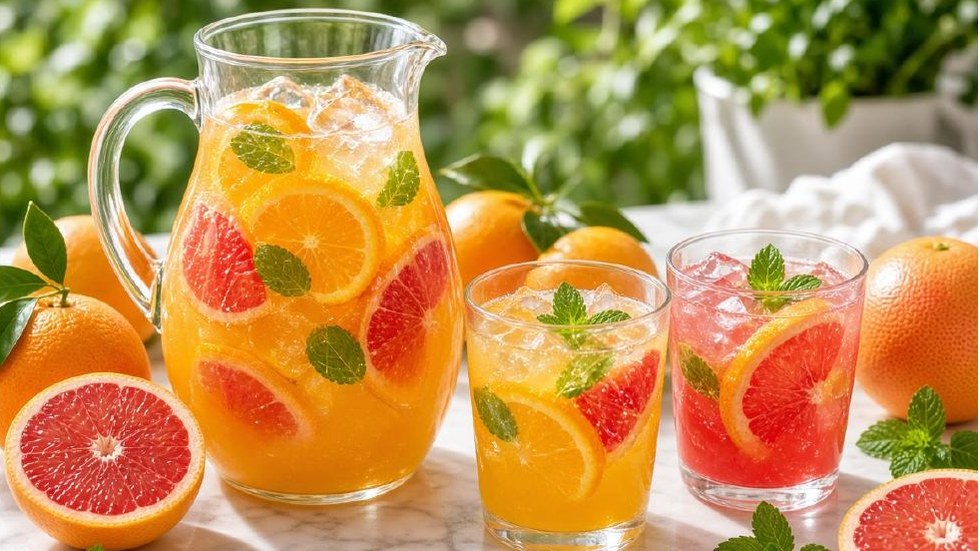
Page 5 of America's seasonal menu. Note the colour difference between the two glasses — same pitcher, different amount of grapefruit in each. That is fresh fruit, and it is the reason we do not apologise for it.
Why This Is a Winter Drink Here
Agua fresca reads as a hot-weather drink, and almost everywhere else in America it is one. In Palm Beach County it sits on the winter board, and the reason is simply that this is when the fruit exists. Florida citrus is harvested roughly October through June. Oranges run across that whole stretch with the biggest volumes from December into May; fresh Florida grapefruit ships from about September through June, with the height of its harvest in February. So a citrus drink made from Florida fruit is a cool-season drink here — and a citrus drink poured here in August is made from somebody else's fruit.
That is the seasonal argument, and on this particular item it is unusually strict. Look at what is in it: fruit, water and ice. No oil, no dairy, no spice, no flour, nothing preserved and nothing out of a jar. It is the only item on the entire 26-dish seasonal menu where every ingredient except the ice is a crop — which makes it the only one with nowhere to hide. A shakshuka can be carried by good bread. A glazed pork bowl can be carried by the glaze. This is fruit and water in a glass. If the fruit is not good, the drink is not good, and no amount of skill in the kitchen will change that, because there is no kitchen step to be skilled at.
The winter menu page makes the broader case about this county — that winter is the growing season here rather than a lull between growing seasons, and that the crop calendar is what the board is built from. Citrus is the cleanest illustration of it anywhere on the menu. The FDACS Florida Crops in Season calendar is the list we actually work from, and citrus sits on it through exactly the months when most of the country's fruit is arriving on a truck from somewhere warmer.
The Recipe
Fresh Citrus Agua Fresca · Serves 4 · About 15 minutes, effectively all of it juicing · A juicer or a reamer, a jug and a spoon. This is the recipe as printed on page 5 of America's seasonal menu, unchanged — and it is the shortest one in the book.
Ingredients — serves 4
- 4 Florida oranges, juiced
- 2 grapefruits, juiced
- 2 limes, juiced
- 4 cups cold water
- Ice
Five lines, and one of them is ice. The mint and the fruit wheels in the photograph are garnish — they are not in the recipe, and note 9 below explains why we put them in anyway.
Method — one sentence on the menu, four steps here
1 · Juice all the citrus
Juice all citrus — 4 Florida oranges, 2 grapefruits, 2 limes.
2 · Combine with cold water
Combine the juice with 4 cups cold water.
3 · Taste and adjust
Taste and adjust — no added sugar needed at peak season.
4 · Serve over ice
Serve over ice.
Step three is the only one that asks anything of you. Nearly everything below this box is about step three.
Source locally: Citrus — Bedner's Farm Fresh or Swank Specialty Produce (both carry Glades-grown citrus in season). That line is printed on the menu page itself, and the addresses and phone numbers are in the shopping list further down.
Cook's Notes — There Is No Cooking, So It Is All Sourcing
The recipe above is complete and you can stop there. What follows is the reasoning underneath it, offered as general kitchen guidance rather than gospel. If you read only two notes, read the first two: together they explain the most-doubted line in this book — no added sugar needed at peak season — and why it is a measurable claim rather than a slogan.
1 · In Florida, ripeness is a ratio — and this drink is that ratio in a pitcher
Florida is unusual in that "is this fruit ripe?" is a question with a written answer. The Florida Citrus Code,
s. 601.11(1)(a), gives the Florida Department of Citrus power to "Establish state grades and minimum maturity and quality standards" for citrus fruits, and it spells out what those standards are made of:
"Color break, predominant color, total soluble solids, juice content, and ratio of soluble solids" to acid. Read the last item twice. Maturity in citrus is not a sugar reading on its own — it is the
relationship between sugar and acid. Which is exactly what this recipe is: the oranges bring the soluble solids, the limes bring the acid, the grapefruit brings the bitter edge that stops the whole thing tasting like syrup, and the water sets the concentration. Four ingredients that are really three variables and a dilution.
2 · "No added sugar" is a test you are running on the fruit, not a boast about the recipe
Florida takes that sugar-and-acid measurement seriously enough to have legislated how to take it.
Section 601.25 — a statute whose entire job is defining the method — provides that until the department sets one by rule,
"the Brix hydrometer shall be used" for total soluble solids, with acid found by titration and calculated as anhydrous citric acid. Nobody is going to titrate a pitcher of agua fresca. But it tells you what the menu line actually means: if your drink needs sugar, the honest reading is not that the recipe is under-sweetened — it is that
the ratio in the fruit you bought is not there yet. That is useful information rather than a failure. Taste before you reach for the sugar bowl, and if it needs help, buy your citrus somewhere else next time.
3 · The grapefruit has a clock on it — this is why the menu says "pressed daily"
This is the one piece of real chemistry in the drink, and it is why that menu phrase is a promise rather than a flourish. Grapefruit's characteristic bitterness comes largely from a compound called limonin, and food scientists call the effect delayed bitterness for a precise reason: limonin is essentially absent from freshly extracted juice. In the intact fruit it sits as a non-bitter precursor, and once the fruit is cut and the juice stands in its own acid, that precursor gradually converts into the bitter compound. Which is to say: fresh grapefruit juice is not bitter, and yesterday's grapefruit juice is. Press it and serve it. Every bottled grapefruit juice you have tasted had already run that clock before you opened it — which is also why a great many people are convinced they dislike grapefruit.
4 · The water is not a shortcut. The water is the recipe
Agua fresca means fresh water, and the name is the instruction. This is not juice and it is not lemonade — it is juice cut roughly half and half with cold water, and everything about the drink follows from that. Straight citrus juice is too concentrated and too acidic to drink by the pint; you take a small glass at breakfast and stop. Diluted, it becomes something a person will genuinely drink two of in Florida weather, which is the entire point of the category. Dilution is also what removes the need for sugar: you are not fighting a concentrated sweet-sour hit, so there is nothing to balance. If four cups of water sounds like a lot to you, that instinct is precisely the difference between a jug of agua fresca and a jug of juice.
5 · Two limes against six large fruit — that is structure, not flavour
Look at the proportions. Four oranges and two grapefruits are the body of the drink; two limes are a small fraction of the total liquid. You are not meant to taste lime as lime. What the lime does is hold the edge — it keeps the orange from going flat and slightly cloying, the way a squeeze of citrus does on almost any sweet thing. It is the same job the hot sauce does on the
Winter Squash & Kale Plate: mostly acid, not mostly heat. Add the lime last and taste as you go, because it is the one ingredient here you can overshoot. Two limes into roughly eight cups of finished drink is a light hand on purpose.
6 · How much juice is in eight pieces of fruit — the arithmetic for scaling up
The most common practical question about this recipe is how big a pitcher it actually makes, and the honest answer is that it depends on your fruit. As general kitchen guidance rather than a rule: a medium orange gives roughly a quarter to a third of a cup of juice, a grapefruit somewhere around two-thirds to three-quarters of a cup, and a lime about two tablespoons. Run the recipe through that and you land near two and a half to three cups of juice, which with four cups of water makes something in the region of a scant two quarts — a full pitcher, four generous glasses. Scale by fruit count rather than by volume: double it and you want eight oranges, four grapefruits, four limes and eight cups of water. Measure your first batch once and you will know your own fruit for good.
7 · Strain it or don't — but decide, because it changes the drink
The recipe does not say to strain, and the drink in the photograph plainly has not been strained fine — it is cloudy, and that cloud is pulp and citrus oil doing useful work. Unstrained is rounder, fuller and seems a little sweeter; strained is cleaner, sharper and looks like a cocktail. Either is right. The middle road is the one we run off the window: through a coarse sieve to catch seeds and the big membrane, letting the fine pulp go through. What you should not do is grind the pith or press the peel hard into a reamer — the white layer carries bitter compounds you have no reason to invite in, particularly with grapefruit already in the jug.
8 · Ice dilutes twice — so chill the jug, don't rely on the cubes
Ice is the fifth ingredient and it is a real one, but it does two jobs at once: it cools the drink, and as it melts it waters the drink down a second time. A pitcher built warm and cooled entirely by ice arrives at the last glass noticeably thinner than it was at the first. So make it with genuinely cold water as the recipe says, give it half an hour in the refrigerator if you have it, and use the ice to hold the temperature rather than to create it. At an event we chill the base and ice the cup, never the batch — the same rule, in service form.
9 · The mint and the wheels are garnish, and they are not decoration
Neither the mint nor the fruit slices in the photograph appear in the ingredient list, and we are not going to pretend otherwise. They stay in anyway because they each do a job. Mint contributes aroma, which is a genuine part of how a cold drink tastes — you smell it before you taste it, and a slap of the leaf between your palms releases far more of it than dropping it in whole. The wheels of orange and grapefruit tell a guest what is in the glass without a word or a sign. Look again at the photograph: two glasses poured from one pitcher, one orange and one pink, because of how much grapefruit landed in each. Fresh fruit does that. A powder does not.
Variations, Substitutions, and One Warning Worth Reading
For the oranges: any sweet Florida orange works, and what is on the shelf will change across the season — early and mid-season varieties through the winter, Valencias later in the run. Tangerines and honeybells make a rounder, softer drink with less acid behind it, so if you go that way keep the limes and consider a third one. What is not interchangeable is a sour orange: Seville and its relatives are a marmalade fruit rather than a drinking fruit, and they will take this somewhere the recipe is not going.
For the grapefruit: pink and red varieties give you the colour in the second glass in the photograph and generally read a little softer; white grapefruit is sharper and more bitter. Either belongs here. The proportion matters more than the variety — two grapefruits against four oranges is the balance point, and pushing the grapefruit share higher tips the whole jug bitter, especially as it stands.
For the limes: lemon is a straight swap and slightly softer. Key limes, which grow in this part of the state, are more aromatic and more acidic, so use fewer than you think you need. If you have neither, do not simply skip the acid — the drink goes flat without it, and that flatness is what people mistake for "needs sugar."
For the water: sparkling water in place of some of the still turns this into something closer to a spritz and is genuinely good; add it at the glass rather than in the jug so it is still lively when it is poured. Coconut water is the one swap we would argue against — it brings its own sweetness and its own flavour, and it competes with the citrus instead of carrying it.
The warning, and it is a real one: grapefruit juice interacts with a number of prescription and over-the-counter medications — some statins, some blood-pressure drugs, transplant anti-rejection drugs and others. The FDA publishes a plain-English consumer update on it, Grapefruit Juice and Some Drugs Don't Mix, and it notes that pomelos and tangelos may behave the same way — worth knowing, since tangelo is otherwise a tempting substitution here. This is not medical advice and we are not qualified to give any. It is simply the reason we say the word "grapefruit" out loud at an event rather than pouring an unlabelled pink drink, and the reason there is always a grapefruit-free jug alongside. If you are serving a crowd, name the ingredients. It costs nothing, and somebody in that line will be glad you did.
Why It Works Off a Truck Window
Practical, not stylistic. A truck window has one oven, one flat-top and a queue, so anything that needs neither is worth its space several times over. This drink needs no heat, no holding equipment and no cook time at all — it needs a jug and a cold box. That makes it the cheapest item on the board in the currency a truck actually spends, which is not money but seconds at the window and inches of hot line.
The catch is that it moves the entire difficulty upstream. Every other dish is a morning of prep and then a service; this one is a shopping trip and then nothing, which means the only thing that can go wrong has already gone wrong by the time the truck is parked. That is why it lives or dies on the sourcing line, and why the grapefruit gets pressed the day it is poured rather than the day before — see note 3, which is a scheduling constraint disguised as chemistry.
It also answers a question that comes up on nearly every event call: what the people who are not drinking are drinking. A jug of this on the table is a real answer rather than a apologetic one, and at a wedding it does something a case of soda cannot — it matches the food, because it is made of the same fruit as the rest of the board. America is a hand-converted 1979 Blue Bird bus and a state-licensed Mobile Food Dispensing Vehicle, MFD1654011, working out of The Bell Farm in Loxahatchee. On a seated private farm dinner the same pitcher goes on the table, poured rather than handed through a window.
Where to Buy the Ingredients — the Local Shopping List
Every recipe on America's menu carries a "source locally" line, because a farm-to-table claim that cannot name the farm is just a font choice. These are the suppliers off the call sheet printed on the back page of the menu. This is the shortest list of any recipe in the book — because there are only two things on it to buy.
Bedner's Farm Fresh
Buy here: the citrus — this is the first name on the menu's own sourcing line for this drink. General produce and U-pick, with citrus among the crops they carry alongside tomatoes, squash, corn, collards, strawberries and blueberries. If you want to see what a good winter orange looks like before you commit to eight of them, this is the stop where you can pick them up yourself.
Swank Specialty Produce
Buy here: the citrus, and the shorter drive. The second name on the menu's sourcing line for this drink, our primary source for specialty and tropical produce generally, and the closest grower to the truck — a mile and a half of road between the field and the jug.
Honeybee's Hydroponic
Buy here: the mint, if you are garnishing. Hydroponic greens and fresh herbs with a consistent year-round supply, on the same road as the farm. Not on the printed sourcing line for this recipe, because mint is not in the recipe — but it is in the photograph, and this is where ours comes from.
Bell Farm (on-site)
Not for this one. The farm grows and presses its own sugarcane along the west boundary — the ingredient behind the
Sugarcane Glazed Pork Bowl — but no citrus. Worth stating plainly, because "farm to table" too often quietly implies that everything came off the one farm. On this drink, none of it did.
The same honest caveat the menu's own call sheet makes applies here, and on this drink it is short. There is nothing on the ingredient list that comes through a wholesale distributor — no oil, no vinegar, no rice, no cornmeal, none of the pantry items the other recipes have to be honest about. The only thing in this glass that did not grow in Florida is the ice. Of the 26 dishes on this menu, that is true of exactly one.
Would Rather Someone Else Made It?
This runs off the window from November through February with the rest of the winter board. America the Food Truck is a state-licensed Mobile Food Dispensing Vehicle (MFD1654011) working out of The Bell Farm in Loxahatchee, and winter is the busiest calendar we run — Saturdays in January go first.
Private catering starts at $800 per event, wedding and event packages start at $2,500, and a seated private farm dinner at The Bell Farm is $150 per guest with a ten-guest minimum. The catering cost guide walks through what actually drives a quote, the wedding catering guide covers the timeline side, and the winter menu page covers what a November-to-February date means for weather, daylight and where a truck can park. If your guest list includes people who are not drinking, say so on the call — this is the item we plan that answer around.
Fresh Citrus Agua Fresca — FAQ
What is a citrus agua fresca?
Agua fresca means "fresh water," and that is literally what it is: fruit juice cut with cold water and served over ice. This version is the juice of four Florida oranges, two grapefruits and two limes combined with four cups of cold water, with no added sugar. It is not juice and it is not lemonade — the dilution is the defining feature of the category, and it is what makes it a drink you can have two of rather than a small glass at breakfast. It is the drink on America the Food Truck's winter board in Loxahatchee, Florida.
How long does it take to make?
About fifteen minutes for four servings, and effectively all of it is juicing eight pieces of fruit. Nothing is cooked at any stage — there is no heat anywhere in this recipe. If you have half an hour to spare, the drink is better for a rest in the refrigerator before serving, because chilling the jug means the ice does not have to do the cooling and therefore does not water the drink down as much.
Do I really not need to add any sugar?
At peak season, no — and if you find you do need it, that tells you something about your fruit rather than about the recipe. Ripeness in Florida citrus is not sugar alone but the ratio of sugar to acid: the Florida Citrus Code at s. 601.11(1)(a) empowers the Department of Citrus to set maturity standards built on "Color break, predominant color, total soluble solids, juice content, and ratio of soluble solids" to acid. Fruit picked inside that window carries its own balance, and the dilution with water means you are never fighting a concentrated sweet-sour hit that needs correcting. Taste it before you reach for the sugar bowl.
Why does my grapefruit juice turn bitter after it sits?
Because of a compound called limonin, and the effect has a name: delayed bitterness. Limonin is essentially absent from freshly extracted juice — in the intact fruit it exists as a non-bitter precursor, and once the fruit is cut and the juice stands in its own acid, that precursor gradually converts into the bitter compound. So fresh grapefruit juice is not bitter and yesterday's is. This is the whole reason the menu says the citrus is pressed daily, and it is why bottled grapefruit juice tastes the way it does: it ran that clock long before you opened it.
How much juice do four oranges, two grapefruits and two limes actually make?
As general kitchen guidance, a medium orange gives roughly a quarter to a third of a cup of juice, a grapefruit around two-thirds to three-quarters of a cup, and a lime about two tablespoons. That puts this recipe near two and a half to three cups of juice, which with the four cups of water makes something in the region of a scant two quarts — a full pitcher and four generous glasses. Your fruit will vary, so measure your first batch once and you will know your own supply from then on.
How do I scale this up for a party or an event?
Scale by fruit count rather than by volume, because fruit varies and cups do not. Doubling means eight oranges, four grapefruits, four limes and eight cups of water; quadrupling means sixteen, eight, eight and sixteen. Two things change at scale. First, juicing becomes the bottleneck, so borrow or rent a proper juicer rather than reaming eighty oranges by hand. Second, do not build one enormous batch hours ahead — the grapefruit gets bitter as it stands, so press closer to service and hold the base cold.
Can I make it ahead of time?
A few hours ahead is fine and a night ahead is not, and the limiting ingredient is the grapefruit. Because of delayed bitterness, grapefruit juice standing in its own acid grows measurably more bitter over hours, so a jug built the night before will not taste like the one built that morning. If you need a head start, juice the oranges and limes ahead, keep them covered and cold, and add the grapefruit and the water as close to serving as you can manage. That is the same sequence we use for an event.
Should I strain it?
Your choice, but make it deliberately, because it changes the drink. Unstrained is cloudy, rounder and seems slightly sweeter — that cloud is pulp and citrus oil, and it is doing real work. Strained is cleaner, sharper and looks like a cocktail. The drink in the menu photograph is plainly not strained fine. The middle road, and the one we use, is a coarse sieve that catches seeds and the big membrane while letting fine pulp through. Whatever you choose, do not grind the pith or press the peel hard — the white layer carries bitter compounds, and there is grapefruit in the jug already.
Is this recipe vegan, gluten-free or dairy-free?
It is all three as written, and unusually unambiguously so — the entire ingredient list is citrus fruit, water and ice. There is no dairy, no egg, no grain, no oil and no sweetener of any kind in it. That is part of why it earns its place at an event: it is the one item on the winter board that almost any dietary restriction can accept without a substitution being made for anybody. The single caution is not a dietary one but a medical one, and it concerns the grapefruit — see the question below.
Is there any reason a guest should avoid the grapefruit?
Yes, and it is worth naming out loud when you serve it. Grapefruit juice interacts with a number of prescription and over-the-counter medications, including some statins, some blood-pressure drugs and transplant anti-rejection drugs; the FDA publishes a consumer update titled "Grapefruit Juice and Some Drugs Don't Mix" that lists the categories, and it notes that pomelos and tangelos may behave the same way. We are not qualified to give medical advice and this is not any. It is simply why we say the word "grapefruit" at an event rather than pouring an unlabelled pink drink, and why there is always a grapefruit-free jug alongside.
What can I use instead of grapefruit?
Leave it out and make up the volume with more orange, adding a little extra lime to keep the edge — the grapefruit is there for bitterness and structure, so if you remove it you have to replace some of the acid. Tangelo is the obvious-looking substitute and is the one we would steer away from for the same medication reason as grapefruit itself. Otherwise, pink and red grapefruit read softer and give you that pink glass in the photograph, while white grapefruit is sharper. Keep the proportion at roughly two grapefruits to four oranges; more than that and the jug tips bitter as it stands.
Can I use bottled or store-bought juice?
You can, and it will be a different drink. The orange half survives it reasonably well; the grapefruit half does not, because bottled grapefruit juice has already developed the delayed bitterness that fresh-pressed juice has not. Bottled juices are also frequently sweetened or blended, which undoes the entire premise of the recipe — the no-sugar line only means anything if you know exactly what went into the jug. If you have to compromise, compromise on the oranges and press the grapefruit and limes yourself.
What is the mint in the photograph, and is it in the recipe?
It is a garnish, and no, it is not in the ingredient list — nor are the wheels of orange and grapefruit floating in the pitcher. We use both anyway because each does a job. Mint contributes aroma, which is a real part of how a cold drink tastes, and slapping the leaf between your palms before dropping it in releases much more of it than putting it in whole. The fruit wheels tell a guest what is in the glass without a sign. Neither adds sweetness and neither changes the recipe.
Why are the two glasses in the photograph different colours?
Because they were poured from the same pitcher and one of them caught more grapefruit than the other. That is what fresh, unstandardised fruit looks like in a glass: pink grapefruit tints what it touches, so a pour that picks up more of it comes out rosier. A commercial mix would produce two identical glasses every time. We would rather have the two in the photograph, and it is a useful thing to point at when someone asks whether the drink is really made on the spot.
When is Florida citrus actually in season?
Roughly October through June. Oranges are available across most of that run with the largest volumes from December into May, and fresh Florida grapefruit ships from about September through June with the height of its harvest in February. That is why this drink sits on a winter board rather than a summer one here, which surprises people who think of agua fresca as hot-weather food. FDACS publishes the current list on its Florida Crops in Season calendar, which is the same source America's seasonal menu is built from.
Where can I buy the citrus locally in Palm Beach County?
The menu's own sourcing line names two: Bedner's Farm Fresh at 10066 Lee Rd in Boynton Beach, which runs general produce and U-pick and carries citrus among its crops, and Swank Specialty Produce at 14311 North Rd in Loxahatchee, a mile and a half from the farm and our closest grower. Both carry Glades-grown citrus in season. If you are garnishing with mint, Honeybee's Hydroponic at 15550 Okeechobee Blvd grows fresh herbs year-round on the same road as the farm.
Is any of it grown on The Bell Farm itself?
No, and it is worth saying plainly. The farm grows and presses its own sugarcane along the west boundary — that is the ingredient behind the Sugarcane Glazed Pork Bowl on the same winter board — but it does not grow citrus. The citrus for this drink comes from the two growers named on the menu's sourcing line. What is true, and unusual, is that everything in the glass except the ice grew in Florida: there is no oil, no vinegar, no grain and no pantry item on this ingredient list at all, which is not something any other recipe on the menu can say.
Can you serve this at a wedding or a private event?
Yes, in season, and it is the item we bring up whenever a guest list includes people who are not drinking alcohol. It matches the food rather than sitting apart from it, because it is made from the same fruit as the rest of the board. Private catering starts at $800 per event and wedding and event packages start at $2,500; a seated farm dinner at The Bell Farm is $150 per guest with a ten-guest minimum. America is a state-licensed Mobile Food Dispensing Vehicle (MFD1654011) and an FDACS-registered agritourism operation at 16140 Okeechobee Blvd, Loxahatchee, FL 33470. Call (561) 779-3213.