Mango Habanero
Chicken Wrap
The First Dish of the Tropical Half
The opening dish on America's spring board and the first recipe in this series that comes with an honest calendar problem printed into it. Spring on this menu runs March to May. Florida mango, by the state's own crop calendar, runs May through August. So for two of the three months this dish is on the board, the fruit it is named after is not being picked in this county — and the page says so at the top rather than burying it. What follows is the recipe exactly as printed on page 8, why half a chilli can feed four people without hurting anybody, why the sour cream in it is a piece of safety equipment rather than a garnish, why the ingredient line says thighs, and where in Palm Beach County to buy the mango and the chicken.
4
Servings — six ingredient lines, three sentences of method
1.5 lb
Chicken thighs — the recipe specifies dark meat
½
One habanero, halved, seeds out, split four ways
May–Aug
Florida's mango window, per FDACS
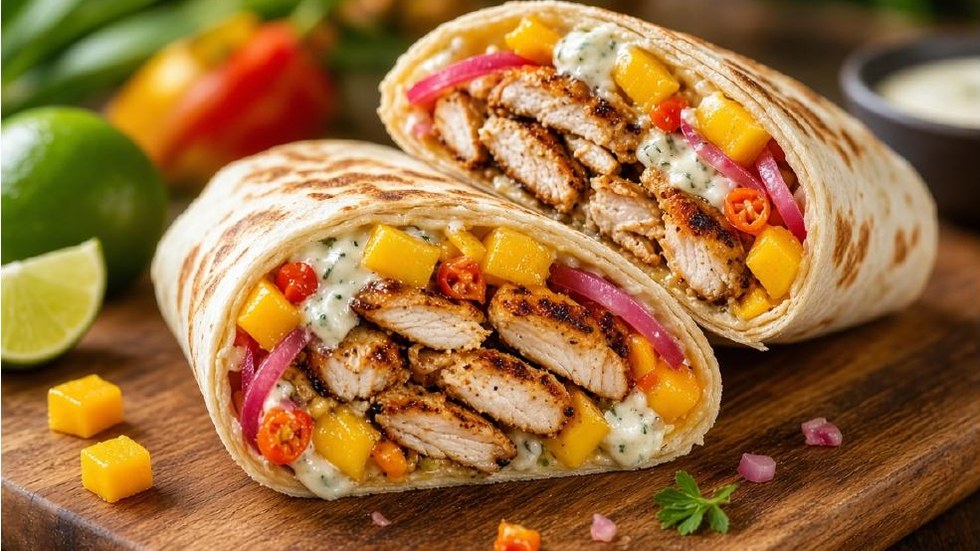
Page 8 of America's seasonal menu, and the first dish of the spring board. Look at the cut face: chicken in one band, mango and onion in another, crema running through the middle. Nothing is stirred together. That layering is the whole build.
The Dish Spring Is Waiting For, Not the Dish Spring Is Built On
Every other recipe in this series has been in season for the whole run of the board it sits on. This one is not, and the gap is worth stating plainly before anything else. The header on page 8 describes spring as "March – May — Transition season — last of the cool-weather crops, first mangoes, tropical fruit ramping up." The Florida Department of Agriculture's Florida Crops in Season calendar lists mango as May through August. Both of those are true at once, and together they say something specific: the wrap arrives in the last few weeks of its own season and then carries straight on into summer.
That is not a flaw in the menu. It is what the word transition on that header is doing. Spring in Palm Beach County is genuinely two growing seasons stacked on top of each other — the tail of the winter vegetable belt in March, and the beginning of the tropical fruit year at the end of May. The same calendar puts sweet corn at October through June, tomato at October through June and bell pepper at November through May, which is why the other mains on this board are still cool-season dishes, while lychee is June and July and avocado is June through January — the tropical crops are all queuing up just past the edge of the board. The spring menu page makes the wider case: this is the only season on the menu that has to be described twice.
So the useful advice, and the one we give on the phone: if your date is in March or April and you want this wrap, you are getting imported fruit and we will tell you so. If your date is in late May, this is the best thing on the board, because a mango picked in this county in the week you eat it is a completely different fruit from one that travelled. It is also the reason this dish does not disappear when the board turns over — it is a spring dish by the printing and a summer dish by the harvest.
One more piece of context for anyone cooking it here rather than buying it. Mango is not a novelty crop in this part of Florida; it is an established one, and the closest supplier on our entire sourcing call sheet — Swank Specialty Produce, 1.5 miles from the farm — is on that sheet specifically as the tropical and specialty grower. The shopping list further down has the address.
The Recipe
Mango Habanero Chicken Wrap · Serves 4 · A grill or a heavy pan, a chopping board, a small bowl for the salsa, a jar for the onions and a dry pan or open flame for the tortillas · This is the recipe as printed on page 8 of America's seasonal menu, unchanged. Note what it does not give you: this dish carries no times and no temperatures at all — no other recipe in this series is quite that bare. The forty minutes in the schema at the top of this page is our own working estimate for four wraps, not the menu's, and the pickled onion wants a head start on top of it.
Ingredients — serves 4
- 1.5 lb chicken thighs, grilled and sliced
- 1 ripe mango, diced
- 1/2 habanero, minced (seeds out for less heat)
- 1/4 red onion, pickled
- 2 tbsp lime crema (sour cream + lime)
- 4 large flour tortillas
Six lines, and four of them carry an instruction inside the line — grilled and sliced, diced, minced (seeds out), pickled. Two ingredients appear only in the method and never on this list: the cumin the chicken is seasoned with and the cilantro in the salsa. Buy both.
Method — three sentences on the menu, three steps here
1 · Grill and slice the chicken
Grill chicken, season simply (salt, pepper, cumin), slice.
2 · Make the mango salsa
Make mango salsa: mango, habanero, red onion, lime, cilantro.
3 · Warm, layer and roll
Warm tortillas, layer chicken, salsa, lime crema, pickled onion, roll tight.
Read step three again: layer, not mix. The salsa goes in as a salsa and the crema goes in as a stripe. Note 8 below is about why that ordering is not decoration.
Source locally: Mango — Swank Specialty Produce (tropical fruit specialty). Chicken — Charmed Life Farm (pasture-raised) or Okeechobee Prime Meat Market. That line is printed on the menu page itself, and this is the first dish in the series where both the protein and the headline ingredient have a named local source. Addresses and phone numbers are in the shopping list further down.
Cook's Notes — Heat Is a Solubility Problem
The recipe above is complete and you can stop there. What follows is the reasoning underneath it, offered as general kitchen guidance rather than gospel. If you read only two notes, read the first two: between them they explain why half a chilli is enough for four people, and why the sour cream on the ingredient list is doing more work than the mango.
1 · Capsaicin does not dissolve in water — and everything follows from that
Start here, because it explains the shape of the whole recipe. The compound that makes a habanero hot, capsaicin, is essentially insoluble in water and readily soluble in fat and in alcohol. It is also not a flavour in the ordinary sense — it binds to a receptor in the mouth that reports heat and physical damage, which is why chilli burn feels like temperature rather than taste, and why water and beer make it worse by spreading it around. A glass of water is the single least effective thing you can drink after this wrap. Once you know that, the ingredient list stops looking like a flavour list and starts looking like a system: a fat-based dairy element to carry and lift the capsaicin off the receptors, a sweet fruit to occupy the palate, an acid to cut, and a starch wrapper to hold the whole thing at a distance. None of those four is optional if you want the dish to be pleasant rather than a dare.
2 · The two tablespoons of lime crema are safety equipment
Two tablespoons across four wraps reads like a garnish quantity, and it is the reason this is a wrap and not an ordeal. Sour cream is fat and water with milk proteins through it, and both halves matter: the fat dissolves capsaicin the way water cannot, and the casein in dairy is widely credited with helping strip it off the receptor — which is the reason cultures that cook with serious chilli almost all keep a dairy or coconut-fat element on the same plate, from raita to crema. Its second job is textural: everything else in this wrap is either firm, chewy or crisp, and the crema is the only soft, cohesive thing in it, so it also functions as the glue that stops a tightly rolled tortilla behaving like a bag of loose parts. Leave it out and you have not made a lighter wrap; you have made a hotter, drier and structurally worse one.
3 · "Seeds out for less heat" works — but not for the reason most people think
The parenthesis on the ingredient line is the most useful four words on page 8, and the folk explanation behind it is slightly off in a way worth correcting. The seeds themselves are not where the heat is made. Capsaicin is produced in the placental tissue — the pale, spongy membrane running down the inside of the pod that the seeds are attached to — and the seeds are simply in contact with it, picking heat up the way a spoon picks up soup. So the instruction is right and the mechanism is the other way round: when you scrape the seeds out you inevitably take the pith with them, and that is what drops the heat. The practical upgrade is to stop thinking about seeds at all and deliberately cut the white ribs away, keeping only the coloured outer flesh, which carries plenty of the habanero's genuinely floral, apricot-like aroma and a fraction of its burn.
4 · Half a habanero is a real quantity — respect the arithmetic
Habaneros sit far up the Scoville scale, commonly quoted in the range of about 100,000 to 350,000 units against roughly 2,500 to 8,000 for a jalapeño — call it somewhere around thirty times hotter, pod for pod, with big variation between individual peppers grown in different conditions. That is why the recipe writes half a pod for four servings and not one, and why it minces rather than slices: minced, the heat distributes; sliced, one person gets a slice and the other three get none. Two working rules. Wear a glove or bag your hand, because capsaicin is oily, it does not wash off with cold water, and it will find your eye hours later. And taste the salsa before it goes near the wrap — pods vary enough that half of one can be mild and half of the next can be genuinely fierce, so start with a quarter, mix, taste, and add.
5 · The recipe says thighs, and it means thighs
Nearly every wrap recipe in the world reaches for breast. This one specifies 1.5 lb chicken thighs, and it is the correct call three times over. Thigh is working muscle: more fat and more connective tissue, so it stays juicy across a much wider window of doneness instead of turning to string the moment it is over. It takes a hard grill better, which is where the char in the photograph comes from. And it is sliced and then left to sit inside a tortilla for the length of a service — breast, sliced and held, dries out fast, while thigh does not. There is a fourth reason specific to this dish: the extra fat in dark meat is itself a capsaicin buffer, working the same way the crema does. If you must use breast, butterfly it so it cooks evenly, pull it early, and slice it as late as you can.
6 · A ripe mango is a fruit you choose by smell and by give
The ingredient line says ripe and it is doing real work, because an unripe mango is not merely less sweet — it is firm, sour and starchy, and it will sit in the salsa as hard cubes that never soften. Colour is the trap: Florida grows many varieties and plenty of excellent ones stay largely green when fully ripe, so judge by the shoulders and the nose, not the skin. A ripe mango gives slightly under gentle pressure near the stem end, the way a ripe avocado does, and smells sweet and resinous right at the stem. Buy them firm a few days ahead and let them finish on the counter, not in the refrigerator, which stalls ripening and can dull the flavour. Dice it a touch smaller than feels right: this is a wrap, and a large cube of soft fruit is what makes the last bite fall out of the end.
7 · Red onion appears twice, in two different states, on purpose
This is the detail people miss when they read the recipe quickly. Red onion is in the salsa (step 2) and it is the separate pickled ingredient on the list. Those are not a duplication; they are two different textures and two different jobs. Raw in the salsa it is sharp, aromatic and structural. Pickled, it becomes the acid spine of the whole wrap — bright pink, slippery, sour, and the only thing in the build that cuts the fat of the crema and the thigh meat. The pickle also happens to be the one component with a time requirement: sliced as thin as you can manage and covered with vinegar, a little water, sugar and salt, it is usable in about half an hour and better the next day. It is the first thing to do and the easiest to forget, which is why it sits at the top of our own prep list rather than at the bottom.
8 · Layer, do not mix — and get the order right
Step three names five things in a specific sequence: tortilla, chicken, salsa, crema, pickled onion. Follow it. A wrap is not a bowl with a lid on; it is eaten in cross-section, and every bite you take cuts through all of the layers at once, which is how one wrap delivers five distinct things instead of one homogeneous paste. There is also a wet-fabric problem to manage: the tortilla is the structural member and liquid is what destroys it. Chicken first puts a dry, warm layer between the bread and the juice of the salsa. Keep everything in a band down the middle with a clear margin at both ends, drain the salsa if it has gone watery in the bowl, and do not overfill — the failure mode of a wrap is always the same, and it is always too much filling.
9 · Warming the tortilla is a mechanical step, not a serving temperature
"Warm tortillas" is easy to read as a nicety about eating things hot. It is not — it is the step that lets the wrap survive being rolled. A cold flour tortilla straight from the packet is stiff and it splits along the fold; thirty seconds in a dry pan or a few seconds over an open flame makes it pliable, and it stays that way for a minute or two, which is your rolling window. Two practical points. Dry heat, not steam — a microwaved tortilla goes soft and then goes gummy and tears just as readily. And warming the surface slightly toasts it, which is the light blistering on the outside of the wraps in the photograph and, on a griddle, the thing that seals the seam shut when you finish with the join face down.
10 · Cumin is the only spice named, and there is a reason it is the one
"Season simply (salt, pepper, cumin)" is the menu's whole seasoning instruction, and the restraint is deliberate — the salsa is already carrying sweet, sour, sharp and hot, so a heavily spiced chicken would be arguing with it. Cumin earns the single slot because it is warm, earthy and faintly smoky, which is exactly what the rest of the wrap has none of: it gives the chicken a savoury floor to stand on so the fruit reads as balance rather than as dessert. Worth doing properly — toast whole seeds in a dry pan for under a minute and grind them, or at the very least buy ground cumin recently, because it is a spice that goes flat and dusty in the jar faster than most. Salt the thighs a little ahead of the grill rather than at the last second, and keep the pepper coarse.
Variations, Substitutions, and Getting the Heat Right for Your Table
For the heat, which is the substitution people actually need: the honest way to run this for a mixed table is not to reduce the habanero until nobody minds it — that produces a wrap nobody wanted. Split the salsa. Make the whole batch mild with the ribs and seeds fully removed, take out half, then mince the reserved pith into what remains and label the two bowls. It costs one extra bowl and it is the difference between one dish that suits everyone and one dish that suits nobody. If you want the habanero's flavour and none of its burn, note that the fruit is genuinely aromatic — floral and apricot-like under the heat — so the trimmed outer flesh alone gives you most of that. Going the other way, a Scotch bonnet is the closest swap in both heat and perfume; a serrano or jalapeño is much milder and greener and will need two or three pods to register.
For the fruit: mango is the point of the dish, but the same salsa works with the crops sitting on either side of it in the Florida calendar. Ripe pineapple behaves almost identically and grills well if you want a smokier version. Papaya is softer and needs to be cut larger and dressed later or it collapses. Peach works and is not a Florida crop. What we would avoid is anything that is merely sweet without acid — the lime in the salsa is doing a lot, and a bland fruit leaves the wrap flat. Out of mango season entirely, the more truthful move is to cook something else off the board and come back in May; the spring menu page has the other five spring dishes and what each one is waiting for.
For the chicken and the wrapper: thigh is the specification and note 5 is our argument for it, but this build is forgiving of protein — grilled pork, skirt steak, or shrimp all work in the same layered order, and shrimp in particular is very good with the mango. For a vegetarian version, thick planks of grilled halloumi or firm tofu are the useful substitutes, because both are dry enough on the outside not to wet the tortilla. On the wrapper: large flour tortillas are specified because they roll. Corn tortillas are not a substitution here — they crack when rolled tight, and the right adaptation is to serve the identical filling as three tacos rather than one wrap, which is exactly what the sweet corn and black bean plate on the same spring board already does.
The make-ahead, and it is the good news: every single component of this dish is better prepped ahead, and only the assembly is last-minute. The pickled onion wants at least half an hour and is better the next day. The chicken can be grilled, cooled and refrigerated whole, then sliced cold and either served cold or warmed briefly — slicing it cold gives you far cleaner slices than slicing it hot. The salsa is the one to hold back: mango softens and weeps in lime, so make it within an hour or two of eating, or dice the mango ahead and dress it at the last minute. Assembled wraps, on the other hand, do not keep. Roll them and eat them.
The allergen note, plainly: there is wheat in the flour tortilla and dairy in the sour cream, and that is the whole list — no egg, no nuts, no shellfish. It is the least allergenic main in this recipe series so far. But both of those swaps are harder than they look. A gluten-free wrap means a gluten-free tortilla, and most tear on a tight roll, so build it as a bowl or as tacos instead of fighting it. Dairy-free is the more consequential one: taking out the crema removes the fat that is managing the capsaicin, so a dairy-free version of this wrap must also be a milder one — a coconut-yoghurt or cashew crema does the same job, plain avocado does a fair share of it. Tell us about allergies on the booking call, not on the day.
Why It Works Off a Truck Window
Of the seven recipes published from this menu so far, this is the one whose operational shape is prep-everything, assemble-on-order — and it is the most common shape in the whole business for a reason. The chicken is grilled, cooled and sliced before the event. The onions were pickled the day before. The salsa is diced and dressed in the last hour. When an order lands, the work is warming a tortilla and laying five things in a line, which is a job measured in seconds rather than minutes. Compare it with the two ends of the winter board: the tomato shakshuka has to be cooked in a pan to order, and the broccoli and cheddar hand pie is finished hours ahead and simply handed over. The wrap sits between them, and that middle position is what makes it good for a long, steady queue rather than a single rush.
It also travels in a way a plate does not. A wrap rolled tight and cut on the diagonal is eaten standing, one-handed, without a fork, and it is the same food twenty minutes later at a table — which matters at an outdoor event in this county in May, where guests scatter into shade. The trade-off is honest: assembled wraps do not hold, so they are made when they are ordered, and that puts a ceiling on how many go out per minute that a bake-ahead item does not have. On a big head count we say so and suggest pairing it with something from the prepped-ahead end of the board. The wedding catering guide works through that arithmetic by guest count.
One thing this dish needs that the others do not is a conversation about heat before the event. A habanero is not a background note, and a plate that is delicious to one guest is genuinely unpleasant to another — so on a booking call we ask, and we run the salsa split into a mild batch and a hot batch as described above. America is a hand-converted 1979 Blue Bird bus and a state-licensed Mobile Food Dispensing Vehicle, MFD1654011, operating from an approved commissary and working out of The Bell Farm in Loxahatchee. Cold components — the salsa, the crema, the pickle — have to be held cold from the commissary to the window, and the health inspector with jurisdiction gives the binding answer on where that line sits.
Where to Buy the Ingredients — the Local Shopping List
Every recipe on America's menu carries a "source locally" line, because a farm-to-table claim that cannot name the farm is just a font choice. These come off the call sheet printed on the back page of the menu — and this dish is the first one in the series whose line names a source for the protein as well as the produce, which makes it the strongest local story we have published yet.
Swank Specialty Produce
The mango, and the closest supplier on the whole call sheet. Our sheet lists it at 1.5 miles from the farm and describes it as the primary source for tropical and specialty produce — mango, avocado, jackfruit, guava, sweet potato and bell peppers. Two of those, mango and avocado, are the ingredients the spring board is waiting on, and one of them is this dish. If you are cooking this in Palm Beach County in May, this is where the fruit comes from and it is a short drive.
Charmed Life Farm
The chicken, named first on the sourcing line. Our call sheet describes it as pasture-raised eggs, chicken and pork, and files it under hyper-local — a Loxahatchee neighbour about five miles away. No phone number appears on the sheet for it, only the website, so that is what we publish here rather than inventing one. This is the reason this recipe's local claim reaches further than the winter dishes did: the thigh meat and the fruit both have a farm behind them, not just the produce.
Okeechobee Prime Meat Market
The chicken's named alternative, and the volume answer. The menu's sourcing line gives it as the "or" on the protein, and our call sheet puts it 14 miles out, listing USDA Prime and dry-aged — brisket, pork and Tomahawk ribeye — with a note to ask about wholesale and event pricing. That last part is the practical distinction between the two options: a small pasture farm is the right call for four wraps at home, and a butcher who quotes event pricing is the right call when the number is two hundred.
The tortillas and the sour cream — a distributor, and we will say so
Named as a gap on the menu's own call sheet
Buy where you normally buy. The back page of our menu lists its own gaps in plain type, and one of them names this dish's wrapper directly: dry goods and dairy — "rice, tortillas, beans, cheese, cotija, cornmeal" — are "not part of the local produce/meat sourcing plan; these come through a standard wholesale food distributor." That covers the flour tortillas and the sour cream in the crema. So the claim on this dish is precise: the chicken and the mango are Palm Beach County, and the wrapper and the dairy are not. The habanero, the lime and the cilantro are not named on any supplier's line either — buy them wherever you buy produce, or grow the cilantro.
Would Rather Someone Else Made It?
This runs off the window on the spring board, at its best from the end of May once Florida mango is actually coming off, and then straight on through the summer calendar. It is the dish we suggest when a booking wants something that eats one-handed and does not need a plate, and it is the one we always ask a heat question about. America the Food Truck is a state-licensed Mobile Food Dispensing Vehicle (MFD1654011) working out of The Bell Farm in Loxahatchee.
Private catering starts at $800 per event, wedding and event packages start at $2,500, and a seated private farm dinner at The Bell Farm is $150 per guest with a ten-guest minimum. The catering cost guide walks through what actually drives a quote, the wedding catering guide works through service speed by guest count — which is the arithmetic an assemble-to-order item like this one changes — and the spring menu page covers what a March-to-May date means for the crop calendar, the weather and the ground. Mention wheat and dairy allergies, and your table's tolerance for chilli, on that first call.
Mango Habanero Chicken Wrap — FAQ
What is in a mango habanero chicken wrap?
Six things: a pound and a half of chicken thighs grilled and sliced, one ripe mango diced, half a habanero minced with the seeds taken out, a quarter of a red onion pickled, two tablespoons of lime crema which is simply sour cream and lime, and four large flour tortillas. The chicken is seasoned with salt, pepper and cumin. A fresh salsa is made from the mango, habanero, red onion, lime and cilantro, and the warmed tortillas are layered with chicken, salsa, crema and pickled onion, then rolled tight. That is the wrap on America the Food Truck's spring board in Loxahatchee, Florida.
How long does the whole recipe take?
The menu gives no times and no temperatures at all for this dish, which makes it the barest recipe on the board. Our own working estimate is about forty minutes for four wraps — roughly fifteen minutes of grilling and resting the thighs and twenty-five of dicing, mixing and assembling — and that is our number rather than the menu's. The pickled onion wants a head start on top of it: half an hour at the absolute minimum and better made the day before. Almost everything else can be prepped ahead too, so the work on the day itself is small.
How hot is it, and can I make it milder?
Half a habanero across four servings with the seeds and pith removed is warm rather than punishing, but habaneros are commonly quoted around 100,000 to 350,000 Scoville units against roughly 2,500 to 8,000 for a jalapeño, and individual pods vary a lot, so taste before you commit. To make it milder, cut the pale ribs out entirely and keep only the coloured outer flesh, which carries the habanero's floral, apricot-like aroma with a fraction of the burn. For a mixed table the better answer is to split the batch: make the whole salsa mild, take half out, then mince the reserved pith into what remains and label the two bowls.
Does taking the seeds out of a habanero really reduce the heat?
Yes, but not for the reason most people give. The seeds are not where the heat is made — capsaicin is produced in the placental tissue, the pale spongy membrane inside the pod that the seeds are attached to, and the seeds pick it up by contact. Scraping the seeds out works because you inevitably take that pith with them. The practical upgrade is to stop thinking about the seeds and deliberately cut the white ribs away, keeping only the coloured flesh. That gives you most of the habanero's aroma and a small fraction of its burn.
Why is there sour cream in it — can I leave the crema out?
Leave it out and you have made a hotter, drier and structurally worse wrap, not a lighter one. Capsaicin is essentially insoluble in water and readily soluble in fat, so the fat in sour cream dissolves and lifts it in a way that water cannot, and the milk proteins are widely credited with helping strip it off the receptors in the mouth. That is why cultures cooking with serious chilli almost all keep a dairy or coconut-fat element on the same plate. The crema also has a second job: it is the only soft, cohesive thing in the wrap, so it binds a tight roll that would otherwise behave like a bag of loose parts.
What should I drink with it if the chilli is too much?
Not water, and not beer. Capsaicin does not dissolve in water, so both mostly move it around the mouth and can make the burn feel worse. Anything with fat or dairy in it works better — milk, a lassi-style yoghurt drink, or simply more of the crema on the plate. Something sweet also helps occupy the palate, which is part of what the mango itself is doing inside the wrap. If you have already taken a mouthful that was too hot, a spoonful of sour cream or a piece of the mango is more effective than a whole glass of anything cold.
Why does the recipe call for chicken thighs instead of breast?
Four reasons. Thigh is working muscle with more fat and connective tissue, so it stays juicy across a much wider window of doneness rather than turning to string the moment it goes over. It takes a hard grill better, which is where the char comes from. It survives being sliced and then held inside a tortilla for the length of a service, where sliced breast dries out quickly. And the extra fat in dark meat is itself a buffer against the habanero, working the same way the crema does. If you only have breast, butterfly it so it cooks evenly, pull it early and slice it as late as possible.
When is mango in season in Florida?
The Florida Department of Agriculture's Crops in Season calendar lists mango as May through August. That is the honest complication with this dish: it is printed on a spring board that runs March through May, so for two of its three months the fruit it is named after is not being picked in this county. The wrap arrives with the fruit at the very end of spring and then carries straight on into summer. If your event is in March or April you are getting imported mango and we will say so; if it is in late May, this is the best thing on the board.
How do I tell whether a mango is ripe?
By smell and by give, not by colour. Florida grows many varieties and plenty of excellent ones stay largely green when fully ripe, so skin colour is the trap. A ripe mango yields slightly to gentle pressure near the stem end, much like a ripe avocado, and smells sweet and resinous right at the stem. Buy them firm a few days ahead and finish them on the counter rather than in the refrigerator, which stalls ripening. It matters here because an unripe mango is not just less sweet — it is firm, sour and starchy, and it will sit in the salsa as hard cubes that never soften.
Why does red onion appear twice in the recipe?
Because it is doing two different jobs in two different states, and it is easy to miss on a quick read. Red onion goes raw into the mango salsa, where it is sharp, aromatic and structural. Separately, a quarter of a red onion is pickled and layered in as its own component, where it becomes the acid spine of the whole wrap — bright pink, slippery and sour, and the only thing in the build that cuts the fat of the crema and the thigh meat. The pickle is also the one component with a time requirement, which is why it belongs at the top of the prep list rather than the bottom.
How do I make the quick-pickled red onion?
The menu says only "pickled" and leaves the method to you, so this is general kitchen guidance rather than a specification from the recipe. Slice the onion as thin as you can manage, pack it into a jar and cover it with vinegar cut with a little water, plus sugar and salt to taste. It is usable in about half an hour, good after a couple of hours, and better the next day, and it keeps in the refrigerator for a week or more. Slicing thin is the part that matters most: thick pickled onion stays crunchy and aggressive, thin pickled onion goes soft, pink and mild.
Are any ingredients missing from the printed list?
Two, and they are both in the method rather than the ingredient list. The chicken is seasoned with salt, pepper and cumin, so buy cumin. The salsa contains cilantro, which appears nowhere on the six printed lines. There is also lime in two separate places — in the salsa and in the crema — although the crema line does at least name it. None of this is unusual on a menu page written for a kitchen that already stocks its own seasonings, but if you are shopping from the list alone you will get home without the cumin or the cilantro.
How do I stop the wrap going soggy or falling apart?
Follow the order the method gives and treat the tortilla as the structural member. Chicken goes in first so there is a dry, warm layer between the bread and the juice of the salsa. Drain the salsa if it has gone watery in the bowl. Keep everything in a band down the middle with a clear margin at both ends, and do not overfill — the failure mode of a wrap is always too much filling. Warm the tortilla in dry heat before rolling so it folds instead of splitting, roll it tight, and if you have a griddle, finish it seam-side down for a few seconds to seal the join.
Why do the tortillas have to be warmed?
It is a mechanical step, not a serving temperature. A cold flour tortilla straight from the packet is stiff and splits along the fold; thirty seconds in a dry pan, or a few seconds over an open flame, makes it pliable for a minute or two, and that is your rolling window. Use dry heat rather than steam — a microwaved tortilla goes soft and then gummy and tears just as easily. Warming in a pan also lightly toasts the surface, which is the blistering you see on the outside of the wraps in the menu photograph.
Can I make it ahead or prepare parts of it in advance?
Every component is better prepped ahead and only the assembly is last-minute, which is exactly how it runs off the truck. Pickle the onion a day before. Grill the chicken, cool it and refrigerate it whole, then slice it cold — cold slices are much cleaner than hot ones — and either serve it cold or warm it briefly. The salsa is the one to hold back, because mango softens and weeps in lime, so dress it within an hour or two of eating or dice the fruit ahead and add the lime at the last minute. Assembled wraps do not keep at all. Roll them and eat them.
Where can I buy Florida mango and pasture-raised chicken in Palm Beach County?
The menu's sourcing line names both. Swank Specialty Produce at 14311 North Rd in Loxahatchee, (561) 202-5648, is the tropical and specialty grower on our call sheet and the closest supplier on it — about a mile and a half from the farm — carrying mango, avocado, jackfruit, guava, sweet potato and bell peppers. For the chicken, Charmed Life Farm in Loxahatchee, around five miles away at charmedlifefarm.com, is listed for pasture-raised eggs, chicken and pork; no phone number appears on our sheet for it. Okeechobee Prime Meat Market at 1959 Wabasso Dr in West Palm Beach, (561) 570-7200, is the named alternative and the one to call about event pricing.
Is this dish gluten-free or dairy-free, and can it be made vegetarian?
As written it is neither: there is wheat in the flour tortilla and dairy in the sour cream. That is the whole allergen list, with no egg, nuts or shellfish, which makes it the least allergenic main we have published from this menu. Both swaps are harder than they look, though. Most gluten-free tortillas tear on a tight roll, so build it as a bowl or as tacos instead of fighting it. Dairy-free is more consequential, because removing the crema removes the fat managing the capsaicin — so a dairy-free version has to be a milder one, with a coconut-yoghurt or cashew crema, or avocado, doing the same job. For vegetarian, thick planks of grilled halloumi or firm tofu substitute well because both stay dry enough not to wet the tortilla.
Can you serve these at a wedding or a private event?
Yes. It is an assemble-to-order item, so every component is prepped before the event and the work at the window is warming a tortilla and laying five things in a line — good for a long steady queue, though it does not go out as fast as a bake-ahead item, so on a big head count we suggest pairing it with one. It is at its best from the end of May once Florida mango is actually coming off, and it carries on into the summer board. We will ask about your table's tolerance for chilli and run the salsa as a mild batch and a hot batch. Private catering starts at $800 per event and wedding and event packages start at $2,500; a seated farm dinner at The Bell Farm is $150 per guest with a ten-guest minimum. America is a state-licensed Mobile Food Dispensing Vehicle (MFD1654011) and an FDACS-registered agritourism operation at 16140 Okeechobee Blvd, Loxahatchee, FL 33470. Call (561) 779-3213.