Strawberry
Shortcake
Florida Strawberries
The fifth item on America's winter board and the only dessert on it. Four ingredients, about thirty-five minutes, and twenty of those minutes are the berries sitting in a bowl doing the work themselves. It is also the one dish here that Florida can fairly claim as its own — eastern Hillsborough County calls itself the Winter Strawberry Capital of the World and throws an eleven-day festival around a shortcake every February. Below is the recipe as we run it, why maceration and not sugar is what makes it sweet, why the shortcake is a biscuit rather than a cake, what the words "heavy cream" legally mean and why that number decides whether this works, and where to pick the berries yourself.
4
Servings — one quart of berries, four biscuits
~35 min
Start to plate, most of it unattended
20 min
Of maceration — the step that makes the sauce
Dec–Feb
Peak, per the menu's own sourcing line
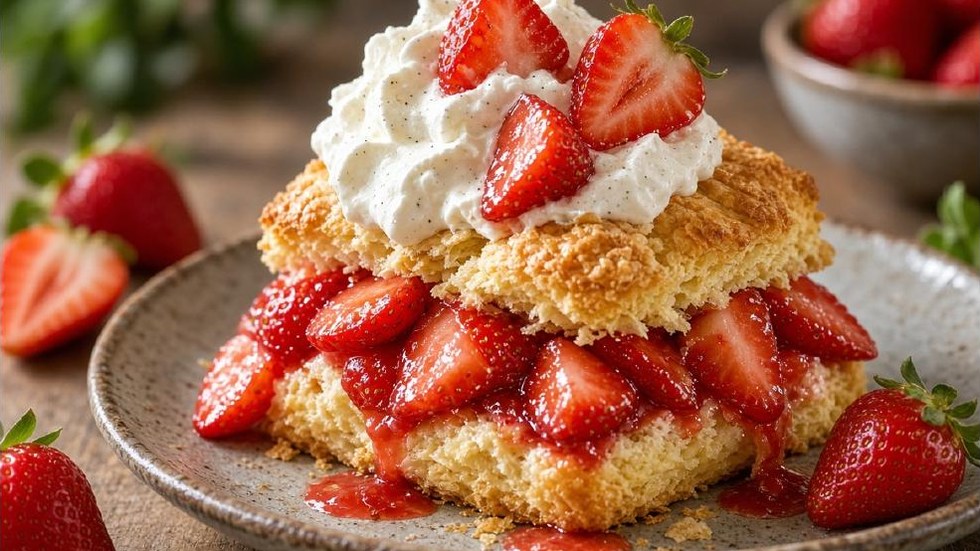
Page 6 of America's seasonal menu. Look at the plate rather than the cake: that pooled red syrup is not a sauce we made, it is juice the berries gave up to two tablespoons of sugar while we baked the biscuits.
The One Dish on This Menu Florida Actually Owns
Most of what is on America's board is a Florida version of somebody else's food. Shakshuka came from North Africa by way of the Levant, agua fresca came from Mexico, the pork bowl is a Caribbean idea with Glades cane on it. Strawberry shortcake is different. It is an American dessert, and the American strawberry industry's winter half runs through this state: eastern Hillsborough County, around Plant City, is known as the Winter Strawberry Capital of the World, and the Florida Strawberry Festival — eleven days, 91 years old, over 650,000 visitors — exists to celebrate that harvest, with strawberry shortcake as its single most famous thing. The 2026 edition ran February 26 to March 8. So when this dish is on a Florida menu in January, it is not a garden-party import. It is the local dessert, in the local season.
And the season is the whole argument. The Florida Department of Agriculture's Florida Crops in Season calendar lists strawberries as December through April; the sourcing line printed on our own menu page is tighter still and says peak December to February. Either way, the run is short and it lands in the exact months the rest of the country has no domestic strawberry to speak of. That is why a Florida berry in January tastes like something and a supermarket berry in July tastes like water — in July you are eating fruit that was bred to survive a long truck ride, and in January, here, you are eating fruit that was picked forty minutes up the road.
The winter menu page makes the broader case — that in Palm Beach County winter is the growing season rather than a gap between growing seasons. This dish is the sweetest evidence for it, and it is also the least forgiving item on the calendar. The other five winter dishes stretch a little at the edges of their window. This one does not: the menu describes it as the item most often requested by name for December and January events, and the one with the least flexible calendar. Both halves of that sentence are true for the same reason.
The Recipe
Strawberry Shortcake · Serves 4 · About 35 minutes, of which 20 are hands-off · A mixing bowl, a baking sheet, a whisk or a mixer, and a serrated knife. This is the recipe as printed on page 6 of America's seasonal menu, unchanged.
Ingredients — serves 4
- 1 qt Florida strawberries, hulled and sliced
- 2 tbsp sugar (macerating)
- 4 biscuits (butter, flour, baking powder, cream)
- 1 cup heavy cream, whipped, lightly sweetened
Four lines, and two of them carry their own instructions inside the brackets. The biscuit line tells you what a biscuit is made of; the cream line tells you what to do to it. Notes 1 and 5 below are about those two sets of brackets.
Method — three sentences on the menu, three steps here
1 · Macerate the strawberries
Toss strawberries with sugar, let macerate 20 min until juicy.
2 · Bake and split the biscuits
Bake biscuits per standard drop-biscuit method, split warm.
3 · Layer it
Layer biscuit, strawberries with juice, whipped cream, biscuit top.
Note what is not a step: whipping the cream. The menu puts that inside the ingredient line rather than the method, which is honest about how it actually goes — you whip while the berries sit. Note 6 covers it.
Source locally: Strawberries — Bedner's Farm Fresh (peak Dec–Feb, they also run U-pick). That line is printed on the menu page itself, and it is the only sourcing line on the whole menu that tells you where to go and pick the ingredient yourself. Address and phone are in the shopping list further down.
Cook's Notes — Four Ingredients, and Almost All of It Is Timing
The recipe above is complete and you can stop there. What follows is the reasoning underneath it, offered as general kitchen guidance rather than gospel. If you read only two notes, read the first two: together they explain why two tablespoons of sugar is enough for a whole quart of fruit, and why the word "heavy" in heavy cream is a legal specification rather than a piece of marketing.
1 · Two tablespoons for a whole quart — you are making syrup, not sweetening fruit
Run the arithmetic and it looks wrong. A quart of sliced strawberries is roughly a pound and a half of fruit, and the recipe puts two tablespoons of sugar against it — a rounding error, if the sugar's job were to make the berries taste sweeter. It is not. Sugar on cut fruit draws water out of the cells by osmosis, and that water leaves carrying the fruit's own colour, acid and aroma with it. Twenty minutes later there is a pool of red syrup in the bottom of the bowl that was inside the strawberries when you started. That pool is the sauce, and it is the whole point of the step. If you double the sugar you get a sweeter, thinner, flatter liquid that tastes of sugar rather than of strawberry — and a berry that has gone limp. The lever here is time, not sweetness.
2 · "Heavy cream" is a legal term, and 36 percent is the number this dish stands on
This is the one line on the ingredient list you genuinely cannot fudge, and it is defined in federal regulation. Under
21 CFR § 131.150,
"Heavy cream is cream which contains not less than 36 percent milkfat." The carton beside it that says
light whipping cream is a different, separately defined product:
21 CFR § 131.157 provides that it "contains not less than 30 percent but less than 36 percent milkfat." Fat is what stabilises whipped cream — the fat globules are what trap the air — so those six percentage points are the difference between a mound that holds its shape on top of hot fruit and one that slumps into pink soup in four minutes. On a plate where whipped cream sits directly on warm, juicy berries, that is not a nuance. Buy the one that says heavy.
3 · Shortcake is a biscuit. It is not a cake, and the name is the confusion
Half the disappointment people have with strawberry shortcake traces to the word cake and to the little yellow sponge cups sold next to the berries in supermarkets. The ingredient line here settles the argument in four words: butter, flour, baking powder, cream. No eggs, no creaming, no sugar to speak of in the dough. That is a biscuit — a chemically leavened, fat-in-flour bread — and it is the older and the better answer, because a biscuit is savoury enough and sturdy enough to take on syrup without collapsing, and its job is to absorb juice rather than to add sweetness. A sponge is already sweet and already soft; put macerated fruit on it and you get two soft sweet things in a bowl. A biscuit gives you contrast, and contrast is what makes you want the second bite.
4 · "Drop-biscuit method" is a specific instruction and it was chosen on purpose
The menu does not just say biscuits, it says standard drop-biscuit method, and the distinction is real. A rolled biscuit is mixed stiff, turned out, patted, cut with a ring and re-rolled from the scraps. A drop biscuit is mixed wetter and spooned straight onto the sheet — no bench, no rolling pin, no cutter, no scraps and nothing to re-roll. It is faster, it is far harder to overwork into toughness, and it produces the craggy, uneven, open-crumbed top you can see in the photograph, which catches syrup in a way a smooth cut biscuit does not. On a truck it is also the only version that makes sense: there is no work surface to roll on. General guidance if you are building your own, rather than a formula from the menu: keep the butter cold, mix only until it comes together, and get it into a hot oven immediately.
5 · There is cream in the biscuit as well as on it
Read the biscuit bracket again — butter, flour, baking powder, and cream. Not milk, not buttermilk. Cream is the liquid, which means the same carton does double duty: some goes in the dough and the rest gets whipped for the top. That is a practical decision before it is a culinary one, because a truck that stocks one dairy item instead of three is a truck that throws less away. It also gives you a richer, more tender biscuit than milk would, since you are adding liquid and fat in the same pour. Practical consequence for your shopping: buy more cream than the ingredient list says. The list's one cup is the whipping cream only — the biscuit needs its own.
6 · "Lightly sweetened," and the ninety seconds where whipped cream goes wrong
The cream is whipped lightly sweetened, and lightly is doing real work: the berries have already been sugared and are sitting in syrup, so a sweet cream on top gives you a dessert with nothing to push against. Stop at soft peaks — the point where a lifted whisk leaves a peak that folds over on itself. Past that you get stiff, then grainy, then, with startling speed, butter and buttermilk. The margin at the end is about ninety seconds on a stand mixer, which is why we finish the last of it by hand. Cold helps at every stage: cold cream, cold bowl, cold whisk. Warm cream whips slowly, holds badly, and is the usual culprit when someone says theirs "never got thick."
7 · "Split warm" is a timing instruction disguised as a serving suggestion
Step two ends with two words that quietly set the schedule for the entire recipe: split warm. Warm is when a biscuit tears cleanly along its own seam rather than crumbling, warm is when it takes up syrup fastest, and warm against cold cream is most of the pleasure of the dish. It also means the biscuits are the last thing to be ready, not the first — the berries can sit for twenty minutes or two hours, the cream will keep in the refrigerator for an hour, but the biscuits have a window of about ten minutes at their best. Build the plan backwards from the oven timer. If your biscuits came out early, a few minutes back in a warm oven is a legitimate rescue; a microwave is not.
8 · "Strawberries with juice" — the two words most people leave in the bowl
Step three does not say strawberries. It says strawberries with juice, and that is the most load-bearing phrase in the method. A slotted spoon is the enemy of this dessert. The syrup you spent twenty minutes drawing out of the fruit is meant to go onto the biscuit and soak into the crumb — that is what turns two dry components into one dish. Look at the photograph again: the syrup has run off the plate's centre and pooled at the rim, and the bottom biscuit is visibly wet with it. Spoon the juice over the bottom half deliberately, then build. Any that is left goes over the top at the end.
9 · Why a Florida strawberry in January is worth the trip — the fruit is bred for it
There is a reason the winter fruit here is good rather than merely available, and it is not the weather alone. Most Florida acreage is planted with cultivars bred at the University of Florida for exactly this window. Take 'Florida Brilliance', released by UF and commercialised in 2018: the university's own publication reports that its "Early yields (late November through January) ... are the highest among the University of Florida cultivars," that the fruit is "firmer than other University of Florida cultivars, with excellent shelf life and juicy texture," and that its soluble solids run about 6–9 °Brix in central Florida. Firm matters here, because a soft berry turns to mush during maceration instead of giving up clean juice. You are not being sentimental about local fruit. You are buying a berry that was designed for the month you are standing in.
10 · Hull, then slice — and slice thicker than you think
The ingredient line says hulled and sliced, in that order, and the order saves you fruit: hull first with the tip of a paring knife or a straw pushed through from the point, taking the white core and leaving the shoulders, rather than beheading the berry and losing its widest and sweetest part. Then slice. Thickness is the one judgement call — thin slices give up their juice faster and more completely but go slack, thick ones keep some bite through the twenty minutes and through the plate. We cut them in the region of a quarter inch, which is thicker than most recipes suggest, because a strawberry that still eats like a strawberry underneath the cream is the difference between this and a jam sandwich. Quarter the very small ones instead of slicing them.
Variations, Substitutions, and One Warning Worth Reading
For the berries: in season, none — the whole recipe is a delivery system for a good Florida strawberry, and there is no technique in it to disguise a bad one. Out of season is a different question, and the honest answer is to make a different dessert. If you insist, frozen sliced strawberries macerate perfectly well and in some ways better, because freezing ruptures the cells and the juice comes out immediately; thaw them in the bowl with the sugar and use every drop of the liquid. Blueberries, which the same farm grows, make a good second-half-of-season version with a longer macerating time, since their skins hold on to their juice far more stubbornly than a cut strawberry does.
For the sugar: the two tablespoons are granulated and dissolve into the fruit's own water, which is exactly what you want. Honey and maple both work and both make themselves heard — they stop being invisible and start being an ingredient, which is a legitimate choice but a different dessert. A split vanilla pod or a strip of lemon or orange zest tossed in with the sugar and pulled out before plating is the addition we would actually defend, and it costs nothing. If you have Florida citrus on the counter anyway — see the Fresh Citrus Agua Fresca, which shares this board and this month — a little zest and a squeeze of lime in the berries sharpens the whole plate.
For the biscuit: a rolled biscuit is fine and looks tidier; you lose the craggy top that catches syrup and you gain a work surface to clean. Pound cake and sponge are the two most common substitutions and both make a dessert people will happily eat, but neither is shortcake, and both give you sweet-on-sweet with nothing to push against. Day-old biscuits reheated in the oven are better here than they have any right to be, because a slightly dry crumb drinks more juice — this is one of the few dishes where yesterday's bread is an upgrade.
For the cream: light whipping cream at 30-to-36 percent will whip, more slowly, and will not hold as long on a warm plate — acceptable at a table, risky on a buffet. Aerosol cream collapses within a minute or two and is not worth the shelf space. Folding a spoonful of crème fraîche, mascarpone or thick yoghurt into the finished whipped cream is a genuine improvement: it adds acidity, which cuts the syrup, and it stabilises the cream so it stands longer. For a dairy-free version, chilled full-fat coconut cream whips and holds well and tastes distinctly of coconut — good, but be straight with your guests that it is a coconut dessert now.
The warning, and it is a plain one: this is a dish made almost entirely of the common allergens. There is wheat in the biscuit, dairy in both the biscuit and the cream, and butter in the dough — and unlike most of the winter board, there is no version of it that quietly drops one of those without becoming something else. Gluten-free flour blends do work in a drop biscuit, better than in a rolled one, because there is no gluten development to imitate; expect a shorter, more crumbly result. What we will not do is serve an unlabelled dessert and hope. At an event this is the plate we name out loud, and it is the reason the agua fresca — four ingredients, no allergens at all — is on the same board. Tell us about allergies on the booking call, not on the day.
Why It Works Off a Truck Window
Practical, not stylistic. A dessert has to survive a queue, and most do not. This one is built from three components that hold beautifully apart — macerated berries improve for a couple of hours, whipped cream keeps cold in a covered tub, biscuits stay good in a warm box — and it collapses within about ten minutes once they are put together. So the answer off a window is simple: nothing is assembled until it is ordered. Three components, fifteen seconds of assembly, out. It is the fastest item on the winter board after the hand pie, and it is the only one where speed is a preservation strategy rather than a throughput one.
The harder part is upstream, and it is the calendar. Every other dish on this board can be pushed a few weeks either side of its window with a shrug. This one cannot: the sourcing line says peak December to February, and outside those months the dish either is not itself or is not on. That is why the winter menu page calls it the most-requested item by name for December and January dates and the one with the least flexible calendar — those are two descriptions of the same fact. If strawberry shortcake matters to your event, the date is the decision, and the earlier we know it the better.
It also solves the problem every event has at the end. A truck can serve a superb main course and then leave a hundred people looking around for something sweet, and a boxed dessert brought in from elsewhere undoes the whole premise. This is the same board, the same county, the same farms, finished. America is a hand-converted 1979 Blue Bird bus and a state-licensed Mobile Food Dispensing Vehicle, MFD1654011, working out of The Bell Farm in Loxahatchee. At a seated private farm dinner the same three components come to the table in bowls and people build their own, which is better than anything we could plate.
Where to Buy the Ingredients — the Local Shopping List
Every recipe on America's menu carries a "source locally" line, because a farm-to-table claim that cannot name the farm is just a font choice. These are the suppliers off the call sheet printed on the back page of the menu — and this is the one recipe in the book where the sourcing line points at a field you can walk into yourself.
Bedner's Farm Fresh
Buy here: the strawberries — this is the only name on the menu's sourcing line for this dish, and the menu adds two things about it: peak December to February, and they also run U-pick. General produce and U-pick, carrying strawberries alongside tomatoes, squash, kale, corn, collards, watermelon, blueberries and citrus. Picking your own is not a novelty here, it is quality control: you will select riper fruit than any buyer would ship, which is precisely the fruit this recipe wants and the fruit a supermarket cannot stock.
Swank Specialty Produce
Not the stop for this one. Swank is our closest grower and our primary source for tropical and specialty produce — mango, avocado, jackfruit, guava, sweet potato, bell peppers — and it carries most of what the rest of the board is built on. Strawberries are not on its list on our call sheet, and we would rather say so than let proximity imply something the sheet does not support. For this dish, make the drive to Boynton Beach.
Bell Farm (on-site)
Nothing here goes in this dish today. The farm grows and presses its own sugarcane along the west boundary — that is the ingredient behind the
Sugarcane Glazed Pork Bowl on the same board — and the call sheet notes raw honey once the apiary is operational, targeted November 2026. Neither is in this recipe as written. The two tablespoons of macerating sugar are granulated, and that is what the menu says.
The dairy and the flour — a distributor, and we will say so
Named as a gap on the menu's own call sheet
Buy where you normally buy. The back page of our menu lists its own gaps in plain type, and one of them reads: dry goods and dairy are "not part of the local produce/meat sourcing plan; these come through a standard wholesale food distributor." That covers the flour, the butter and the cream — which is to say three of this recipe's four ingredients. This is the least locally sourced dish on the winter board, and it sits directly beside the most: the agua fresca on the next page has nothing in it but Florida fruit and ice. Both are on the same menu, and pretending otherwise would be the easiest lie in this business.
Which leaves an honest summary of what "farm to table" means on this particular plate: the strawberries are local and picked at peak, and the rest of it came off a truck like anyone else's. That is still worth something — the fruit is the ingredient this dessert is judged on, and it is the one we drove to Boynton Beach for. But the claim stops where the ingredient list stops. If the apiary comes online as targeted, the honey option in the variations above becomes a genuinely local swap for the sugar, and we will say so here when it does.
Would Rather Someone Else Made It?
This runs off the window from December through February with the rest of the winter board, and it is the shortest window on the menu. America the Food Truck is a state-licensed Mobile Food Dispensing Vehicle (MFD1654011) working out of The Bell Farm in Loxahatchee, and winter is the busiest calendar we run — Saturdays in January go first, and this is the dish people ask for by name when they book them.
Private catering starts at $800 per event, wedding and event packages start at $2,500, and a seated private farm dinner at The Bell Farm is $150 per guest with a ten-guest minimum. The catering cost guide walks through what actually drives a quote, the wedding catering guide covers the timeline side — including where a dessert course sits in a reception — and the winter menu page covers what a December-to-February date means for weather, daylight and where a truck can park. Tell us about wheat and dairy allergies on that first call.
Strawberry Shortcake — FAQ
What exactly is strawberry shortcake made of?
Four things: a quart of Florida strawberries hulled and sliced, two tablespoons of sugar for macerating, four biscuits made from butter, flour, baking powder and cream, and one cup of heavy cream whipped and lightly sweetened. The berries are tossed with the sugar and left twenty minutes until juicy, the biscuits are baked by the standard drop-biscuit method and split warm, and it is layered biscuit, strawberries with juice, whipped cream, biscuit top. That is the dessert on America the Food Truck's winter board in Loxahatchee, Florida.
How long does it take to make?
About thirty-five minutes for four servings, and roughly twenty of those are hands-off while the strawberries macerate. The two active jobs — mixing and baking drop biscuits, and whipping a cup of cream — both happen inside that same twenty minutes, which is why the recipe reads longer than it feels. Assembly itself takes seconds. The biscuits should be the last thing out, because step two ends with the words "split warm."
Why only two tablespoons of sugar for a whole quart of strawberries?
Because the sugar is not there to sweeten the fruit — it is there to pull juice out of it. Sugar on cut fruit draws water out of the cells by osmosis, and that water comes out carrying the strawberry's own colour, acid and aroma, which is the red syrup you find in the bottom of the bowl twenty minutes later. That syrup is the sauce for the whole dessert. Adding more sugar gives you a thinner, flatter liquid that tastes of sugar instead of strawberry, and limper fruit with it. Time is the lever in this step, not sweetness.
What does macerate mean, and how do I know when it is done?
Macerating is soaking cut fruit in sugar so it releases its own juice. The menu gives you both a time and a test — "let macerate 20 min until juicy" — and the test is the one that counts. You are done when there is a visible pool of red syrup in the bottom of the bowl and the slices have gone glossy and slightly translucent at the edges. Ripe, soft fruit gets there faster than firm fruit, and cold berries straight from the refrigerator get there slower, so look before you rely on the clock.
Is shortcake a cake or a biscuit?
A biscuit, and this recipe's ingredient line says so in four words: butter, flour, baking powder, cream. No eggs, no creaming of butter and sugar, and almost no sugar in the dough. That is a chemically leavened bread, not a cake, and it is the better answer for this dessert because it is sturdy enough to take on syrup without collapsing and savoury enough to give the sweet fruit something to push against. The little yellow sponge cups sold beside the berries in supermarkets are a different thing entirely, and they are the reason so many people think they do not like shortcake.
What is a drop biscuit, and why does the recipe specify one?
A drop biscuit is mixed wetter than a rolled one and spooned straight onto the baking sheet — no bench, no rolling pin, no cutter and no scraps to re-roll. It is faster, it is much harder to overwork into toughness, and it bakes with a craggy uneven top that catches syrup in a way a smooth cut biscuit does not. On a food truck it is the only version that makes sense, because there is no work surface to roll on. As general guidance rather than a formula: keep the butter cold, mix only until it comes together, and get it straight into a hot oven.
Can I use light whipping cream instead of heavy cream?
You can, and it will whip more slowly and hold less well — which matters here because the cream sits directly on warm, juicy fruit. The two are legally distinct products in the United States: under 21 CFR 131.150, "Heavy cream is cream which contains not less than 36 percent milkfat," while 21 CFR 131.157 defines light whipping cream as containing "not less than 30 percent but less than 36 percent milkfat." Fat is what traps and holds the air in whipped cream, so those few percentage points are the difference between a mound that stands up on the plate and one that slumps into pink soup. Buy the carton that says heavy.
How much cream do I actually need to buy?
More than the ingredient list shows, because cream appears twice in this recipe. The listed one cup is the whipping cream for the top. The biscuits use cream as their liquid as well — the bracket reads butter, flour, baking powder, cream, not milk or buttermilk — so the same carton does double duty. That is a deliberate choice on a truck, since stocking one dairy item instead of three means throwing less away, and it also gives a richer, more tender biscuit because you are adding liquid and fat in the same pour.
How do I keep from overwhipping the cream?
Stop at soft peaks — the point where a lifted whisk leaves a peak that folds over on itself rather than standing upright. Past that, cream goes stiff, then grainy, then turns to butter and buttermilk, and the margin at the end is roughly ninety seconds on a stand mixer, which is why we finish the last of it by hand. Cold helps at every stage: cold cream, cold bowl, cold whisk. Warm cream whips slowly and holds badly, and it is the usual explanation when someone says theirs never got thick.
Can I make strawberry shortcake ahead of time?
Make the parts ahead, never the plate. The three components hold well separately and badly together: macerated berries are good for a couple of hours and arguably better after one, whipped cream keeps covered and cold for about an hour, and biscuits are at their best for roughly ten minutes out of the oven and can be revived with a few minutes of gentle reheating. Assembled, the whole thing starts going soft almost immediately. That is exactly how we run it off the truck — nothing is put together until it is ordered.
Why does the method say "strawberries with juice"?
Because the juice is the sauce, and a slotted spoon is the most common way this dessert gets ruined. The syrup you spent twenty minutes drawing out of the fruit is meant to go onto the biscuit and soak into the crumb — that is what turns two dry components into one dish. Spoon the juice deliberately over the bottom biscuit half, build the berries and cream on top, and pour whatever is left over the finished plate. In the menu photograph you can see it: the bottom biscuit is visibly wet, and the syrup has run out to the rim.
When are Florida strawberries actually in season?
The Florida Department of Agriculture's Crops in Season calendar lists strawberries as December through April. The sourcing line on our own menu page is tighter and says peak December to February, which is the window this dish sits in on the winter board. Either way it is a short run, and it falls in the months when the rest of the country has almost no domestic strawberry — which is why eastern Hillsborough County, around Plant City, is known as the Winter Strawberry Capital of the World.
Why are Florida strawberries good in January when supermarket ones are not?
Partly the weather and partly the plant. Most Florida acreage is planted with cultivars bred at the University of Florida for this exact window. 'Florida Brilliance', released by UF and commercialised in 2018, is one of the most widely grown: the university's own publication states that its "Early yields (late November through January) ... are the highest among the University of Florida cultivars," that the fruit is "firmer than other University of Florida cultivars, with excellent shelf life and juicy texture," and that soluble solids run about 6 to 9 °Brix in central Florida. Firmness matters here — a soft berry turns to mush during maceration instead of giving up clean juice.
Where can I pick or buy Florida strawberries in Palm Beach County?
The menu's sourcing line for this dish names one place: Bedner's Farm Fresh at 10066 Lee Rd in Boynton Beach, (561) 733-5490, peak December to February, and they also run U-pick. It carries strawberries alongside tomatoes, squash, kale, corn, collards, watermelon, blueberries and citrus. Picking your own is quality control rather than novelty — you will pick riper fruit than any commercial buyer would ship, and riper fruit is exactly what this recipe wants and what a supermarket cannot stock.
Is any of this grown on The Bell Farm itself?
No, and this is the least locally sourced dish on the winter board — worth saying plainly. The strawberries come from Bedner's. The flour, butter and cream come through a standard wholesale food distributor, which our menu's own call sheet lists in plain type as a gap in the local sourcing plan. The farm grows and presses sugarcane along its west boundary and expects raw honey once the apiary is operational, targeted November 2026, but neither is in this recipe as written. The agua fresca on the facing menu page is the opposite case: nothing in it but Florida fruit and ice.
Can I make it with frozen or out-of-season strawberries?
Frozen works better than out-of-season fresh, which is not the answer most people expect. Freezing ruptures the fruit's cells, so the juice comes out immediately and the maceration essentially happens as it thaws — put them in the bowl with the sugar, let them come up, and use every drop of the liquid. Out-of-season fresh berries are the genuinely poor option, because there is no technique anywhere in this recipe to rescue a flavourless strawberry. In the off months we would rather make a different dessert than a disappointing version of this one.
Can this be made gluten-free or dairy-free?
Partly, and honestly it is the hardest dish on the board to adapt, because it is made almost entirely of the common allergens — wheat in the biscuit, dairy in both the biscuit and the whipped cream. Gluten-free flour blends do work in a drop biscuit better than in a rolled one, since there is no gluten development to imitate, and you should expect a shorter, more crumbly result. For dairy-free, chilled full-fat coconut cream whips and holds well but tastes clearly of coconut, so tell your guests it is a coconut dessert. The macerated berries themselves are naturally vegan and gluten-free.
Can you serve this at a wedding or a private event?
Yes, in season, and it is the dish people book December and January dates around. It is the only dessert on the winter board, and it means the sweet course comes off the same truck, the same board and the same farms as the rest of the meal rather than arriving in a box from elsewhere. Because nothing is assembled until it is ordered, it moves fast through a queue. Private catering starts at $800 per event and wedding and event packages start at $2,500; a seated farm dinner at The Bell Farm is $150 per guest with a ten-guest minimum, and there the three components go to the table in bowls so people build their own. America is a state-licensed Mobile Food Dispensing Vehicle (MFD1654011) and an FDACS-registered agritourism operation at 16140 Okeechobee Blvd, Loxahatchee, FL 33470. Call (561) 779-3213, and mention wheat or dairy allergies on that call.