RSB EmpireAmerica the Food TruckSpring Menu → Guava Lemonade

Guava
Lemonade
Guava · Lemon

This is the only drink on America's spring board that never gets a firm opening date. Every other spring item tracks a calendar — first blueberries, first mango, sweet corn at volume. Guava tracks the tree instead, fruiting in flushes through the warm months rather than on a fixed schedule, so this glass is built from whatever The Bell Farm's own guava trees are carrying that week, backed up by Swank Specialty Produce when they're not. It is also the only vegan item on the board. Below is the recipe exactly as we run it, the technique notes that matter, and the local shopping list.

Jump to the Recipe ↓ Book the Truck — (561) 779-3213 Full Seasonal Menu → ← The Spring Menu

4
Servings — one pitcher, four glasses
~15 min
Prep — pureeing, straining and stirring
No cook
Nothing touches heat — a pitcher and a strainer
Farm flush
Tracks the tree, not the calendar
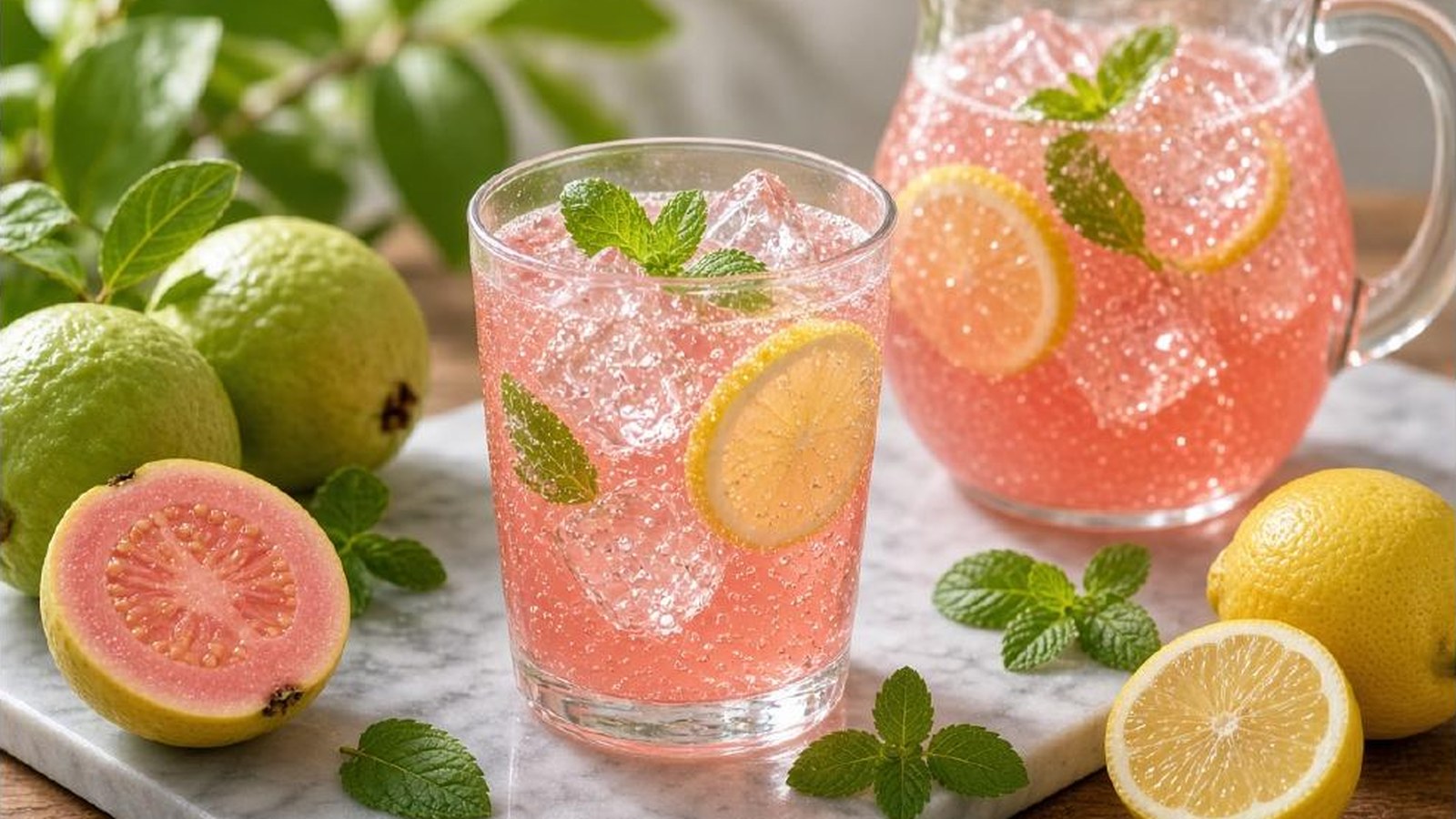
Guava Lemonade — pink guava lemonade over ice in a glass and pitcher, garnished with mint and lemon slices, with fresh guava and lemon halves alongside
Page 11 of America's seasonal menu — opening the second half of the spring board.
Why This Is a Spring Dish Here

Every other item on America's spring board has a window you can put a date range on. Florida blueberries run roughly March into May, sweet corn peaks with the vegetable belt, and the mango does not arrive until the very end of May. Guava does not play by that rule. In this climate, a guava tree does not fruit once a year on a fixed calendar the way a blueberry bush does — it flushes in waves through the warm months, often several times across a single year, driven more by rainfall and recent heat than by the date on a wall calendar.

That is the honest reason this drink's own "source locally" line names a backup supplier instead of a single farm. When The Bell Farm's guava trees are flushing, this glass is poured from fruit picked on the same ground the truck is parked on. When they are between flushes, we buy from Swank Specialty Produce a mile and a half away rather than let the drink disappear from the board or ship in guava from somewhere it isn't in season. Either way, nothing about the recipe changes — only which few miles the fruit traveled.

The other reason this dish opens the second half of the spring board: it is the only vegan item on the entire spring menu. Four guava, lemon, simple syrup, sparkling water and ice — no dairy, no egg, nothing that requires a substitution conversation at the window. On a board where four of six dishes are already vegetarian, this is the one glass every guest at a mixed event can hold without asking a single question.

The color is the fruit, not a garnish. Pink guava flesh is what turns the glass that shade of rose without a drop of added color, and it is also why ripeness matters more here than in almost anything else on the menu — an underripe guava is pale, hard and tart, and it will not give you the drink in the photo no matter how much syrup you add.

The Recipe

Guava Lemonade · Serves 4 · About 15 minutes, no stove required · One pitcher and a fine-mesh strainer. This is the recipe as printed on page 11 of America's seasonal menu, unchanged.

Ingredients — serves 4
  • 4 ripe guavas, seeded and pureed, strained
  • 1/2 cup lemon juice
  • 1/3 cup simple syrup
  • 2 cups sparkling water
  • Ice
Method — about 15 minutes
1 · Puree and strain the guava
Puree the ripe guava, then strain to remove the seeds.
2 · Build the base
Combine the guava puree, lemon juice, and simple syrup, and stir well.
3 · Top and serve
Top with sparkling water and ice.
Source locally: Guava — Swank Specialty Produce or grown on-farm if in season at Bell Farm. That line is printed on the menu page itself, and the address and distance are in the shopping list further down.
Cook's Notes — What Actually Decides How This Turns Out

The recipe above is complete and you can stop there. These are the things we have learned running it off a truck window, offered as general kitchen guidance rather than gospel.

1 · Ripeness decides the color and the sweetness
A guava that gives slightly to a gentle squeeze and smells fragrant at the stem end is what gives this drink its rosy color and its natural sweetness. An underripe guava is pale, hard and noticeably tart, and no amount of extra syrup fully makes up for it — you'll taste the difference in the glass before you see it.
2 · Strain twice if you want it fully smooth
Guava seeds are small, hard and numerous, and the flesh itself carries a faint grit from stone cells that a single pass through a sieve does not always catch. Push the puree through a fine-mesh strainer or cheesecloth, and run it through a second time if you want the clean, sippable texture in the photo rather than any texture at all.
3 · Taste the base before you add the sparkling water
The guava, lemon and simple syrup should taste balanced while they're still concentrated — sparkling water and ice both dilute, and they mute sweetness and tartness at roughly the same rate. Adjust the lemon-to-syrup ratio at this stage; it is much harder to fix once the glass is topped and full of ice.
4 · Build the base ahead, add sparkling water to order
The guava-lemon-syrup base holds well in the fridge for several days, which is exactly how we handle it for a booked event — mixed the day before, sparkling water and ice added only when a glass is actually poured. Add the sparkling water too early and it goes flat before anyone drinks it.
5 · Strained puree browns fast
Once guava is pureed and exposed to air, it starts to darken at the edges within the hour. The lemon juice in this recipe slows that down, so mix the puree with the lemon juice sooner rather than later if you're prepping ahead, and keep it covered and refrigerated in between.
6 · This is a farm-crop drink, not a shelf-stable one
Because guava here comes in flushes rather than on a fixed season, we would rather tell a guest the drink is temporarily off the board than pour it from concentrate. If you're booking an event around this specific dish, ask us how the trees are running that week — it's the same honesty we build the rest of the menu on.
Where to Buy the Ingredients — the Local Shopping List

Every recipe on America's menu carries a "source locally" line, because a farm-to-table claim that cannot name the farm is just a font choice. These are the two places this drink's guava actually comes from, and both are open to the public.

Swank Specialty Produce
14311 North Rd, Loxahatchee · 1.5 mi from the farm
Buy here: guava, when the farm's own trees are between flushes. Our primary source for specialty and tropical produce, and the closest grower to the truck — a mile and a half of road between the fruit and the pitcher.
The Bell Farm
16140 Okeechobee Blvd, Loxahatchee
Where the truck lives. Guava grows on-site, and when the trees are flushing this glass is poured from fruit picked steps from where the truck parks. Visit the farm →
Would Rather Someone Else Made It?

This is the drink to have on hand for any spring event with a mixed guest list — vegan by design, poured cold, and the first thing that runs out once the temperature climbs. America the Food Truck is a state-licensed Mobile Food Dispensing Vehicle (MFD1654011) working out of The Bell Farm in Loxahatchee, and spring is one of its busiest calendars.

Private catering starts at $800 per event, wedding and event packages start at $2,500, and a seated private farm dinner at The Bell Farm is $150 per guest with a ten-guest minimum. The catering cost guide walks through what actually drives a quote, and the spring menu page covers what a March-to-May date means for weather, daylight and which half of spring your date falls in.
Book a Spring Date — (561) 779-3213 See All 26 Dishes & Recipes → America the Food Truck →

Guava Lemonade — FAQ

What is guava lemonade?

A cold drink built from ripe guava pureed and strained, mixed with lemon juice and simple syrup, then topped with sparkling water and ice. Ours is the vegan drink off America the Food Truck's spring board, built from guava grown on The Bell Farm in Loxahatchee or sourced from Swank Specialty Produce nearby.

How long does it take to make?

About 15 minutes for four servings, and none of it involves heat. Most of that time is pureeing and straining the guava; combining the base and topping with sparkling water and ice takes only a couple of minutes once the puree is ready.

Why do I need to strain the guava?

Guava is full of small, hard seeds, and the flesh itself carries a faint grit from stone cells. Straining the puree through a fine-mesh sieve or cheesecloth removes both, and running it through twice gets you the smooth, sippable texture in the photo instead of a gritty one.

How ripe should the guava be?

Ripe enough to give slightly to a gentle squeeze and smell fragrant at the stem end. A fully ripe pink guava is what gives this drink its rosy color and natural sweetness; an underripe one is pale, hard and tart, and extra simple syrup will not fully make up the difference.

Can I use white guava instead of pink?

Yes — the recipe works with either. Pink guava gives the drink its signature rose color; white-fleshed guava makes a paler, still perfectly good lemonade. What matters more than the color of the flesh is ripeness, since an underripe guava of either variety comes out tart and pale.

Can I make this ahead of time?

The guava, lemon and simple syrup base holds well in the fridge for several days, which is how we prep it for a booked event. Add the sparkling water and ice only when you're ready to serve — sparkling water added too early goes flat before anyone drinks it.

Is guava lemonade vegan?

Yes — guava, lemon juice, simple syrup, sparkling water and ice, with no dairy, egg or any other animal product. It is the only vegan item on America's entire spring menu, which is exactly why it belongs at any event with a mixed guest list.

Why doesn't guava season have a fixed window like blueberries or mango?

Because a guava tree in this climate doesn't fruit once a year on a set calendar — it flushes in waves through the warm months, driven more by rainfall and recent heat than by a fixed date. That's why this drink's own sourcing line names a backup supplier rather than one farm: we pour from The Bell Farm's own trees when they're flushing and from Swank Specialty Produce when they're not.

Can I adjust the sweetness or tartness?

Yes — taste the guava, lemon and syrup base before you add the sparkling water and ice, since both of those dilute the drink and mute sweetness and tartness at roughly the same rate. It's much easier to adjust the lemon-to-syrup balance while the base is still concentrated than after the glass is full and iced.

Where can I buy guava locally in Palm Beach County?

From Swank Specialty Produce on North Road in Loxahatchee, a mile and a half from the farm, when the farm's own trees are between flushes. When they're fruiting, the guava in this glass comes straight from The Bell Farm at 16140 Okeechobee Blvd, Loxahatchee. Those are the same two sources named on the menu page for this drink.

When is this drink actually on the truck?

Whenever the guava is running, which is not a fixed part of the March-through-May window the way the rest of the spring board is. Ask us how the trees are running for your date, and we'll tell you honestly whether it's on. The spring menu page has the rest of the March-to-May crop calendar, and the full seasonal menu has all 26 dishes with their recipes.

Can you cater this for an event?

Yes, in season. Private catering starts at $800 per event and wedding and event packages start at $2,500; a seated farm dinner at The Bell Farm is $150 per guest with a ten-guest minimum. America is a state-licensed Mobile Food Dispensing Vehicle (MFD1654011) and an FDACS-registered agritourism operation at 16140 Okeechobee Blvd, Loxahatchee, FL 33470. Call (561) 779-3213.

Related Reading
Sweet Corn & Black Bean Tacos →
The most local dish on the spring board and the fastest main out of the window — fresh sweet corn off the cob, black beans, cotija and lime crema, three tacos to a plate.
Avocado Toast — Farm Edition →
The other dish on this board running on the farm's own crop calendar — Florida avocado is a summer-into-winter crop, so spring catches it at both ends, the tail of one season and the start of the next.
Mango Habanero Chicken Wrap →
The spring board's opening dish, and the one that arrives late to its own season: Florida mango does not start until May. Why half a habanero feeds four, and why the sour cream is safety equipment.
Fresh Citrus Agua Fresca →
The winter board's cold drink and the recipe this one shares the most technique with — Florida citrus cut with cold water, no sugar and no heat, decided almost entirely by shopping.
Spring Menu — Mar to May →
Why spring here is a changeover rather than a season, the month-by-month crop calendar, the six dishes it produces, and which half of spring your date lands in.
The Full Seasonal Menu →
All 26 dishes across winter, spring, summer and fall — each page with its own recipe and its own local sourcing line, plus the call sheet of farms behind them.
America the Food Truck →
The hand-converted 1979 Blue Bird bus, the booking process, the instant estimator and the licensing story. State-licensed MFD1654011, anchored at The Bell Farm.
The Bell Farm →
The Loxahatchee farm the truck is anchored to and the ground this drink's guava sometimes comes from — farm stays, the natural spring soak, weddings and events.
Private Farm Dinner →
The seated version of the seasonal board — a farm-table meal at $150 per guest, ten-guest minimum, at the farm the produce comes from.
Food Truck Catering Cost Guide →
Per-guest pricing, event minimums, travel and weekend fees, and worked budget examples by guest count — the money side of booking the truck.
AMERICA the Food Truck badge — farm to table, Loxahatchee FL
📞  Call (561) 779-3213 — Book the Truck