Sweet Corn &
Black Bean Tacos
The Dish the Season Is Built On
Page 8's wrap arrives at the tail end of its own season, waiting on fruit that will not be picked for weeks. This dish has no such problem. It is on the board because Palm Beach County grows more fresh sweet corn than any other county in the United States, and March through May is when that corn comes off at volume — no imported substitute, no honest asterisk, just the county's own signature crop at its own peak, cut off the cob and put straight into a tortilla. Here is the recipe exactly as printed on page 9, why the corn gets charred before anything else happens to it, why cotija is not a swap-in for feta even though they look alike, and where in Palm Beach County to buy the corn.
4
Servings — three tacos a plate, five ingredient lines
12
Small corn tortillas — three per person, no leftovers to plan for
#1
Palm Beach County's rank for fresh sweet corn production in the US
Oct–Jun
Florida's sweet corn season, per FDACS — peak volume in spring
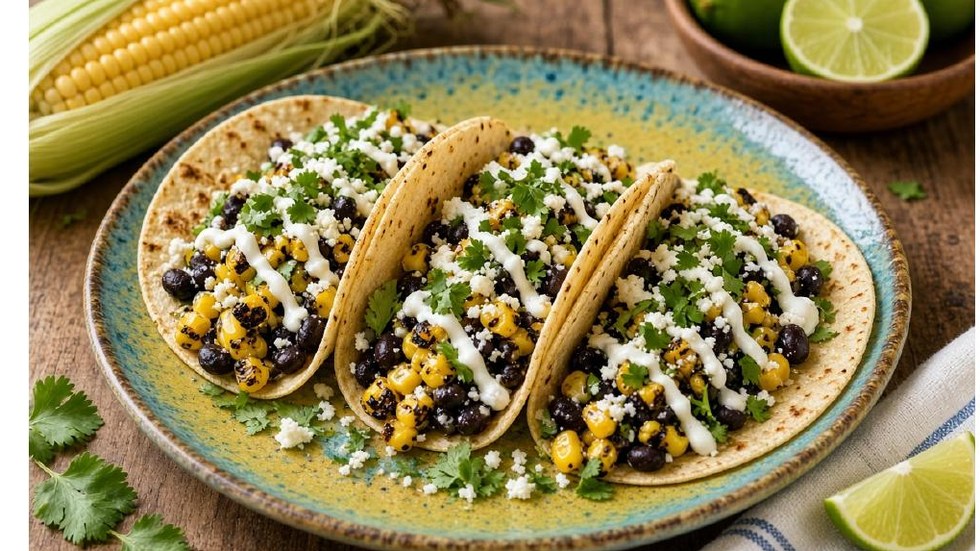
Page 9 of America's seasonal menu, the second main of the spring board. Three tortillas, standing open, each one showing the same build: corn and beans first, cotija and cilantro over the top, crema drizzled last. No sauce pooled on the plate — everything that is going to be on the taco is already on the taco.
The Dish the Season Is Built On
The Mango Habanero Chicken Wrap, the dish immediately before this one on the spring board, carries an honest complication: it is named after a fruit that Florida does not pick until the very end of spring. This dish carries the opposite story. Sweet corn is one of the crops the Florida Department of Agriculture's crops-in-season calendar lists as running October through June — one of the longest windows on the whole board — and March through May is when it comes off at volume, the heart of the harvest rather than the edge of it. There is no asterisk to add here and nothing to tell a caller to wait for.
That is also why this is, on its own terms, the most locally-sourced dish on the entire menu. Palm Beach County and the Glades farmland just west of it — Belle Glade, Pahokee, South Bay — grow more fresh sweet corn than any other county in the United States. A dish built from that crop, sold from a truck parked in the same county the corn came out of, is about as short a supply chain as farm-to-table food gets. The spring menu page puts the same claim next to the dish's description; this page is the recipe underneath it.
The spring board even tells you where in the season this dish is strongest. Early spring — March through mid-April — is when the crop calendar has sweet corn at its own peak, before the March-to-May menu turns toward its tropical half in late May. So while the wrap on page 8 is waiting for its season to start, this one is already standing in the middle of it, and it stays there for most of the board's run.
One more thing worth saying plainly, because it is the honest twin of the wrap's sourcing note: the corn is local and the beans and cheese are not. The menu's own call sheet draws that line, and the shopping list further down repeats it rather than blurring it.
The Recipe
Sweet Corn & Black Bean Tacos · Serves 4 · A hot griddle or grill for the corn, a small pot for the beans, a dry pan or open flame for the tortillas · This is the recipe as printed on page 9 of America's seasonal menu, unchanged. Like the wrap on page 8, it carries no times and no temperatures — the twenty-five minutes in the schema at the top of this page is our own working estimate for four servings, not the menu's, and it assumes the corn is charred and the beans are warm before the tortillas ever go on the heat.
Ingredients — serves 4
- 3 ears sweet corn, charred and cut off cob
- 1.5 cups black beans, cooked
- 1/2 cup cotija cheese, crumbled
- Lime crema, cilantro
- 12 small corn tortillas
Five lines, and the menu leaves two things to a cook who already stocks a kitchen: the cumin the beans are warmed with, and the quantity of lime in the crema and the squeeze at the end. "Lime crema" is the same two-ingredient mix — sour cream and lime — as the crema on the mango wrap.
Method — three sentences on the menu, three steps here
1 · Char the corn
Char corn on a hot griddle or grill until spotted.
2 · Warm the beans
Warm black beans with cumin and a pinch of salt.
3 · Warm, layer and serve
Warm tortillas, layer beans, corn, cotija, cilantro, a squeeze of lime.
Notice the order in step three: beans go down first, corn on top of them, then the two finishers. Note 8 below is about why that sequence, and not the reverse, is the one that keeps twelve open-faced tacos intact.
Source locally: Sweet corn — Bedner's Farm Fresh or Naga Gardens. Black beans and cotija — a dry goods run, not a produce or meat local item; standard wholesale. That is the line printed on the menu page itself: one true local ingredient, named twice over with a primary source and a backup, and one honest admission that the rest of the dish comes from a distributor like every kitchen's does. Addresses and phone numbers are in the shopping list further down.
Cook's Notes — Why the Order of Operations Matters
The recipe above is complete and you can stop there. What follows is the reasoning underneath it, offered as general kitchen guidance rather than gospel. If you read only one note, read the first — it explains why the corn is charred before it is anything else, and everything downstream of that follows from it.
1 · Char is not decoration — it is the only cooking this corn gets
Read the ingredient line again: "3 ears sweet corn, charred and cut off cob." The char is not a garnish step tacked on at the end — for the corn, it is the entire cooking process. Direct heat on the kernels drives a Maillard reaction across the sugar-dense surface, which is what turns a boiled or steamed ear's mild sweetness into something toasted and faintly smoky. Fresh sweet corn is sweet enough raw that most of the work here is flavor, not safety, which is exactly why "charred and cut off cob" is one clause instead of two separate steps. Get the griddle or grill genuinely hot before the corn goes on — a lukewarm pan steams the kernels instead of marking them, and steamed corn in this dish tastes like a different recipe.
2 · Cutting corn off the cob is a knife-safety problem before it is a recipe step
The menu says "cut off cob" and leaves the technique to you. The safest version: stand the charred ear upright, stem end down, in the center of a wide, shallow bowl, and run a knife down the cob following its curve, letting the kernels fall into the bowl rather than skitter across a cutting board. A bundt pan works even better if you have one — the ear sits in the center hole and the kernels drop straight into the pan below. Cut close to the cob but not into it; the tough, starchy cob center adds nothing to the filling and is unpleasant to bite into if a chunk comes loose.
3 · Cumin is the one spice named, and it is doing the same job it does on the wrap
"Warm black beans with cumin and a pinch of salt" is the whole seasoning instruction, and it is worth taking seriously rather than skipping. Plain warmed beans read as flat next to charred, sweet corn and salty cotija — cumin gives them a warm, earthy floor the way it does for the chicken on the
mango wrap. Toast whole seeds in a dry pan for under a minute and grind them if you have the time; pre-ground cumin goes dusty in the jar faster than most spices, so buy it recently if that is the route. Salt the beans gently — the cotija arrives salty on its own, and the two can easily stack past where you want them.
4 · Cotija looks like feta and behaves like neither feta nor mozzarella
Cotija is a firm, aged Mexican cow's-milk cheese, named for the town of Cotija in Michoacán — dry, salty and crumbly, closer in texture to a hard grating cheese than to a soft one. It does not melt the way mozzarella or even feta softens under heat; sprinkled over warm corn and beans it stays in distinct crumbles rather than going creamy, which is exactly the texture the dish wants against the crema. If a store genuinely does not carry it, feta is the closer stand-in on saltiness and crumble than any melting cheese, though it is tangier and wetter than cotija's dry, milky bite. Cotija is also the cheese with the shortest shelf life of anything on this ingredient list once opened — buy it close to when you plan to cook.
5 · Twelve small tortillas for four people is three tacos each, on purpose
The ratio on this ingredient list is exact and worth keeping if you scale the recipe:
twelve small corn tortillas, three per person, matches the photograph and the "three tacos, one plate" description already published on the
spring menu page. Small, street-taco-sized tortillas are specified rather than the larger burrito-style ones, because a smaller tortilla holds a thin, even layer without the corn and beans sliding out the open end — this is not a folded, sealed shape, so an overfilled small tortilla fails the same way an overfilled large one does, just sooner.
6 · Corn tortillas crack when they are cold — the same fact the wrap page states in reverse
The mango wrap's own recipe page makes the point that corn tortillas are not a substitute for flour ones because they crack when rolled tight, and that the right adaptation for a corn-tortilla build is to serve the filling as tacos rather than a wrap — which is precisely what this dish already is. The same fragility means corn tortillas need the same warming step flour ones do, and for the same mechanical reason: a cold corn tortilla splits at the fold the instant you try to close it around a filling. Warm each one in a dry pan or over an open flame for a few seconds a side until pliable, and keep them under a clean towel while you assemble the rest, since they stiffen again within a minute or two of coming off the heat.
7 · Corn and beans are a genuinely old pairing, not a modern combination
Corn and beans have been grown and eaten together across Mesoamerica for thousands of years, traditionally alongside squash as the "three sisters" — corn provides a stalk for beans to climb, beans fix nitrogen the corn draws down, and nutritionally, corn's amino acids and beans' amino acids fill in each other's gaps to make a more complete protein together than either does alone. None of that changes how you cook this recipe, but it is worth knowing that the pairing on this taco is not a fusion invention — it is one of the oldest combinations in the hemisphere's food, dressed with a very Florida crop rotation on top of it.
8 · Beans first, corn second — the build order stops the tortilla from tearing
Step three names the layering order — beans, corn, cotija, cilantro, lime — and it is worth following rather than reversing out of habit. Warm black beans are soft and slightly sticky; laid down first, directly on the tortilla, they act as a bed that holds the drier charred corn kernels in place on top rather than letting them roll off an open taco the moment it is picked up. Put the corn down first instead and the beans have nothing to grip, and the kernels are the first thing to spill. Cotija and cilantro go on last precisely because they need no cooking and no time to sit — sprinkled at the very end, they stay dry and distinct rather than steaming into the warm filling below them.
9 · Everything here reheats — this is a stovetop dish built for a queue
Both fillings are cooked components that hold and reheat cleanly: charred corn kept warm in a covered pan does not lose its char, and beans warmed with cumin only improve after twenty minutes of sitting with the seasoning. That is unusual among this menu's mains — the
tomato shakshuka genuinely has to be cooked to order in a single pan — and it is the operational reason this dish moves as fast as the spring menu page already says it does.
Variations, Substitutions, and Feeding a Mixed Table
For the cheese: feta is the closest widely-available substitute for cotija — both are firm, salty and crumbly, though feta carries more brine and moisture. A vegan cotija-style crumble, now sold by several plant-based cheese makers, will hold up here better than a vegan mozzarella would, since this dish never asks the cheese to melt. Whatever you use, add it at the very end so it stays distinct rather than disappearing into the warm filling.
For the beans: black beans are the specification and the ones that photograph and taste right against charred corn, but pinto beans work in the same method if that is what is in the pantry. Canned beans, drained and rinsed, are entirely fine for a home batch — just warm them gently with the cumin rather than boiling them, which dulls both the texture and the flavor.
For the heat: the printed recipe carries none at all, which makes it the mildest main on the spring board and the easiest to serve to a table that includes children. If a booking wants heat, a pickled jalapeño or a few dashes of hot sauce added at the table is the right place for it rather than built into the filling, so the base recipe stays approachable for everyone else.
Off-season, or for a home cook without a grill: the sweet corn in this recipe is what makes it the local dish it is, so outside Florida's own October-to-June season the honest move is the same one this page takes with every other ingredient — say so. A char can still be achieved on frozen corn kernels blistered hard in a dry cast-iron pan, which gets closer to the real thing than steaming ever will, but it is not the same as an ear picked in this county the same week.
For protein, if you want more than beans: grilled chicken or shrimp both sit well alongside this filling without changing the build — add either warm, in the same layer as the corn, and treat the beans as the base they already are. That turns this from the board's vegetarian main into a heartier plate without touching the sourcing story, since the corn stays the headline ingredient either way.
The allergen note, plainly: as printed, this dish contains dairy — the cotija and the sour cream in the lime crema — and nothing else on the standard allergen list. There is no wheat: corn tortillas make this the one gluten-free main on the spring board, unlike the wrap's flour tortilla. For a dairy-free version, swap in a plant-based crema and a vegan cotija-style crumble; the dish stays vegetarian either way. Tell us about allergies on the booking call, not on the day.
Why It Works Off a Truck Window
The spring menu page already calls this "the fastest main out of the window," and the recipe explains exactly why. Both fillings are cooked ahead: the corn is charred and cut off the cob before service, the beans are warmed with cumin and held. When an order comes in, the work is warming a tortilla and laying four things on top of it in order — corn and beans that are already hot, cotija and cilantro that need no heat at all. That is a job measured in seconds, and it is why this dish, more than any other main on the spring board, can move through a long line without becoming the bottleneck.
It also serves a genuinely mixed crowd without extra planning. It is vegetarian as printed, it is the only gluten-free main on the board, and it carries no heat unless a guest asks for it at the table — which covers more dietary requests from one dish than anything else in this series. Compare it with the board's other bookend: the Mango Habanero Chicken Wrap needs a heat conversation before every booking and is built around meat. This dish needs neither conversation, which is part of why it belongs early in the queue at a big event rather than as a specialty add-on.
The one operational note worth naming: the corn is a genuine local ingredient with a real harvest window, which is not true of every item on this menu. America is a hand-converted 1979 Blue Bird bus and a state-licensed Mobile Food Dispensing Vehicle, MFD1654011, operating from an approved commissary and working out of The Bell Farm in Loxahatchee. Booking this dish for an event outside its October-to-June window is the one case where we would tell a host to expect a substitution conversation, the same honest confirmation the spring menu page already promises for every dish on the board.
Where to Buy the Ingredients — the Local Shopping List
Every recipe on America's menu carries a "source locally" line, because a farm-to-table claim that cannot name the farm is just a font choice. These come off the call sheet printed on the back page of the menu — and this dish's line is the shortest and plainest one published so far: one crop, two named growers, and an honest line drawn around everything else.
Bedner's Farm Fresh
The corn, first on the sourcing line. Our call sheet lists Bedner's as general produce and U-pick — tomatoes, squash, kale, corn, collards, watermelon, strawberries, blueberries, citrus — which makes it a general vegetable-belt supplier rather than a specialty grower, the same section of the sheet the winter board's cool-weather crops come from. Sweet corn is one of several things it grows at volume through this county's long main harvest.
Naga Gardens
The corn's named backup. Our call sheet lists Naga Gardens as a specialty and tropical grower, and names it specifically as a backup source for corn, okra, jackfruit and cauliflower. Having a named backup at all is not typical of this sourcing sheet — most ingredients on it carry a single named supplier — which is part of why this dish's local claim is as solid as it is: two independent Loxahatchee-area growers, not one.
The black beans, cotija and tortillas — a distributor, and we will say so
Named as a gap on the menu's own call sheet
Buy where you normally buy. The back page of our menu names its own gaps in plain type: dry goods and dairy — "rice, tortillas, beans, cheese, cotija, cornmeal" — are "not part of the local produce/meat sourcing plan; these come through a standard wholesale food distributor." That covers the black beans, the cotija and the corn tortillas in this recipe. So the claim on this dish is exact: the corn is Palm Beach County, and the beans, the cheese and the tortillas are not. The cilantro and lime are not named on any supplier's line either — buy them wherever you buy produce.
The Bell Farm
Where the truck is based, and where this dish is served from. America the Food Truck works out of The Bell Farm, an FDACS-registered agritourism operation in Loxahatchee. It is not the corn's own grower, but it is the address behind the booking line and the walk-up window this dish comes out of Thursday through Sunday.
Would Rather Someone Else Made It?
This runs off the window on the spring board, at its own peak from March through mid-April and available the whole March-to-May run, no calendar asterisk attached. It is the dish we suggest first for a mixed guest list — vegetarian, gluten-free, no heat unless asked for — and the one that keeps a line moving fastest because both fillings are already cooked before the truck opens. America the Food Truck is a state-licensed Mobile Food Dispensing Vehicle (MFD1654011) working out of The Bell Farm in Loxahatchee.
Private catering starts at $800 per event, wedding and event packages start at $2,500, and a seated private farm dinner at The Bell Farm is $150 per guest with a ten-guest minimum. The catering cost guide walks through what actually drives a quote, the wedding catering guide works through service speed by guest count, and the spring menu page covers what a March-to-May date means for the crop calendar, the weather and the ground. Mention dairy allergies and vegetarian counts on that first call.
Sweet Corn & Black Bean Tacos — FAQ
What is in Sweet Corn & Black Bean Tacos?
Five things: three ears of sweet corn, charred and cut off the cob, a cup and a half of cooked black beans, half a cup of crumbled cotija cheese, lime crema and cilantro, and twelve small corn tortillas. The beans are warmed with cumin and a pinch of salt, the tortillas are warmed, and everything is layered — beans, corn, cotija, cilantro, a squeeze of lime. That is the taco on America the Food Truck's spring board in Loxahatchee, Florida, three to a plate.
How long does the whole recipe take?
The menu gives no times or temperatures for this dish, the same as every recipe published from this board. Our own working estimate for four servings is about twenty-five minutes — roughly ten to char three ears of corn and warm the beans, and another fifteen to cut the corn off the cob, warm the tortillas and assemble twelve tacos. That is our number, not the menu's, and both fillings can be made well ahead and reheated, which shortens the work on the day itself.
Why is this called the most locally-sourced dish on the menu?
Because its headline ingredient, sweet corn, is the crop Palm Beach County produces more of, fresh, than any other county in the United States, and the menu's own sourcing line names two growers for it rather than one — Bedner's Farm Fresh as the primary source and Naga Gardens as a named backup. Most dishes on this menu have one local ingredient among several shipped-in ones; this is the dish where the defining ingredient and the county's own agricultural identity are the same thing.
When is sweet corn in season in Florida?
The Florida Department of Agriculture's Crops in Season calendar lists sweet corn as running October through June, one of the longest windows of any crop on this menu, with March through May as the volume peak. That means this dish, unlike the mango wrap on the same board, carries no seasonal complication at all — it is on the spring menu because spring is when the crop it is built from is genuinely at its heaviest.
Why does the recipe say to char the corn instead of boiling or steaming it?
Because char is the only cooking this corn gets, and it is doing flavor work rather than a safety requirement. Direct heat on the kernels drives a Maillard reaction across their sugar-dense surface, turning fresh sweet corn's mild sweetness into something toasted and lightly smoky. A hot griddle or grill is essential — a lukewarm pan steams the kernels instead of marking them, and steamed corn changes the whole character of the dish.
What is cotija cheese, and can I substitute feta?
Cotija is a firm, aged Mexican cow's-milk cheese, named for the town of Cotija in Michoacán — dry, salty and crumbly, and it does not melt the way mozzarella or feta softens. Feta is the closest widely available substitute on saltiness and crumble, though it carries more brine and moisture than cotija's dry, milky bite. Whichever you use, add it at the very end of assembly so it stays in distinct crumbles rather than disappearing into the warm filling.
Why does the recipe use twelve small tortillas for four people?
Twelve small corn tortillas across four servings works out to three tacos per person, matching the "three tacos, one plate" description already published for this dish. Small, street-taco-sized tortillas are specified rather than larger ones because a smaller tortilla holds a thin, even layer of filling without the corn and beans sliding out the open end, which a larger tortilla loaded the same way would do faster.
Do corn tortillas need to be warmed before filling them?
Yes, for the same reason flour tortillas do on the mango wrap recipe on this same menu — a cold tortilla is stiff and splits the instant it is folded or filled. Warm each corn tortilla in a dry pan or over an open flame for a few seconds a side until pliable, then keep them under a clean towel while you finish assembling the rest, since they stiffen again within a minute or two off the heat.
Why do the beans go on the tortilla before the corn?
Because warm black beans are soft and slightly sticky, and laid down first they hold the drier charred corn kernels in place on top rather than letting them roll off an open taco. Put the corn down first and the beans have nothing to grip, so the kernels are the first thing to spill when the taco is picked up. Cotija and cilantro go on last because they need no cooking and stay dry and distinct rather than steaming into the warm filling below.
Is this dish vegetarian, and is it gluten-free?
Yes to both, as printed. It is one of four vegetarian dishes on the spring board, and because it uses corn tortillas rather than flour, it is the one main on the whole board with no wheat in it at all. The only allergen in the standard recipe is dairy, from the cotija and the sour cream in the lime crema — swap in a plant-based crema and a vegan cotija-style crumble and the dish stays vegetarian while dropping the dairy too.
Can I make it ahead of an event?
Yes, more so than most dishes on this menu. Both fillings are cooked components that reheat cleanly: charred corn kept warm in a covered pan does not lose its char, and beans warmed with cumin only improve after sitting with the seasoning for twenty minutes or more. That is why this dish is described as the fastest main out of the window — at service, the only work left is warming a tortilla and laying already-hot filling on top of it.
Where can I buy Florida sweet corn in Palm Beach County?
The menu's sourcing line names two growers. Bedner's Farm Fresh at 10066 Lee Rd in Boynton Beach, (561) 733-5490, is a general produce and U-pick farm carrying corn alongside tomatoes, squash, kale, collards, watermelon, strawberries, blueberries and citrus. Naga Gardens at 3160 D Road in Loxahatchee, (561) 247-4423, is a specialty and tropical grower named specifically as a backup source for corn, okra, jackfruit and cauliflower.
Can you serve these at a wedding or a private event?
Yes. Both fillings are prepped before the event, so at the window the work is warming a tortilla and laying already-cooked corn and beans on top of it — one of the fastest builds on the whole menu, which makes it a strong choice for a long, steady line. It is vegetarian, carries no wheat and no heat unless asked for at the table, so it is often the dish we suggest first for a mixed guest list. Private catering starts at $800 per event and wedding and event packages start at $2,500; a seated farm dinner at The Bell Farm is $150 per guest with a ten-guest minimum. America is a state-licensed Mobile Food Dispensing Vehicle (MFD1654011) and an FDACS-registered agritourism operation at 16140 Okeechobee Blvd, Loxahatchee, FL 33470. Call (561) 779-3213.